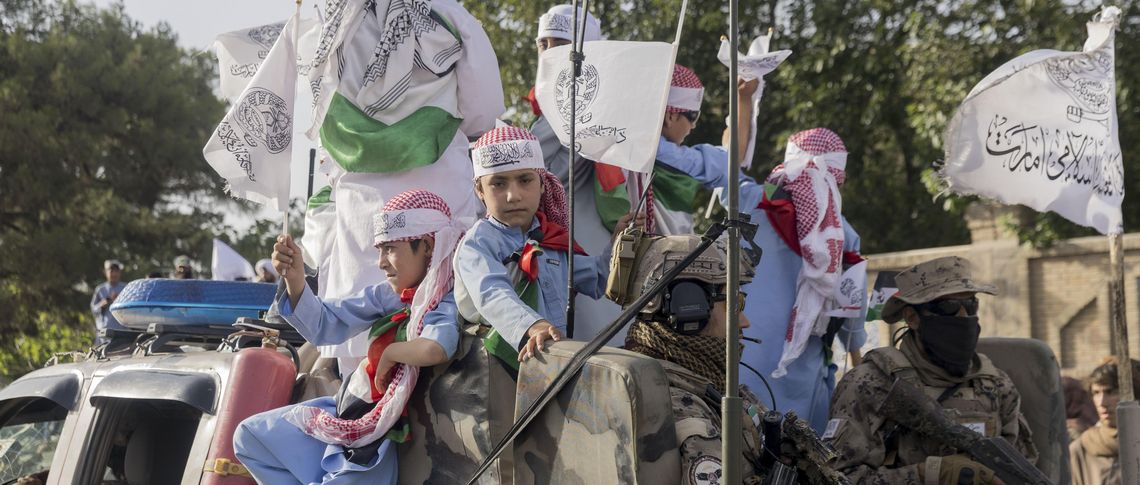
Last weekend, marked five years since the Taliban’s return to power in Afghanistan. For five years, much of the Western world has pursued a policy of non-engagement toward the Taliban, premised on the assumption that isolation would generate pressure for change on issues such as human rights particularly the rights and freedoms of women. Not only has this not materialized, but the approach has also imposed a severe cost on ordinary citizens. Humanitarian assistance aside, international development aid has dried up and with an unrecognised Taliban government, climate finance for one of the world’s most climate-vulnerable countries remains entirely inaccessible. Non-engagement is quietly evolving as recent behind-closed-doors migration negotiations between European governments and the Taliban signal a more selective approach. It is no longer about whether to engage the Taliban, but why the world has chosen to do so on deportations and not on climate, women’s rights, or governance. Five years later, it is time for a clear-eyed stocktake and an honest reckoning with what must change.
In the lead-up to the US-Taliban Doha agreement of 2020, some were hoping for and others convinced of a changed Taliban, a more moderate Taliban. However, five years of their one-gender one-ethnicity rule in a vastly diverse and multi-ethnic nation of 40 million have shown anything but. The group has issued more than 100 decrees to restrict the rights and freedoms of women, shutting school doors in the face of around 2.4 million girls for 1795 days and counting. The Taliban’s exclusion and discrimination do not stop at women; their one-gender one-ethnicity cabinet is made up of more than 90 per cent Pashtuns in a country where around 60 per cent of the population is non-Pashtun. In the distribution of aid and public services, or in land disputes, the Taliban are reported by UNHCR accounts to discriminate against ethnic Hazaras, Tajiks, Uzbeks and other minority and marginalized groups. Together, these confirm that the group governs today much as it did during its first and brutal reign in the mid-1990s.
Kabul, with over six million inhabitants, may become the first city to run out of water by 2030.
Afghanistan is unable, especially after the aid cuts and climate finance freeze, to cope with the mounting climate impacts and the forced return of six million migrants from Iran and Pakistan. Frequentfloods and consecutive years of severe drought continue to destroy agriculture-based rural livelihoods, resulting in extreme food insecurity with nearly 22 million people now in need of assistance. These and other disasters have displaced nearly 2 million between 2021 and 2025. Searching for water and food will remain a daily struggle for millions. Kabul, with over six million inhabitants, may become the first city to run out of water by 2030. Six million empty-handed returnees from Iran and Pakistan end up in cities and villages already facing acute water and food insecurity. The Taliban lack both the technical capacity and financial means to address the growing, large-scale, multi-dimensional crisis Afghanistan faces.
Means for engagement
Despite the official non-engagement policy, the West has started talks with the Taliban, but only on deportations.Following the Taliban’s return to power, humanitarian and development assistance dropped sharply with international organisations leaving the country and halting previously approved projects including 32 environmental protection projects worth more than $800 million. The US and its European allies also quickly froze $9.5 billion of Afghanistan’s Central Bank assets, later releasing $3.5 billion but also retaining $3.5 billion to pay compensation to victims of 9/11 attacks. In 2025, the International Criminal Court issued arrest warrants for the Taliban leaders over their persecution of women and girls. Yet, the group has not remained entirely isolated. Short of official recognition, regional powers including China, India, Pakistan, Iran, and Türkiye have built working relationships with it. So far, only Russia has formally recognised the Taliban government, but many others, including several European governments are keen to strike deals in exchange for their cooperation on deportations. Germany is one such case. It has accepted the Taliban diplomats and in return has deported more than 200 individuals back to Afghanistan.
Whether governments choose engagement or isolation, it is ordinary citizens who bear the consequences. A more effective approach should focus on three priorities over the next five years.
Any meaningful strategy for Afghanistan must begin with the everyday realities facing its people. With poverty, food insecurity and climate pressures deepening, addressing basic needs is both a humanitarian imperative and a prerequisite for long-term stability. The direction is clear and there are existing mechanisms which can be scaled up, such as further support for the agriculture sector, which is the backbone of the economy and on which around 90 per cent of the population relies for livelihood. Increasing investment in water-efficient irrigation and water management; and safeguarding the health system, where women still work. The UN’s new approach of providing basic human needs (BHN) assistance must be expanded and receive sustained multi-year funding. Humanitarian assistance alone is simply not enough. Neglecting immediate action may render large parts of the country uninhabitable and result in outmigration as Afghanistan Analysts Network’s research shows.
The Taliban remain the country’s de facto rulers, making some form of engagement unavoidable.
Support for Afghanistan does not have to flow through the Taliban. Local civil society groups and international organisations remain among the most effective actors for reaching communities and delivering assistance while preserving a degree of independence from the de facto authorities. Local civil society, partly built up under the previous government with international support, and the remaining international organisations, including the UN system, offer alternative channels to bypass the de facto Taliban authorities. Working closely with local NGOs and communities, the Food and Agriculture Organization (FAO) and the UN Development Programme (UNDP), for instance, should be supported to access more funds, including from the Green Climate Fund (GCF), the Global Environment Facility (GEF), and the Adaptation Fund. There is evidence showing off-budget projects outside the Taliban control between international funders and local accredited NGOs with the involvement of women do work.
The Taliban remain the country’s de facto rulers, making some form of engagement unavoidable. The challenge is to ensure that such engagement serves the interests of the people of Afghanistan, advances human rights and delivers tangible improvements in living conditions rather than conferring legitimacy for its own sake. Non-engagement with unrecognised regimes does not always bring about desired change and outcomes. Experience from Yemen and Myanmar confirms this. But any kind of engagement must first and foremost prioritize human rights and the needs of the people over the interests of the de facto Taliban authorities.
The June 2026 closed-door meeting between the European Commission, 15 member states and representatives of the Taliban on deportations is an example of narrow, interested-driven engagement that may, in the end, fail to serve even that single purpose. Engagement must target improving living conditions in Afghanistan; otherwise, starving people will seek a way out. Spaces for dialogue, to press for the rights of women and inclusive governance and to hold technical discussions on essential service delivery, must remain open. Some factions of the Taliban are more ‘pragmatic’ than others. Lastly, international presence in Afghanistan, with or without coming into dialogue with the Taliban, can serve as an eye to the outside world and an indirect check on the group inside the country. The cost of non-engagement and another five years of the same is simply too high for ordinary citizens.