200 people died when mass protests in Kazakhstan made headlines around the world at the beginning of 2022. Anger over rising energy and food prices escalated to a level never before seen in Central Asia’s largest and richest country. The war in Ukraine and the economic fallout could re-ignite conflicts in Kazakhstan, given Central Asia is one of the regions most affected by Russia’s invasion. The government in Nur-Sultan now finds itself in a difficult position.
In response to the riots and in an attempt to stabilise the country, President Kassym-Jomart Tokayev appealed to troops from the Collective Security Treaty Organisation (CSTO), a security organisation dominated by Russia. Around 2,500 CSTO soldiers, mostly from Russia, were deployed to secure critical infrastructure, leaving Kazakhstan two weeks later. But questions remain about the country’s relationship with its larger neighbour to the north. Will this increase Moscow’s influence in Kazakhstan? Will Nur-Sultan remain dependent on Russia in the future?
Calling on Moscow’s help was a double-edged sword for Kazakhstan. For a long time, the country avoided excessive dependence on Russia through its ‘multi-vector foreign policy’. Kazakhstan built good relations with China and the West, as well as with neighbouring countries. The aim was to strike a balance with major powers and create its own active foreign policy.
China and Kazakhstan have a significant economic partnership: the PRC imports about 20 per cent of its gas from or through Kazakhstan. In turn, the Central Asian country is a hub in China’s Belt and Road Initiative (BRI), which sees China investing heavily in infrastructure in strategically important countries.
Kazakhstan’s dependence on Russia
There are strong institutional interdependencies between Kazakhstan and Russia too. Both countries are members of various regional organisations, such as the Shanghai Cooperation Organisation, the CSTO, the Commonwealth of Independent States (CIS), and the Eurasian Economic Union (EAEU). And Russia is Kazakhstan’s largest import market, with more than 40 per cent of its total import volume coming from there. The Baikonur Cosmodrome also plays a major role, as well as the countries’ geographical and cultural proximity.
The Kazakh currency, the tenge (KZT), fell dramatically alongside the rouble.
Given their strong economic interdependence, sanctions against Russia could have serious consequences for Central Asian economies. Surrounded by countries sanctioned by the West – Afghanistan, Iran, China, and Russia – the region’s republics are struggling with the effects of the new unprecedented sanctions against Moscow. Kazakhstan in particular, as the biggest energy exporter in the region, relies on Russian ports and infrastructure to reach global markets.
The latest developments threaten to exacerbate an already difficult economic situation. The Kazakh currency, the tenge (KZT), fell dramatically alongside the rouble. Since Kazakhstan relies on importing many day-to-day goods, the decline in its currency values means a sharp rise in prices. Standard stocks in the country are also already feeling the consequences: Bank Halyk, Kazakhstan’s largest financial institution, lost about 40 per cent of its value on the London Stock Exchange. Kaspi Bank lost 45 per cent. The national uranium company Kazatompom also recorded a decline of almost a quarter of its value.
After CSTO troops were deployed in January, we could be forgiven for assuming that Moscow’s influence in Kazakhstan and the region would grow. But this does not seem to be the case at first sight. Quite the opposite: Kazakhstan appears to still be pursuing a balance in its partners and its foreign policy. It is even starting to distance itself from Russia.
Tokayev is walking a tight geopolitical rope
After Russia’s attack on Ukraine, President Tokayev was demonstratively seeking talks with several foreign politicians in addition to Vladimir Putin, including Emmanuel Macron, Charles Michel, Volodymyr Zelenskyy, and Frank-Walter Steinmeier. Kazakhstan will not take sides, was the message.
In his first statement on the situation in Ukraine, Tokayev stressed that ‘the geopolitical situation has escalated’ and that ‘both parties must seek a common solution at the negotiating table’. Since then, it has been trying to position itself as a mediator, openly advocating an early diplomatic solution. ‘A bad peace is better than a good war’ read a statement from the Akorda, the presidential palace in Nur-Sultan.
From a security point of view, the CSTO binds Kazakhstan to Russia – but the two countries don’t share the same interests when it comes to Ukraine.
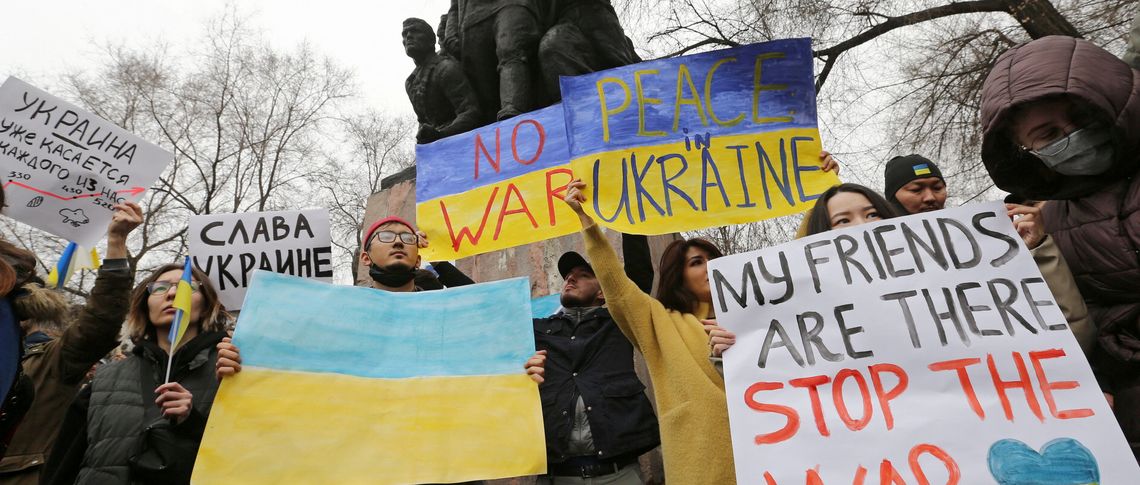
Kazakhstan’s role goes beyond words alone. The country has supplied aid to Ukraine, both publicly and privately. Massive anti-war demonstrations and expressions of solidarity with Ukraine took place in Almaty, whose streets saw riots and violence just a few weeks earlier. And yet, Kazakhstan abstained in the vote at the UN General Assembly – just as it did in 2014 when Crimea was annexed. This is hardly surprising given the country’s strong ties with Russia. It is rather indicative of the diplomatic balancing act that President Tokayev has been trying to strike.
Central Asia’s new order
The ongoing conflict in the Eurasian region has led to the security and economic architecture being challenged and restructured. The Eurasian Economic Union has been severely damaged by the sanctions, and its purpose is again being called into question in Kazakhstan. It no longer serves as an institution that can help the country generate medium and long-term growth. From a security point of view, the CSTO binds Kazakhstan to Russia – but the two countries don’t share the same interests when it comes to Ukraine. Kazakhstan must now reassess its institutional ties in security and the economy.
What the new order will look like exactly is difficult to predict. Kazakhstan’s options for more strategic independence are on the table. It will be hugely important for the country to rethink its institutional links – especially those with Russia – and to clearly define its own interests as it continues to pursue a balanced foreign policy that tilts between the great powers. Deepening regional integration and cooperation with neighbouring countries in Central Asia even further is also a key building block.
But at the same time, it is important to look inward: trust between the government and the people must be rebuilt. In view of its current challenges, that is the only way to prevent Kazakhstan from plunging into a deep crisis.