


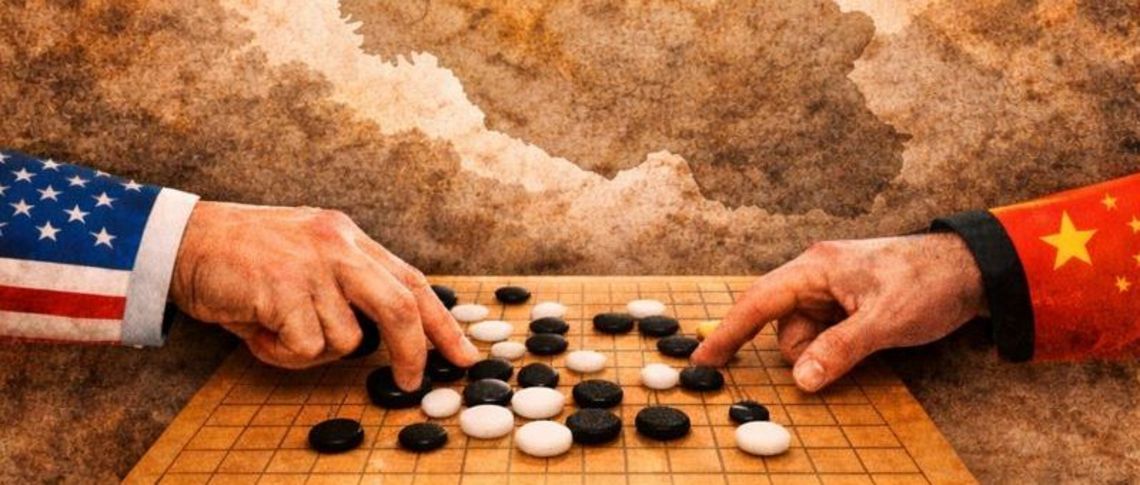
The drums of war in the Middle East have rarely sounded as rhythmic or as deliberate as they do today. To the casual observer, the escalating pressure on Tehran, involving biting sanctions and heavy military posturing, appears to be a predictable rerun of a decades-old script: nuclear non-proliferation or the pursuit of regime change. But look closer at the board, and it becomes clear that Washington is no longer playing traditional Western geopolitical chess, where the goal is to topple the King. Instead, it has adopted the logic of the Chinese game of Go (weiqi).
In Go, the objective is not to destroy the opponent’s pieces, but to surround territory and control key nodes. On the modern Eurasian map, Iran is arguably one of the most vital of these nodes. Washington’s ultimate goal is not the collapse of the Islamic Republic, but its strategic disciplining. The objective is a ‘cooperative Iran’, a state that is forced to decouple from Beijing and transition into a manageable, predictable partner of the West. By tightening the noose around Tehran, the United States is effectively sealing the landward cage around China’s global ambitions.
Beijing’s landward fortress
For decades, Beijing’s strategic nightmare has been the Malacca Dilemma, the reality that the US Navy could, in a crisis, choke off China’s energy supply at the narrowest point of the maritime Silk Road. To survive, China has spent hundreds of billions on a landward escape, building a secure Eurasian interior. In 2025, this strategy seemed to bear fruit: China became Central Asia’s top trading partner for the first time, with volumes exceeding $100 billion.
Iran is the cornerstone of this landward fortress. It is the logistical heart of the Belt and Road Initiative (BRI). However, a significant move recently occurred on the diplomatic flank: the US and Armenia signed a framework agreement to create the TRIPP Development Company, granting the US a 74 per cent controlling stake for 49 years. This project, aimed at building infrastructure connecting Azerbaijan to Nakhchivan, just 100 meters from the Iranian border, is a masterstroke. By controlling this narrow strip, Washington can effectively oversee China’s attempt to bypass the Malacca Dilemma through the Caucasus.
While public rhetoric often defaults to regime change, Washington’s 2020s realism is far more pragmatic.
In response, China doubled down on Iran. In July 2025, Beijing signed a contract to electrify the 1 000-km Sarakhs-Razi railway line, connecting the Turkmen border to Turkey via Iran. This route is touted by Tehran as the safest and most economical link between China and Europe. By targeting Iran now, Washington is striking at the very jugular of this logistical alternative. If the US can coerce Tehran into cooperation, China’s landward strategy becomes unviable without American consent.
While public rhetoric often defaults to regime change, Washington’s 2020s realism is far more pragmatic. The US has learned the bitter lessons of Iraq and Libya: the collapse of central authority leads to chaos and uncontrollable proxies, a nightmare shared by regional allies like Saudi Arabia and the UAE.
A total Iranian collapse would be a geopolitical black hole in the heart of Eurasia, destroying the very transit routes, like TRIPP, that Washington may wish to utilise to import critical minerals from Central Asia. This explains why Donald Trump has voiced scepticism regarding Prince Reza Pahlavi’s ability to consolidate power. Washington does not seek a new, unproven government; it seeks the current regime’s capitulation on favourable terms. A ‘cooperative Iran’ is a regime that stays in power but is stripped of its regional teeth and its strategic dependence on Beijing.
The pressure on Iran is high
The disciplining is already yielding results. Unlike previous rounds, the nuclear negotiations that resumed in April 2025 are not defined by Iranian strategic patience. Tehran, its economy on the brink, has no room left to manoeuvre.
Foreign Minister Araghchi’s recent interview was a watershed moment. His readiness to negotiate, hinting at the possibility of nuclear transparency in exchange for sanctions relief, was a signal of desperation. The US has surrounded the Iranian stone, and Tehran is now looking for a way to stay on the board.
This calibrated escalation is visible in the arrival of the USS Abraham Lincoln (CVN-72) carrier group, expected in the Arabian Sea around 25 January. This move, combined with the informal non-aggression pact between Iran and Israel mediated by Russia in late 2025, keeps the Iranian leadership in a state of permanent vulnerability. The goal is clear: keep the pressure high until Tehran trades its alliance with Beijing for economic survival. Otherwise, the US reserves the right to strike.
By encircling Iran, the US is not trying to eliminate the Iranian state; it is removing Iran as a functional piece for China.
For Europe, this strategic recalibration carries direct consequences. A coerced or partially reintegrated Iran would reshape energy markets, transit routes, and Europe’s long-term dependence on both Russian and Middle Eastern supply chains. At the same time, it would further underline Europe’s limited agency in a confrontation increasingly defined by Washington and Beijing, leaving the EU to adapt to outcomes rather than shape them.
A ‘cooperative Iran’ would represent a serious dynamic. It means a Tehran that no longer sells pistachios for Yuan to buy Chinese car parts, but one integrated into a Western-influenced energy and transit framework.
By encircling Iran, the US is not trying to eliminate the Iranian state; it is removing Iran as a functional piece for China. The Middle East has ceased to be a separate theatre; it is now the western flank of the Indo-Pacific struggle. Washington is playing the long game to ensure China remains unable to secure the resources needed to challenge American hegemony. The ‘cooperative Iran’ strategy is a warning to every state China depends on.
As the US places its final stones around Tehran, the message to Beijing is clear: your landward escape has been cut off. Whether this scenario succeeds depends on one final question: can Washington and Tehran reach a real deal, or will Russia and China find a way to break the encirclement? The answer will dictate the terms of the 21st century in Eurasia.


