


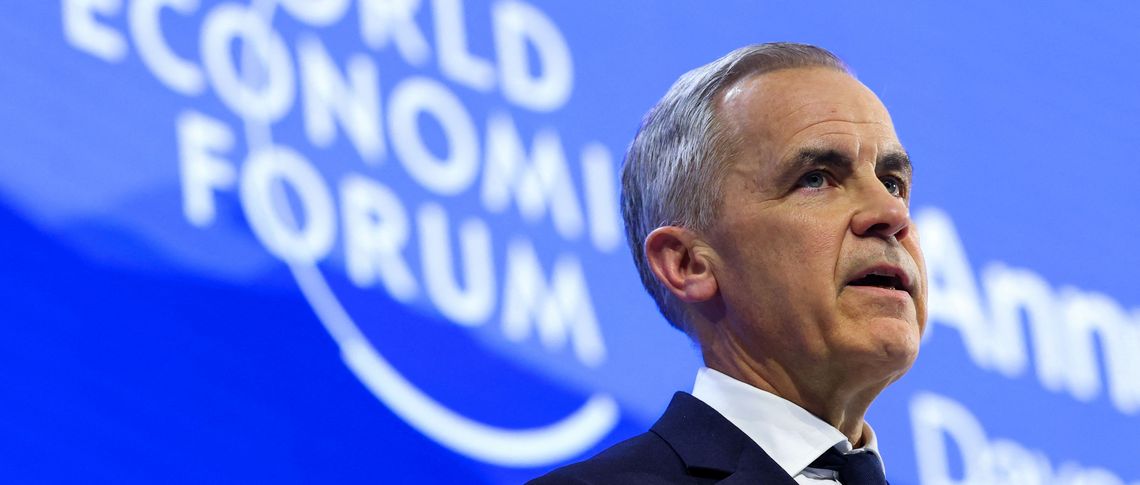
‘We know the old order is not coming back. We shouldn’t mourn it. Nostalgia is not a strategy, but we believe that from the fracture we can build something bigger, better, stronger, more just. This is the task of the middle powers, the countries that have the most to lose from a world of fortresses and the most to gain from genuine co-operation.’ — Canadian Prime Minister Mark Carney, Davos, 20 January 2026
A year ago, few in Canada would have predicted that former central banker – now Prime Minister – Mark Carney would deliver what may be the most consequential Canadian foreign policy speech in a generation. Yet that is precisely what he did before world leaders on a brisk day in Davos, forcefully outlining the new reality facing middle powers amid the geopolitical instability caused by President Trump’s threats to NATO allies, Russian aggression and the rise of China.
Over the last year, Canada has experienced the brunt of Trump’s aggression. Despite a long history as America’s closest ally and second-largest trading partner, Canada was among the first countries targeted by US tariffs, and the first to star in the President’s recurring fantasies of territorial expansion. Linked by an 8 800-kilometre undefended border and profound economic dependence on the US market – over three-quarters of Canadian exports go to America – every twitch of the Trump presidency has landed like an earthquake in Canada.
In recent months, Prime Minister Carney has largely sought to keep Canada out of President Trump’s sights — and off his hit list.
Prime Minister Carney has not always responded sharply to Trump’s threats. Despite campaigning last spring on an elbows up’ response (an appropriately Canadian hockey metaphor), once he did become prime minister, Carney focused on dialling down tensions with the US.
Making early moves to proactively scrap proposed taxes on tech giants opposed by Trump, quietly dropping Canada’s retaliatory tariffs, and recently pointedly avoided critiquing Trump’s Venezuela raid while politely considering his offer to join the so-called Board of Peace. In recent months, Carney has largely sought to keep Canada out of Trump’s sights — and off his hit list.
But this approach has not worked. President Trump continued to arbitrarily hike tariffs as a reaction to other issues — from Canada’s recognition of a Palestinian state to a pointed anti-tariff ad run in the US by Canada’s largest province.
Nearly a year into the trade war, Canada appears further from a deal than ever, and on the horizon is the review of the existing Canada-United States-Mexico Agreement. This trade agreement, inked by Trump in his first term, currently shields 85 per cent of Canadian exports from tariffs. It faces an uncertain fate this year as Trump has made clear that he sees little strategic value in it for the US.
Appeasement has failed
What ultimately appears to have driven Carney’s Davos intervention, however, was not tariffs alone. It was Trump’s explicit interest in seizing territory from a fellow NATO ally and his, now-paused, threat of additional punitive tariffs against any country that opposed him. These actions laid bare a more fundamental truth: appeasement cannot constrain a leader who views coercion as a right. Only collective action has any realistic chance of doing so.
In Davos, Prime Minister Carney crystallised the choice that lies before Canada, the EU and other middle powers. They can continue, as he put it, ‘the performance of sovereignty while accepting subordination’ or they can pursue new alignments where ‘the power of legitimacy, integrity and rules will remain strong, if we choose to wield them together’. He warned against reliance on old institutions and alliances to protect from new great power threats, and called for a new ‘values-based realism’.
The speech resonated widely around the world because it articulated, out loud, what many Western leaders have privately acknowledged for months: the old order has left the building, permanently.
Yet there remains a wide gap between Carney’s vision and the fragmented, often hesitant responses to American aggression that have characterised Western policy over the past year. Europe, in particular, faces difficult questions about the failure of appeasement to deter President Trump. Despite accepting a widely-panned trade deal with the US, Trump’s tariff threats toward European allies have not abated, and to top it off, he continues to undermine Ukraine’s stand against Russia’s war.
Working people on both sides of the Atlantic have shouldered much of the risk in the tariff war, weathering layoffs and plant closures, with little prospect of benefiting from promised economic realignments.
It remains to be seen if Carney’s Davos moment will mark a shift in Canada’s approach to Trump’s threats. Canada will shortly make a decision about participation in NATO sovereignty exercises in Greenland that will offer clues about whether this is, in fact, a pivot in the Canadian strategy.
What Carney did not address directly – and what may ultimately determine whether his doctrine is sustainable – is the question of democratic buy-in. In Canada, as across Europe, the cost of living remains stubbornly high, unemployment is rising, public services are under strain, and voters are increasingly sceptical of international commitments that appear abstract or elite-driven.
A strategy built on new trade deals that entail real trade-offs for local economies, alongside costly defence co-operation, needs sustained public support at a time when many citizens are more concerned about grocery bills than geopolitics. Working people on both sides of the Atlantic have shouldered much of the risk in the tariff war, weathering layoffs and plant closures, with little prospect of benefiting from promised economic realignments. Without a clear link between actions abroad and economic security at home, Carney’s middle-power strategy risks running aground on domestic discontent.
It is too early to say whether Carney’s Davos moment will translate into a sustained shift in Canadian policy. What is clear, however, is that he named the reality that the costs of inaction in the face of Trump’s threats are now greater than the costs of collective action. Such is the strangeness of this moment that his candour itself is a political act.
Whether Canada and Europe are prepared to do what it takes to meet that challenge together will determine whether Prime Minister Carney’s striking speech is remembered as a turning point — or a warning that goes unheard.


