The most unsettling image for a liberal observer is not a tank rolling into a presidential palace; it is the crowd of cheering citizens running alongside it. We create comfortable narratives to explain this away: disinformation, lack of education, or the ‘strongman’ allure. But these narratives are intellectual laziness masquerading as analysis. The uncomfortable truth is that for millions of African people, the ‘democratic’ era has been synonymous not with liberation, but with the precipice of survival.
For the average citizen in central Mali or northern Burkina Faso, the democratic state was an entity that extracted taxes but provided no security. It was a system where the political class debated in air-conditioned capitals while the hinterlands burnt. Citizens watched democratic governments preside over escalating jihadist violence, collapsing state authority, and brazen corruption while foreign military bases operated with more autonomy than their own elected parliaments. When the democratic form hollows out the democratic function, protection and service delivery, citizens will inevitably choose the order promised by a soldier over the chaos presided over by a politician.
When democratic forms produce only the appearance of accountability while delivering none of its substance, citizens stop defending them.
Tanzania’s and Mozambique’s trajectories are equally instructive. The country’s democratic opening delivered competitive elections, then watched as those systems calcified into vehicles for elite capture and performative opposition that changed nothing. When democratic forms produce only the appearance of accountability while delivering none of its substance, citizens stop defending them.
Sudan’s catastrophe completes the indictment. A popular uprising toppled a dictator, and transition frameworks were being negotiated. Yet, the collapse of the state was preceded by a process obsessed with the mechanics of power-sharing while ignoring the underlying political economy of violence. The international community’s obsession with a specific procedural path ignored the rotting foundations of the state, leading to a civil war that has shattered the country.
This path was an aggregative/representative one: demanding rapid, often ‘winner takes all,’ elections without addressing the underlying deliberative and institutional failures. This path, focused solely on the mechanics of voting and the transfer of power, neglected the deeper issues of rational ignorance among the Sudanese voters, systemic corruption within the emerging bureaucracy, and the ingrained lack of trust required for genuine political compromise. By prioritising the immediate, short-term goal of holding a scheduled vote, the international community often ignored the biggest elephant in the room, which was that short electoral cycles could not resolve years of deep-seated conflicts over wealth, ethnicity, or power-sharing, and instead merely provided a new platform for conflicts to erupt.
Design failure and how to fix it
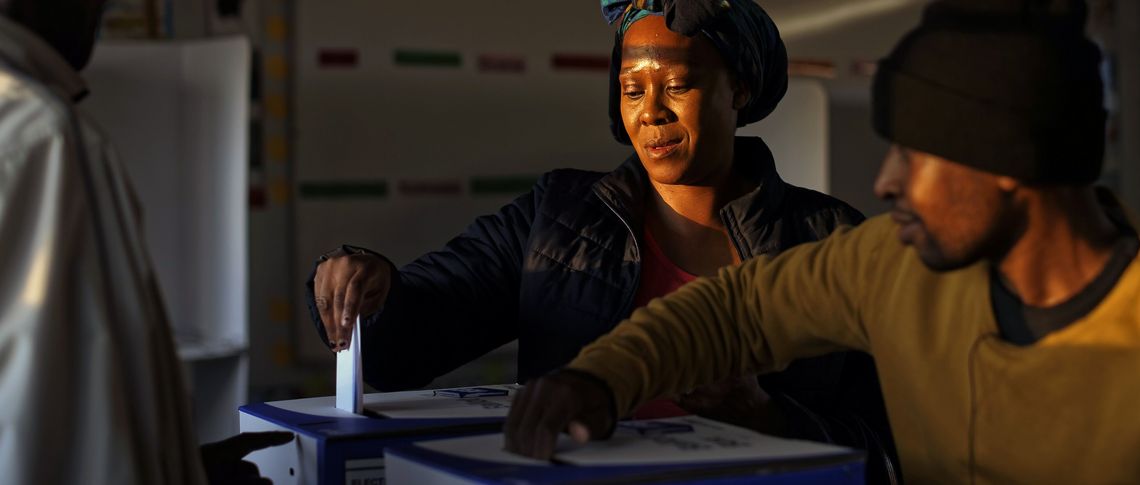
Electoral dysfunction across the continent tells the same story: citizens are convinced that democratic procedures serve elite interests rather than public good, so they refuse to participate. Low turnout is not apathy; it is a rational assessment that the democratic architecture does not represent them. For too long, the international community has measured African democracy by procedural orthodoxy, counting ballots and ticking governance checklists, rather than functional legitimacy.
The common thread is not cultural incompatibility; it is a design failure. We have installed adversarial, winner-take-all parliamentary systems in fragile, diverse societies where consensus is the only safeguard against fragmentation. We have prioritised the theatre of elections over the hard wiring of local accountability. Consequently, democracy is viewed not as a mechanism for solving problems but as a violently competitive game for resource extraction.
A reimagined democratic architecture must begin with this insight: legitimacy flows from delivering what citizens need to survive, not from importing procedures.
The narrative that human rights concerns prevent effective security operations is false; it is the lack of legitimate, accountable institutions that makes security forces predatory.
First, we must question the utility of the winner-take-all model in highly pluralistic societies. If an election result is an existential threat to the losing side, the system is flawed. We must explore formalised models of direct democracy, consociationalism and power-sharing, not just as emergency peace deals but as standard practice.
Second, the locus of power must shift. The hyper-centralised post-colonial state is too distant to be responsive. Reimagined democracy might look like radical decentralisation, where local councils, often retaining high levels of trust, are integrated into the formal state architecture rather than treated as parallel structures. Here, an unwavering and sincere inclusion of the ever more present and protesting youth has a high chance of success.
Third, we must decouple ‘democracy’ from ‘weakness.’ A democratic state must be capable of projecting force and enforcing the law but based on the African philosophy of human rights called ‘Ubuntu,’ I see and respect you. The narrative that human rights concerns prevent effective security operations is false; it is the lack of legitimate, accountable institutions that makes security forces predatory.
This means constitutional designs with accountability mechanisms beyond elections and economic models that do not force citizens to choose between democracy and eating. It is not about abandoning universal principles but accepting that the Westminster or American presidential models are not the only ways to achieve them. Democracy must ‘deliver again.’
Not just an African problem
Inherited democratic architectures are struggling to deliver accountability and responsive governance globally. Africa is simply the bleeding edge, where the economic buffer is too thin to absorb institutional failure. European observers should not view this as an exotic ‘African’ problem. The crisis of representation is global.
In both continents, 20th-century architectures struggle with 21st-century volatilities. In established democracies, institutions bend; in fragile ones, they break. But the root cause, alienation of the citizen from power, is shared. Europe has as much to learn from Africa’s crisis as it has to teach. Across European democracies, citizens increasingly report that elections change nothing and that institutions cannot address crises from migration to climate change.
This is not an argument for equivalence but against exceptionalism. If we frame African failures as unique, we miss what they reveal about democratic architecture itself. The stress tests are more severe, and failures more catastrophic, but the underlying problems — representation without responsiveness, accountability without power — plague systems globally.
The progressive alternative is necessary: separate the principle of democracy from the practice of its current institutions.
We can continue defending failing systems by invoking procedural orthodoxy and blaming ‘weak institutions,’ or we can treat these failures as evidence that our inherited architectures require reimagination.
The regressive response is clear: abandon democracy, either through authoritarian nostalgia or by accepting dysfunction as ‘good enough’ for Africa. The progressive alternative is necessary: separate the principle of democracy from the practice of its current institutions. The coups and crises are the breaking point of a flawed model, not the end of the democratic project.
Drawing on insights from the Gaborone Democracy Lab organised by the Friedrich-Ebert-Stiftung and Afrobarometer, we must recognise that democratic institutions can deliver again, but only if allowed to evolve. The solution is not to preach incremental reform but creative, risky institutional reimagination that prioritises what citizens need over what international indices measure.