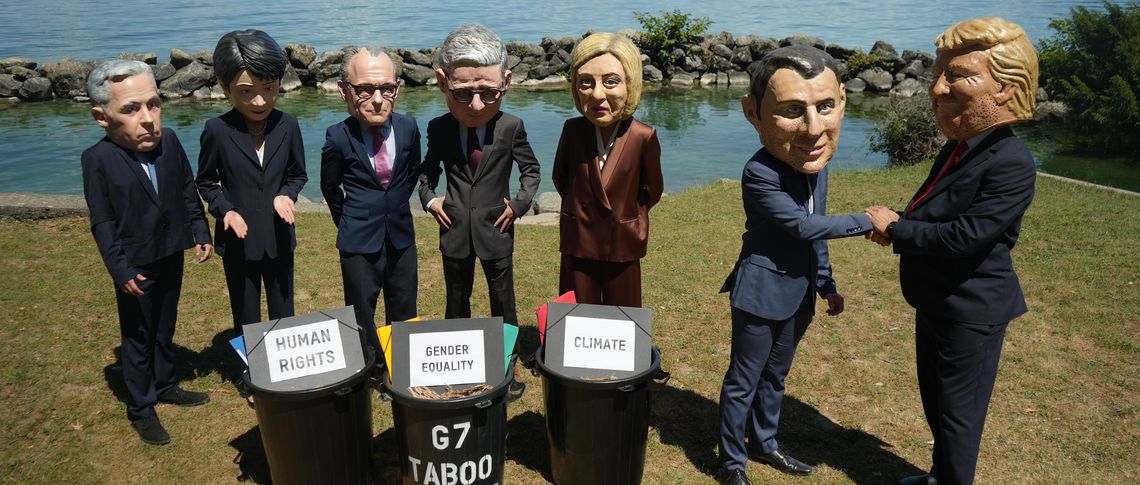
Nestled between mountains and a pristine lake, Évian-les-Bains, the French town where G7 leaders are gathering today, evokes an image of stability and prosperity. Yet beyond the summit venue lies a world marked by deepening economic insecurity, political fragmentation, climate change and distrust in institutions. And at the centre of these interconnected crises is a challenge that governments continue to treat as an afterthought: rising inequality.
This G7 summit puts ‘global imbalances’ at the top of its agenda, with French President Emmanuel Macron warning that the international economy is becoming a theatre of confrontation rather than cooperation. But if G7 leaders are serious about addressing that problem, they must tackle inequality head-on.
That means abandoning the mistaken view that inequality is primarily a problem for developing countries. Extreme disparities in income, wealth, opportunity and political influence have become a defining feature of the global economy, affecting rich and poor countries alike. In OECD countries, the wealthiest 10 per cent of households hold roughly half of all household wealth, while the bottom 40 per cent hold around four per cent. From stagnant living standards, declining social mobility and political polarisation to growing scepticism toward democratic institutions, the consequences are increasingly visible across the G7 itself.
Adjusting priorities
The question facing G7 leaders, then, is not whether inequality matters, but whether they are willing to recognise it as the systemic problem it has become. Last year, the Extraordinary Committee on Inequality, established under South Africa’s G20 presidency and chaired by Joseph E. Stiglitz and Jayati Ghosh, concluded that the world faces an ‘inequality emergency’. Among its findings were that one-quarter of people worldwide experience moderate or severe food insecurity; and that the richest one per cent of humanity captured 41 per cent of all new wealth created globally since 2000, while the bottom half captured just one per cent.
These figures show that inequality is increasingly shaping the rules of the entire economy. For G7 governments, this should raise serious concerns about the priorities they claim to champion.
Consider economic growth. For decades, policymakers assumed that even concentrated wealth would drive investment and innovation. Yet growing evidence suggests that when large shares of national income flow to those already at the top, consumption slows, and business dynamism suffers.
Democracy becomes harder to sustain when citizens believe that political influence can be bought and economic outcomes are predetermined.
Rising inequality also has become a powerful source of political instability in advanced economies, as frustration with stagnant wages, food prices, housing insecurity and declining public services fuels anti-establishment sentiment. When a small number of corporations and billionaires control an outsize share of economic resources, they gain disproportionate political influence through lobbying, campaign financing, media ownership, algorithmic manipulation and privileged access to decision-makers. Public policy then becomes more skewed toward serving moneyed interests, reinforcing the perception that the political system is rigged.
For the G7, which portrays itself as a defender of democratic values, this trend should be alarming. Democracy becomes harder to sustain when citizens believe that political influence can be bought and economic outcomes are predetermined.
The rapid development of AI has added a new dimension to this challenge. AI has enormous potential to drive innovation, productivity and scientific progress. But without deliberate policy choices, its economic benefits may become concentrated among a small number of firms and countries, potentially at the expense of many workers and communities. Ensuring that AI contributes to broad-based prosperity, rather than reinforcing existing inequalities, should be a top priority.
Inequality also complicates another G7 priority: managing geopolitical competition. The French presidency has correctly identified the erosion of international cooperation as a major challenge. But geopolitical tensions cannot be separated from global disparities. Developing countries are expected to invest in climate-change mitigation and adaptation while carrying unsustainable debt burdens and enduring rising borrowing costs. Yet because the benefits of globalisation remain so unevenly distributed, resentment toward existing international institutions is growing, and geopolitical fragmentation is accelerating.
The green transition will succeed only if it is perceived as fair. Citizens will not support ambitious climate policies for which they must bear the costs while wealth and profits remain concentrated elsewhere. Likewise, developing countries will be reluctant to accept stronger climate commitments if financing remains inadequate and debt burdens continue to constrain public investment.
It's time for the International Panel on Inequality
Despite a growing recognition of these challenges, governments still lack a common framework for understanding and responding to rising inequality. The world has developed sophisticated mechanisms for monitoring climate change, financial stability and public health, but not for tracking inequality. That is why inequality is often treated as a symptom, rather than as a systemic force shaping economic, political and environmental outcomes. It is also why one of the most important recommendations to emerge from the G20 process deserves serious consideration in Évian: the creation of an International Panel on Inequality.
Modelled on the Intergovernmental Panel on Climate Change, such a body would bring together leading experts from around the world to provide regular, independent assessments of global inequality trends and policy options. It would help establish common metrics, identify successful interventions, strengthen evidence-based policymaking, and elevate inequality to the level of urgency that governments have accorded to other global issues.
An International Panel on Inequality would not dictate policy choices, but it would provide governments with the knowledge to make decisions in a rapidly changing world. Just as climate science has helped shape international action, a shared evidence base for understanding inequality could improve policy coordination and cooperation.
The G7 is uniquely positioned to advance this initiative. Its members continue to wield enormous influence over international financial institutions, development finance and global economic governance. They can help move inequality from the margins of international discussions to the centre of economic policymaking, not as an act of charity, but as an investment in their own future.
If the Évian summit is to be remembered for more than managing immediate crises, G7 leaders should begin by acknowledging that there can be no lasting economic stability, democratic resilience, green transition or sustainable prosperity without confronting the inequality emergency.