A popular cheer in Spanish football stadiums is: ‘A por ellos!’ It can be translated neutrally as ‘Let’s go!’, but the chant is also an aggressive and self-assured declaration to the opposition, along the lines of: ‘Let’s show them!’
‘A por ellos’ is also the signal being sent out by Spanish Prime Minister Pedro Sánchez, together with numerous leading progressive politicians, trade unionists and members of civil society from over 40 countries, through the Global Progressive Mobilisation (GPM) — a long-overdue alternative to the internationally networked right.
The Progressive Congress is the response to a time of fundamental challenges worldwide: right-wing populist and right-wing authoritarian movements threaten democracy; inequality is growing at the same rate as the wealth and political influence of the super-rich; climate change, digitalisation and artificial intelligence are fundamentally transforming the world as we know it; and the law of the jungle is regaining influence in international politics.
In Barcelona, it became clear that the progressive camp is not resigned to this, but is ready to take up the fight against it: with courage, unity and good ideas for responsible government policy. The greatest source of encouragement was the host, Spain’s Prime Minister Pedro Sánchez. Hardly any social democrat is currently better placed than he is to set in motion a movement such as the one in Barcelona. If it is true that progressive actors have a tendency to focus too much on policy solutions and thus often lose out to the radical right, which thrives on symbolic politics, Sánchez seems to be succeeding in combining both: making good policy whilst also painting a broader vision of the kind of world we want to live in.
A successful track record
Sánchez has a highly successful track record as prime minister, particularly in terms of economic policy. For several years now, Spain has been among the countries with the highest economic growth in the EU, and no other country created anywhere near as many jobs last year. Key reasons for this include, on the one hand, the early and consistent expansion of renewable energy, which now provides Spain with comparatively cheap electricity and makes the country attractive for new industrial investments. This policy is also paying dividends in geopolitical crises, as, given the current blockade of the Strait of Hormuz, Spain has so far been less vulnerable to price rises than other EU states.
Following Russia’s war of aggression against Ukraine, Sánchez and his Socialist Party have also demonstrated that they are not afraid of political intervention in the market. Together with Portugal, he secured the so-called ‘Iberian exception’ from the European Commission between 2022 and 2024, which allowed both countries to cap gas prices for electricity generation and, as a result, keep inflation lower than elsewhere. Furthermore, between 2023 and 2024, he introduced a temporary windfall tax on energy companies and banks to use the additional revenue to fund relief measures for the population.
The gender pay gap in Spain has been significantly reduced over the last ten years and is below the European average, even though structural disadvantages for women in the labour market persist. It is no wonder that women constitute a strong voter base for the PSOE.
However, Spain’s economic growth is driven above all by its open migration policy, which has brought the country population growth despite low birth rates and ensures that Spain faces far fewer difficulties with skills shortages or paid care work than other countries. The Sánchez government’s recent decision to legalise around 500 000 undocumented migrants living in Spain, contrary to the current global trend, has consequently attracted worldwide attention.
Ever since the passing of a comprehensive law in 2004, Spain has been regarded as a pioneer and role model in the fight against gender-based violence, with electronic tagging being just one of many successful measures. Under Sánchez, there has been further significant progress on gender equality since 2018: the equalisation of the duration of paternity and maternity leave, the solo sí es sí law on sexual self-determination, which requires explicit consent for sexual acts, and the introduction of paid sick leave for period pain – making Spain the first country in the EU to do so. The gender pay gap has been significantly reduced over the last ten years and is below the European average, even though structural disadvantages for women in the labour market persist. It is no wonder that women constitute a strong voter base for the PSOE.
Sánchez’s initiative to regulate social media and online platforms also caused a stir at the start of the year. Whilst this initiative does focus on the protection of children under the age of 16, it is not limited to this; rather, its primary concern is the threat to democracy posed by hate speech, incitement and disinformation campaigns on social media. Sánchez wants to oblige operators to disclose their algorithms and also to establish a European AI infrastructure to reduce dependencies. The vicious attacks that Elon Musk and Telegram founder Pavel Durov immediately launched against Sánchez on X and Telegram respectively – labelling him a ‘tyrant’, ‘fascist’ and ‘traitor’ – show that the Spanish Prime Minister has struck a nerve here too.
Divided and still united
That said, the domestic political landscape for Sánchez and his PSOE party is anything but straightforward. In 2023, following a defeat in the local elections, they were practically with their backs against the wall, whereupon Sánchez – to the surprise of many – called a snap general election. Contrary to all expectations, he and the PSOE managed, after a furious comeback, to finish just behind the conservative opposition party Partido Popular (PP). Unlike PP leader Alberto Feijoo, however, Sánchez was able to secure a parliamentary majority for his election as head of government.
Since then, Sánchez has been governing in a coalition with the left-wing electoral alliance SUMAR, but relies on the support of a very diverse group of parties for a parliamentary majority. Under these circumstances, governing is extremely complicated and also requires concessions of a largely symbolic nature, such as in the case of the desired recognition of Catalan as an official language of the EU. Sánchez is also facing massive personal attacks from the opposition. A corruption scandal involving two of his closest confidants last year is being consistently exploited for this purpose, even though both were forced to resign immediately after the allegations against them came to light.
Whilst Spain is deeply polarised on domestic issues, Sánchez’s foreign policy is supported by a large majority of Spaniards. Here, too, he has shown courage, first by speaking out clearly in support of the people of Gaza and, most recently, by issuing an equally clear ‘no’ to a US attack on Iran. In this context, he also refused to allow Donald Trump to use the US military bases in Rota and Morón, Spain.
According to Sánchez, the task now is also to regain dignity and pride and not to be intimidated by right-wing denigration.
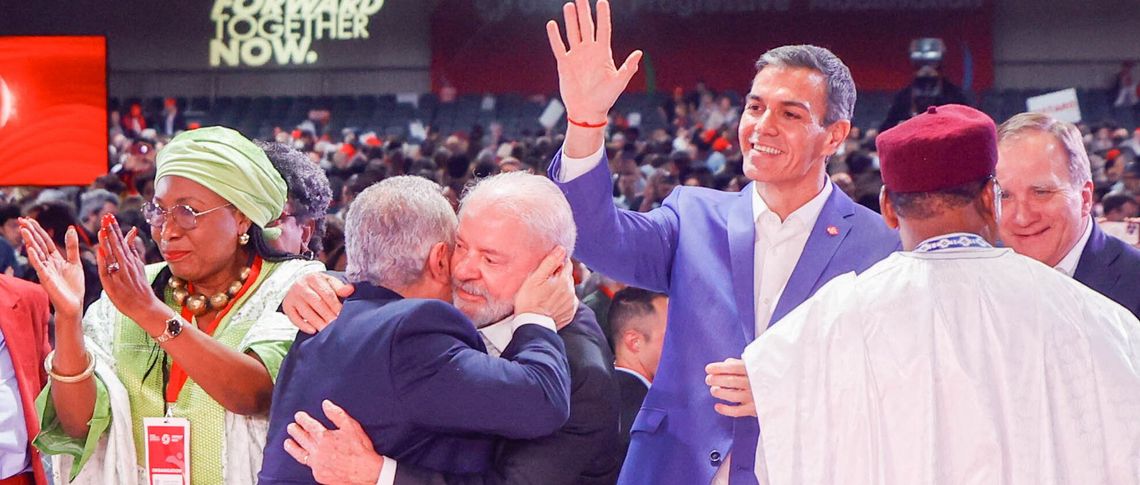
This courageous domestic and foreign policy action, his clear course guided by social democratic values, and his steadfastness explain why it was Sánchez in particular who succeeded in bringing together such a broad progressive movement in Barcelona. Numerous leading social democrats from around the world accepted his invitation: including Lula da Silva from Brazil, Lars Klingbeil from Germany, Cyril Ramaphosa from South Africa, Elly Schlein from Italy, Claudia Sheinbaum from Mexico and Tim Waltz from the US.
In Barcelona, Sánchez encouraged them – and above all the more than 5000 enthusiastic participants – by expressing his conviction that progressive forces have the better solutions for shaping the future. He argued that the more united we are and the more progressive movements come together to tackle the major challenges collectively, the easier it will be to achieve this.
According to Sánchez, the task now is also to regain dignity and pride and not to be intimidated by right-wing denigration. Social Democrats and Socialists should stop allowing right-wing populists to make them feel politically ashamed. Instead, he turned this shame on its head in his speech: it is not the progressives who should be ashamed, but those who exploit workers, collude with the right and condone war and violence.
He countered this with a confident commitment to pacifism, environmental protection, trade unions, feminism and progressive politics. Right now, he said, it is more important than ever to be proud of these values. Only with this pride can we fight for a just system, for prosperity for all, for the protection of the environment and for a policy of peace. This spirit of Barcelona must now be carried forward by international social democracy.