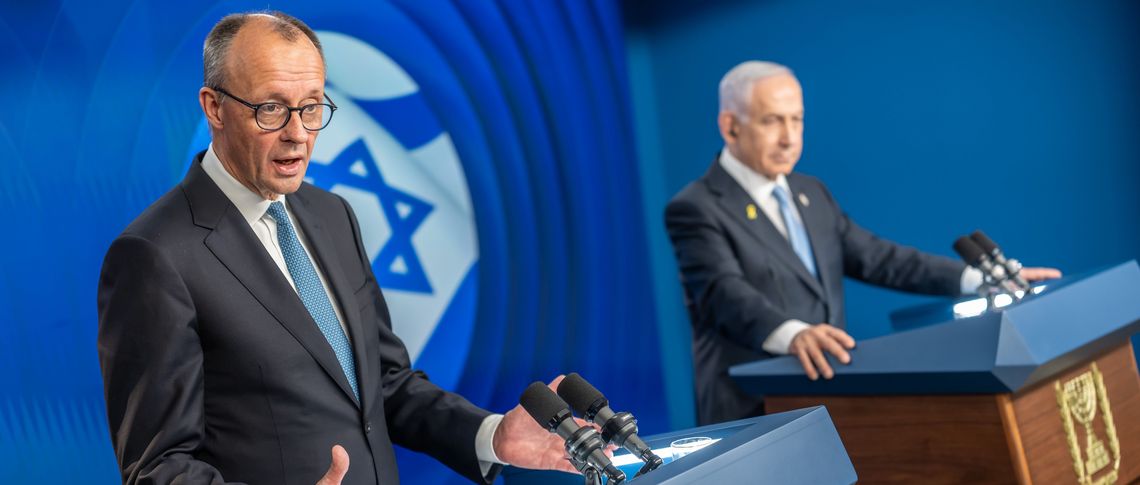
Chancellor Friedrich Merz’s first official visit to Israel should have offered a clear demonstration of Germany’s principled leadership at a moment when international norms are under severe strain. Instead, the visit exposed a troubling gap between Germany’s stated commitments to human rights and international law and its policies vis-à-vis the Israeli government’s blatant violation of these principles. The tightly managed 24-hour itinerary, which was confined to senior Israeli officials and symbolic sites, conveyed not resolve but avoidance. And what the Chancellor chose not to see became as significant as what the schedule included.
The most consequential signal came from his decision to stand beside a head of government who is the subject of an ICC arrest warrant for war crimes and crimes against humanity. Whatever Berlin’s diplomatic calculations, appearing publicly with an ICC-wanted official without reaffirming Germany’s obligations to the Court contributes directly to the normalisation of these alleged crimes. It reinforces the climate of impunity that has enabled Israel’s large-scale killing of Palestinian civilians, destruction of communities, and denial of basic protections in Gaza and the West Bank. The ICC is not a symbolic institution; it is the court of last resort for victims of grave abuses. When democratic states treat its authority as a matter of discretion, they erode the very architecture meant to safeguard civilians worldwide, not only in Israel/Palestine.
Germany’s profound responsibility to thesecurity of theJewish people cannot substitute for the obligations it adopted under the Geneva Conventions and the Rome Statute.
This dynamic was further underscored at the joint press conference itself. Prime Minister Benjamin Netanyahu repeated his absolute rejection of a Palestinian state, framing it as an existential threat to Israel. Merz gestured toward a two-state framework but insisted that German recognition should occur only at the end of a negotiated process. In the current context, defined by aggressive Israeli settlement expansion, permanent Israeli infrastructural entrenchment and forced displacement of Palestinian rural communities, deferring recognition does not outline a path towards justice. It postpones it indefinitely and allows Israel to continue its decades-long policy of de facto annexation of the West Bank.
Merz delivered his cautious formulation on Palestinian statehood while standing beside a leader who categorically denies it, and whose entire coalition rejects the mere principle of Palestinian sovereignty anywhere between the Mediterranean Sea and the Jordan River. This is a sign of accommodation rather than principled disagreement.
For Germany, this is not a technical divergence in foreign policy. It was a test of whether the principles it invokes, of historical responsibility, universal rights and strong commitment to international law, function as true guideposts or merely as rhetoric. Germany’s profound responsibility to the security of the Jewish people cannot substitute for the obligations it adopted under the Geneva Conventions and the Rome Statute. Those frameworks exist precisely to restrain state violence and protect civilians when political incentives push in the opposite direction. They do not permit selective application; they demand consistency.
Chosen blindness
The omissions in Merz’s itinerary during his visit sharpen this point. He did not engage directly with Palestinians living under the policies his government routinely comments on, expressing concern. He did not visit the West Bank, where the structures of occupation – walls and barriers, military checkpoints, segregated roads, bureaucratic restrictions, demolition orders, land seizures, fear of Israeli settlers – shape Palestinians’ daily life. Witnessing these conditions firsthand would have grounded political statements in the realities they purport to address.
Merz could have met Palestinian families whose homes have been destroyed, students and workers whose movement is curtailed, and entire communities whose access to basic services such as education and medical care has been systematically obstructed. Without such encounters, high-level discussions about ‘political horizons’ become detached from the reality in which they must operate.
Germany has tools at its disposal that would align its actions with the norms it claims to defend.
This gap between stated concern and chosen blindness avoids the uncomfortable fact that Palestinian civilians continue to face mass displacement, lethal force, illegal arrests and administrative detentions, inhuman treatment that amounts to torture of detainees and systematic restrictions on a large and systematic scale, while Israel’s political leadership rejects even the premise of their political rights.
Germany has tools at its disposal that would align its actions with the norms it claims to defend. It can state clearly that policies amounting to annexation, permanent dispossession or the institutionalised denial of Palestinian self-determination carry diplomatic consequences. This is not punitive symbolism; it is the application of international law and of the ICJ advisory opinion of 19 July 2024 that has reiterated that Israel’s occupation since 1967 is illegal. Conditioning elements of bilateral cooperation with Israel on tangible improvements on the ground, such as reducing settler violence, halting demolitions, protecting humanitarian operations and easing movement, would demonstrate that Germany’s leverage is tied to legal standards, not to political convenience.
It is not too late for Berlin to correct course. Doing so would require acknowledging that Holocaust remembrance and respect for international law are not opposing imperatives but mutually reinforcing ones: honouring Germany’s commitment to its past while refusing to accept the suffering of Palestinians.