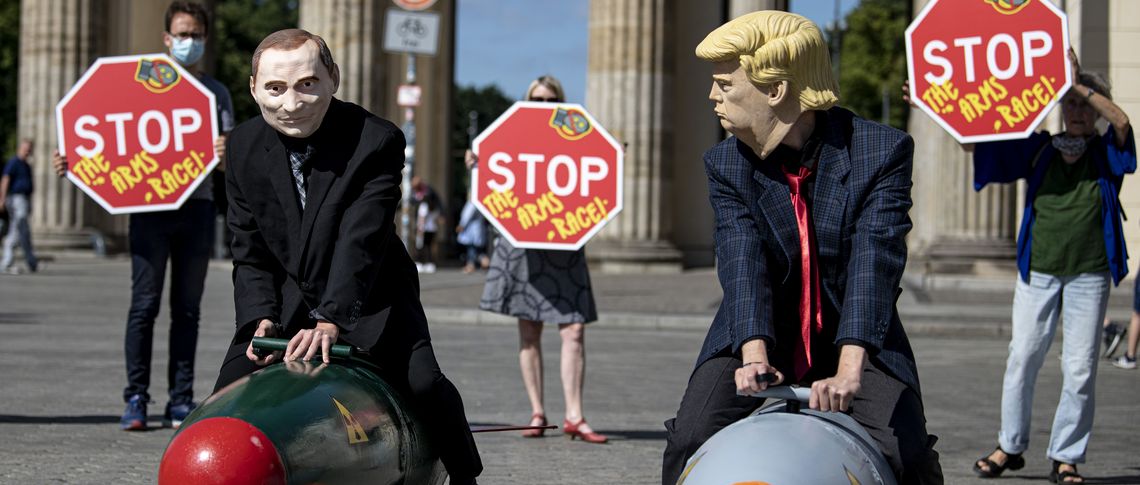
Under Trump, the United States is evolving from a security guarantor into a risk for Europe. Disregarding the security interests of its NATO allies, the Trump administration has not shied away from making concessions to Russia that would have been unthinkable for its predecessors. When the New START Treaty, which limits the strategic nuclear weapons of the United States and Russia, expires on 5 February, a new powder keg for Europe’s security will be opened. Europe must now put forward its own proposals before an agreement is reached at its expense.
Fears that the United States could sacrifice European security interests on the altar of arms control are as old as the Russian-American arms control process itself. When Washington and Moscow conducted the SALT negotiations on strategic nuclear weapons nearly 50 years ago, German Chancellor Helmut Schmidt feared that Washington might agree to an imbalance in weapons systems of particular relevance to Europe. While people in the United States and the Soviet Union might sleep more soundly, Schmidt warned, Europe would have to worry about a possible decoupling of American risks from Europe. This was followed by a transatlantic crisis of trust that, with interruptions, lasted until the end of the Cold War.
Since then, Washington has always closely coordinated with its allies on nuclear deterrence and arms control. In 2022, for example, President Joe Biden refrained from implementing a planned adjustment of US nuclear doctrine because several allies feared it could weaken America’s security commitment to Europe. Time and again, the United States blocked Russian attempts to drive a wedge into the alliance by tabling arms control proposals at Europe’s expense.
Putin is targeting the very core of nuclear deterrence in Europe.
The Trump administration is shaking these established rules. Trump has repeatedly tied US security guarantees to conditions. In his efforts to win Russia over to a peace plan for Ukraine, he has publicly pressured Kyiv, without consultation, to give up red lines. Trump is now even pushing for the takeover of Greenland and putting pressure on allies. At the same time, Europe often appears passive, reacting only to Trump’s initiatives instead of proactively developing its own strategies.
Europe could also face neglect if Putin and Trump turn their attention to nuclear arms control. On 5 February, the New START treaty, which limits the strategic arsenals of Russia and the United States, will finally expire. Without a replacement, nothing would stand in the way of a new nuclear arms race. To avert this scenario, the United States under Biden repeatedly signalled its willingness to hold talks, but Moscow demanded a halt to Ukraine aid as a precondition. Trump sees no danger in this: if it expires, it expires. They would simply conclude a better agreement.
Europe must not stand by while the world’s largest nuclear powers put their own interests above Europe’s security concerns. Russia could, as it did at the end of 2021, seek not only to talk about nuclear weapons but to renegotiate the entire European security order. At the time, Moscow’s draft treaties included not only arms control proposals but also restrictions that would have amounted to a de facto rollback of NATO eastward enlargement. Unlike the Biden administration, Trump might be willing to agree to such a deal if it allows him to present himself as a peacemaker and secures a political or economic advantage for himself.
Russia’s demands are no secret: the withdrawal of US tactical nuclear weapons stationed in Europe and restrictions on the British and French arsenals. Putin is thus targeting the very core of nuclear deterrence in Europe. Nuclear sharing is not least a symbol of shared risks among NATO member states. If Trump is determined to reach an agreement at any price, he could pledge to withdraw US tactical nuclear weapons from Europe. He could also, together with Putin, call on France and the United Kingdom to limit their nuclear stockpiles as well. Asked about the future of strategic arms control, Trump recently merely hinted that they would probably want to involve a few other actors too. From a European perspective, both would be disastrous signals.
Such an agreement would confront Europe with a dilemma. From a European point of view, it may be unacceptable, yet Europeans could not afford to reject it without an alternative proposal. Trump’s drive to reach an agreement with Putin is too strong to simply let it pass. Moreover, Europe must not alienate the many non-nuclear-weapon states in the Global South that have been calling for progress on nuclear disarmament for years. Precisely at a time when fundamental principles of international law are under pressure, Europe must strengthen these partnerships. Under no circumstances should the impression be created that long-awaited progress is now being blocked by Europeans.
To safeguard its genuine security interests in the event of a Russian-American rapprochement on nuclear arms control, Europe needs its own coherent negotiating position that it can use to win Trump over.
Europeans therefore need to make clear that nuclear arms control remains a central security policy instrument for them, albeit not an end in itself. Rather, it must serve Europe’s genuine security interests. An agreement under which nuclear weapons on NATO territory in Europe are reduced while Russia’s thousands of tactical nuclear weapons continue to threaten Europe must be prevented by all means. Europeans must therefore proactively formulate their own position and assert it with confidence. To initiate this process, German Chancellor Friedrich Merz should build on the existing dialogue with French President Emmanuel Macron and British Prime Minister Keir Starmer.
It is crucial that Europe first clarifies what measures France and the United Kingdom are prepared to take. Given the tense geopolitical situation, quantitative limits on French and British nuclear arsenals are out of the question for the time being. As an alternative, however, Paris and London must be willing to participate in a multilateral transparency regime under which participating states regularly inform one another about the number of their operational nuclear weapons. This would make it possible to ensure a minimum level of predictability regarding the development of nuclear arsenals. Paris and London could submit such a proposal to the other recognised nuclear powers in the P5 format. Europe must finally commit itself to strengthening established nuclear norms. The use of nuclear weapons, nuclear threats and explosive tests of nuclear weapons in particular must be unequivocally condemned. Europe should work to build a broad multilateral alliance, for example in the G20 format or at the review conference of the Nuclear Non-Proliferation Treaty.
To safeguard its genuine security interests in the event of a Russian-American rapprochement on nuclear arms control, Europe needs its own coherent negotiating position that it can use to win Trump over. Europeans must make clear that arms control has to serve their security interests, while at the same time keeping an eye on prospects for progress in nuclear disarmament. As constructive proposals to improve predictability, they should advocate a multilateral transparency regime and the strengthening of established nuclear norms. If Europe does not address these issues proactively, if it fails to develop its own strategy, it risks being pushed to the margins of international security policymaking.