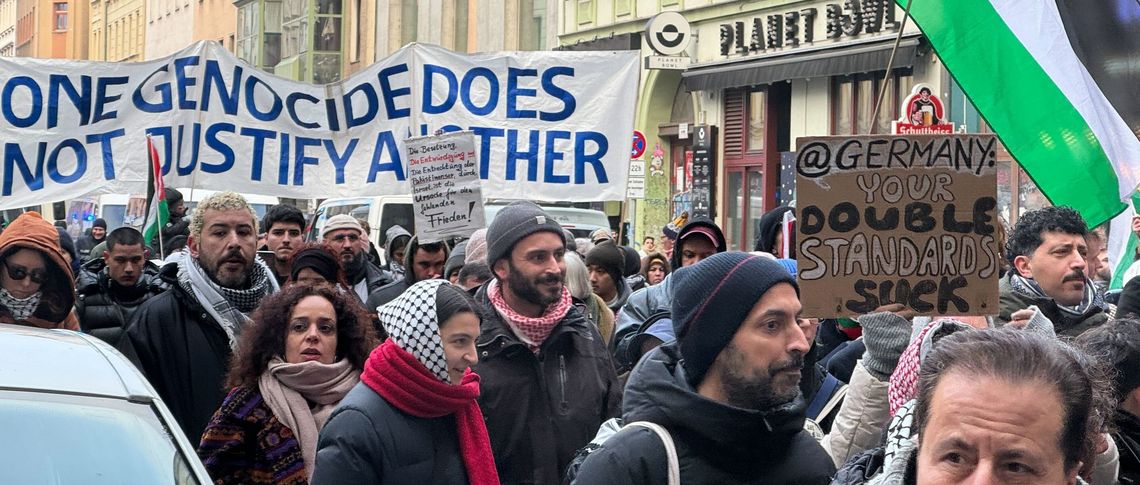
‘One genocide does not justify another.’ This is what demonstrators across Germany are writing on their raised signs, calling on the German government to use every lever of pressure at its disposal to force Netanyahu into stopping the war in Gaza. This sentence reflects the inherent difficulty and dilemma the German government faces in its dealings with Netanyahu’s government, despite its openly voiced criticism of it.
The Holocaust still lies at the heart of the special relationship between Germany and Israel. But Netanyahu’s government, which continues to push for an endless war, while advancing plans to deport the civilian population from the city of Gaza, has for the first time cracked the unconditional support that Germany has given to Israel across decades.
Chancellor Merz’s declaration to halt arms exports to Israel marked the first time Germany translated its criticism of Netanyahu’s government into concrete action. Yet, like in a dance, Germany took one step forward and two steps back: Immediately afterwards, it refrained from joining the statement by 26 EU countries calling on Israel to allow humanitarian aid into Gaza, and also abstained from joining the group of countries that announced their intention to recognise a Palestinian state.
During his visit to Israel in early August, German Foreign Minister Johann Wadephul warned against Israel’s international isolation and called on Netanyahu’s government to position itself clearly against expulsion and annexation. Since then, however, Netanyahu has acted in the opposite direction — continuing to advance his plan to conquer and destroy Gaza, promoting construction in the E1 area, and more. Yet the German Foreign Minister not only refrained from intensifying criticism of the Israeli government but even announced that Germany would not support the promotion of additional European sanctions against Israel.
The historical significance of recognising a Palestinian state cannot be overstated.
It seems that despite its criticism, Germany still refuses to grasp the full implications of the conduct of Israel’s far-right government. To appease its messianic members – such as Ministers Smotrich and Ben-Gvir, whose political outlooks mirror those of German politicians like Björn Höcke – Netanyahu’s government is advancing extreme measures.
Instead of the reluctance to act, Germany’s historic commitment to the Jewish people and to the State of Israel should have led it to join the countries calling for recognition of a Palestinian state.
The historical significance of recognising a Palestinian state cannot be overstated. Just as in the case of the Balfour Declaration that marked the first international recognition of Zionism, now 108 years later, international recognition is the cornerstone for realising the right to Palestinian self-determination. This, in turn, will save Israel from the destiny of a bloody binational catastrophe or an apartheid state — both cases would mean the end of Zionism.
For the first time, it seems that through its failures, the Netanyahu government may have initiated a positive turn for the Palestinians and no less so for us Israelis. Germany should be part of this shift.
The Zionist vision of a democratic nation-state for the Jewish people desperately needs a Palestinian state and will not be able to exist much longer without it. The 7 October massacre deeply shattered Israeli society, and the horrors of the Gaza war further heightened the Palestinian sense of victimhood. However, nearly two years later, we are once again returning to the starting point: There will be no future for Israel without a Palestinian state.
In contrast to the dead end we are being led towards by a power-drunk government controlled by the most dangerous and extreme elements in Israel’s history, there must be a political alternative.
The Netanyahu government seeks to lead us to a one-state reality — its branches in the West Bank have escalated the violent displacement of the Palestinian population, while the endless war in Gaza continues without hope or purpose, creating a humanitarian tragedy of historic proportions. Some of Netanyahu's ministers are already seeking to annex parts of the Gaza Strip, paving the way for an Israeli military occupation.
In the face of this reality, we must embrace and encourage the efforts of our friends around the world to promote a different reality based on the only viable solution: two states for two peoples as part of a regional coalition. As Israel’s main ally in Europe, Germany should be leading in this direction, not pursuing an indecisive policy toward an Israeli government determined to prevent the realisation of the two-state solution.
For 58 years, the State of Israel has ruled over another people, leading to the highest point of moral failure in its history. We are at a pivotal moment in the Zionist movement. In contrast to the dead end we are being led towards by a power-drunk government controlled by the most dangerous and extreme elements in Israel’s history, there must be a political alternative. One that is rooted in an agreement between two sovereign entities, leading to either full separation, a confederation, or two political entities sharing the land between the river and the sea without rigid borders — if that is mutually agreed upon.
Israeli society is wounded and damaged both by Hamas murderers and by an endless war that is exhausting and disheartening. Right now, the Israeli opposition needs to offer an alternative to acts of revenge, messianism, and dominance over another people. Instead of condemning international recognition of the Palestinian state, it should encourage it and work together with the liberal democracies of the world to promote a better reality for all of us.
In the face of efforts to replace the Zionist vision with a messianic one, we must stand with our allies across the world, and Germany among them — not to perpetuate war, but to advance a political solution.