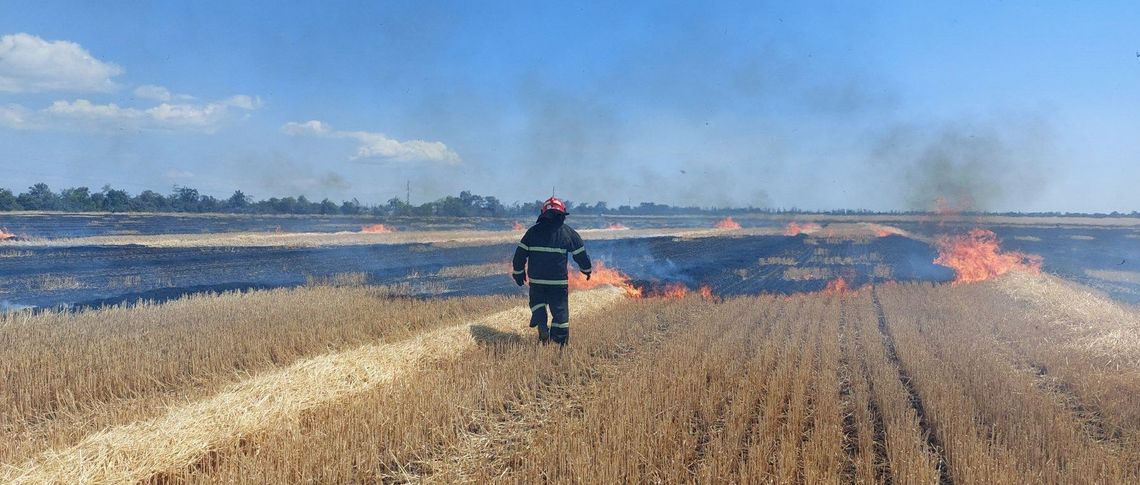
Before the full-scale Russian invasion, Ukraine, particularly its southern regions, was a leading supplier of wheat, corn, sunflower and sunflower oil, soya and soya meal to the Middle East, Asia, Africa and Europe. Every tenth cob of corn in Europe, for instance, was exported from Ukraine, and every third serving of chips was grown in Ukraine. We supplied 47 per cent of sunflowers to the world and ranked among the top ten largest product suppliers to 12 countries, the largest share of which went to Lebanon, Pakistan and Libya.
The Kherson region was the absolute leader among Ukrainian regions in terms of vegetable crop production and one of the three regions where the largest number of grapes was grown, as well as a lot of sunflowers, melons and wheat.
Still, last year was a black year for the agrarians of the region: the State Statistics Service reported zeros on all crops that used to be grown in the region, due to the occupation of the territory during the entire sowing and harvesting seasons. Total land mining, the unwillingness of farmers to co-operate with the occupying administration and the obstruction of farming by Russian soldiers also played their part.
Consequences of the dam explosion
In November 2022, the right bank of the Kherson region was liberated, and it would seem that this year, farmers had a chance to resume their activities. But the situation in the south remains difficult: destroyed or stolen equipment, abandoned fields due to the downtime last year and an inability to repay loans taken for the sowing campaign in 2022 persist. Constant rocket attacks and lack of electricity further complicate the situation.
And after the terrorist attack at the Kakhovka HPP, water problems have been added to the list. The UN also noted that the attack by the Russians would add new issues to the already existing food supply problems, and prices would rise. The blowing up of the dam is therefore yet another Russian crime against the world’s food security.
According to satellite images, more than 7,000 hectares of land on the left bank were flooded after the disaster, but the Ministry of Agrarian Policy estimates an even higher figure – 25,000 hectares.
The next three to five years, Ukraine will lose about two million tonnes of agricultural production each year, which will amount to about $1.5 bn.
On the right bank of the Kherson region, 100 thousand tonnes of crops were destroyed. In the Mykolaiv region, more than a thousand agricultural lands were covered with water, and commercial losses amounted to more than $500.000.
And these are only the first consequences of the disaster. The next three to five years, Ukraine will lose about two million tonnes of agricultural production each year, which will amount to about $1.5 bn.
The technogenic catastrophe actually left one-third of fields in Dnipropetrovsk, 94 per cent of Kherson and 74 per cent of the Zaporizhzhya regions without water. This water allowed the cultivation of up to 80 per cent of all Ukrainian vegetables and a significant percentage of fruit and grapes. All heat-loving fruits and most of the greenhouses providing affordable vegetables to the population of Ukraine and Moldova were also located along branches of the Kakhovka irrigation system.
Adaptations and potential solutions
The fields that do not directly depend on irrigation could also remain empty. Previously, farmers benefitted from irrigated land and closed other unprofitable production for the sake of crop rotation. Having lost the opportunity to irrigate the land, for the next three to five years, one and a half million hectares of land which were sown at this expense will be empty.
It is likely that it is now impossible to talk about the cultivation of vegetables, but luckily, grain and oilseed crops will be grown according to an extensive model with low yields.
The south of Ukraine is an arid region, with the lowest amount of precipitation in the country. It is impossible to grow most crops without additional irrigation. However, many farmers in semi-desert or desert areas – in southern Kazakhstan and Armenia – practice rainfed farming. This practice is based on the absence of irrigation and the cultivation of drought-resistant grain, fodder and melon crops.
Water user associations (WUAs) are already being established in Ukraine, allowing for joint ownership of irrigation system facilities.
Ukrainian farmers already consider this a promising prospect, as there are a number of crops that can be safely grown in the south ‘on rainfed land’: sunflower, winter wheat, winter rape and spring barley. And the market is already adapting to the new system. This year, vegetables will be supplied to Ukraine by the Odessa Oblast (now the region with the largest amount of irrigated land), where agrarians have begun to show interest in changing the cropping pattern.
In addition, water user associations (WUAs) are already being established in Ukraine, allowing for joint ownership of irrigation system facilities. The establishment of WUAs is one of the solutions that will help farms survive the Kakhovka HPP dam explosion.
Under current conditions, Ukrainian farmers lack funds to restore the irrigation systems. But there are prospects. Among others, the fund of American businessman Howard G. Buffett, who considers Ukrainian agriculture the most important economic component, is investing in irrigation systems and, even before the disruption of the grain deal by the Russian side, emphasised the need to invest in facilities that will help move grain.
While Russian missiles are destroying hundreds of thousands of tonnes of grain in the Odessa region which should have gone through the grain corridor, hunger and poverty will hit the most vulnerable.
The European Bank for Reconstruction and Development (EBRD) is also working in this direction. In 2022, the bank, together with the Ministry of Agrarian Policy of Ukraine, developed a project to reconstruct the Lower Dniester irrigation system, which takes water from the Dniester. And in 2023, the EBRD allocated additional funding for a feasibility study of the project, as well as for the development of water user associations.
It is quite clear that the Russian war is not only being waged against Ukraine but goes far beyond it. World prices are rising, and food security problems will only worsen in the short term. And while countries that have diversified import channels will be able to adapt and see this as a ‘positive shock’, countries with a heavy dependence on imports will continue to experience shortages, which, scientists conclude, could cause political instability around the world through geopolitical conflicts and famine.
While Russian missiles are destroying hundreds of thousands of tonnes of grain in the Odessa region which should have gone through the grain corridor, hunger and poverty will hit the most vulnerable – countries in Africa and South East Asia. Subsequently, people will be forced to seek salvation in developed countries, provoking new migration crises.
That is why the agenda of the international community supporting Ukraine should include active and comprehensive assistance to Ukrainian agrarians who desperately need to stay ‘on the ground’ in the conditions of war.