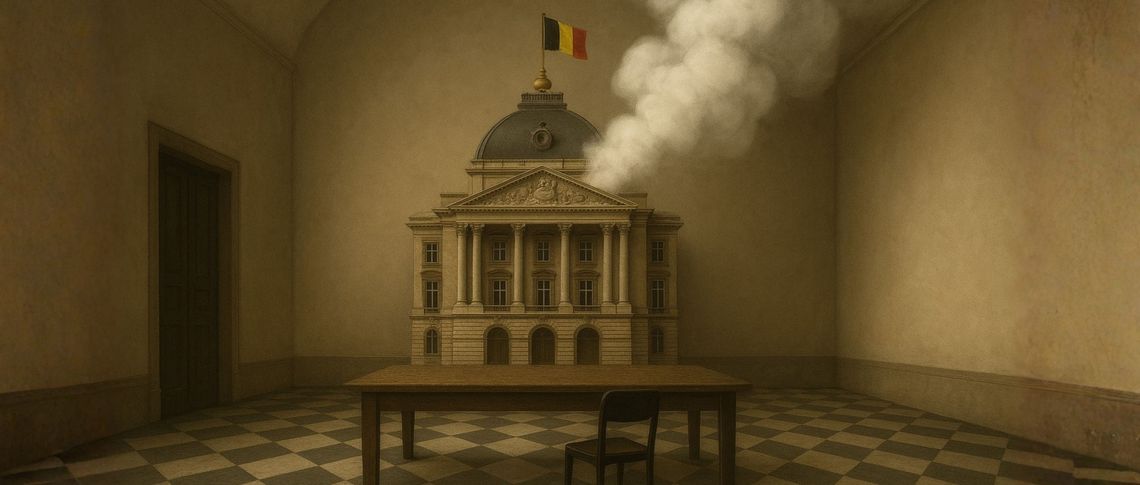
Belgium outdid itself in terms of surrealism this week: Brussels – the capital of Belgium and the heart of the European Union – broke the world record that nobody wants to hold. As of last Tuesday, the Region is without an elected government for 542 days — breaking the previous world record for longest government formation in peacetime, coincidentally (or not) also held by a Belgian government: it took 541 days to find the Federal Government eventually led by Prime Minister Elio Di Rupo in 2011.
While Belgium has long tolerated a certain level of political absurdity, Brussels’ current paralysis is testing that national patience in ways that should worry not just the city itself, but the country and Europe as a whole.
Brussels is not a sovereign nation and so does not have the dubious honour of actually making it into the book of Guinness World Records, but symbolically, it is not a good look for the unofficial capital of Europe, which hosts the EU institutions and NATO. On the contrary, the political paralysis comes at a horrible time, not just globally but also at home: a growing budget crisis, increasing levels of drug-related violence, the rise of the far-right, growing homelessness, stalled construction sites all over the city and much more.
Not only is the lack of political leadership not helping to solve these issues, but it is actively making them worse. With the previous government’s ministers glued to their seats while the Region is on autopilot, no new spending decisions can be made. On the ground, this means that social support organisations are losing subsidies and may soon have to start cutting salaries, big construction projects are on hold, hundreds of people have to wait for renovation grants and investments are frozen. For months, businesses, NGOs, academics, artists and plain old concerned citizens have been urging politicians to put their egos aside and start negotiating. But to no avail.
Difficult systems or difficult people?
In the politicians’ defence, it’s not easy to find an agreement in a system as complex as the one in Brussels. As Brussels is officially a bilingual city, voting happens in two languages as well: political parties cannot submit mixed language lists but have to work with two separate electoral colleges: a Dutch-speaking and a French-speaking one. This split runs right through to the Brussels Parliament, which is made up of 89 seats — 17 on the Dutch-speaking side and 72 on the French-speaking side.
After the elections, both language groups need to find a majority on their own side first: a Flemish team with at least nine seats in Parliament and a Francophone one with at least 37. In theory, these two groups then form one unified government for the entire Brussels-Capital Region.
But that is exactly where the shoe pinches. While liberal MR became the largest party on the French-speaking side (and quickly formed a coalition with socialist PS and centrist Les Engagés), the progressive green Groen party won convincingly on the Flemish side. It may come as no surprise, but the two parties are polar opposites on pretty much all levels.
Adding the typical Belgian layer of complexity is the fact that the Brussels government has a fixed number of ministerial positions in each language group. This is to protect the interests of Dutch-speaking voters, who are a minority in the capital. Yet, it is this fixed number of ministers which posed a problem: four parties are needed to find a majority in a system that only provides three ministerial positions — and so is designed for just three coalition partners.
After six months of difficult negotiations, a Dutch-speaking majority was finally found in December last year. However, this resulted in the French-speaking side immediately falling apart. The hope was immediately dashed, as the francophone socialists ruled out a coalition with the Flemish nationalists – the N-VA party of the country’s prime minister, Bart De Wever – and left the negotiating table. According to the socialists, N-VA is an ‘anti-Brussels, anti-diversity’ party and as long as they have a seat at the table, PS refuses to return. Meanwhile, the Flemish liberal party (Open VLD) is refusing to join a Brussels government without that same N-VA, resulting in a stalemate that has been going on for over a year.
A familiar loss of trust in politics
With all of this happening in the midst of geopolitical turmoil dominated by big egos across the world, the lack of leadership in the European capital is not particularly reassuring. Complex electoral system or not, if a budget deficit of €1.6 billion (and counting) and images of men with Kalashnikovs in Brussels metro stations will not make these party leaders put away their pride, then what will?
The lack of answers to this question has resulted in many Belgians and Brussels residents – who have otherwise become so used to shrugging their way through the latest political fait divers of the day – losing trust (and patience). Many are left wondering why they even bother voting. The country has tolerated political dysfunction for decades, but with social unrest and economic strain rising, this time may be different.
So where does that leave the people of Brussels? Should we follow the example of the tens of thousands of protestors who have taken to the streets every month to protest against the Federal Government’s measures this year? Or should we just stay quiet until the next elections, hoping against our better judgment that years of political inaction will not push even more voters to extreme parties? If it comes to that, Brussels’ political paralysis will no longer be a quirk of Belgian democracy — but a danger to the city, to the country and to Europe as a whole.
Even in a country that prides itself on its national ‘it is what it is’ attitude to dealing with its layers of inbuilt complexity, enough is enough.
Taking inspiration from the election of the new pope earlier this year, I suggest we organise a conclave: all Brussels party leaders get locked in a room together, and no one leaves until a government is formed. We give the key to Prime Minister De Wever, and he will not open the door until white smoke comes out of the chimney. No phones or laptops, no contact with partners or children, no distractions. Just negotiations.
And if De Wever is not up to the task, I’m sure there are plenty of others who would love the chance to move the needle. Nearly 200 of them published an open letter on Monday — signed by dozens of important and well-connected people, from businesses and academia to the private sector, arts and culture. They complained that the inaction is now ‘affecting their daily lives’, adding that the ‘immense challenges that Brussels needs to tackle – economic, social, climatic and institutional – can no longer wait.’ On the same day, over 500 Brussels residents gathered as a protest against the impasse. Holding signs with slogans like ‘politicians everywhere, politics nowhere’ or ‘shame on you, Brussels’, the protesters booed politicians walking into the parliament.
This just goes to show that even in a country that prides itself on its national ‘it is what it is’ attitude to dealing with its layers of inbuilt complexity, enough is enough.
542 days after the elections, the lack of leadership in Brussels is looking a lot less like compromis à la belge and a lot more like something dreamed up by Belgian surrealist René Magritte. Ceci n'est pas une crise?
Shame on you, indeed.