


From the outside, Chile often looks like the shining light of Latin America: stable institutions, a functioning democracy, growing environmental awareness, a stable economy. Yet behind this façade, things are simmering. The upcoming election has far greater implications than a normal ballot. On 16 November, the nation will decide whether to continue on the path of social reform — or else make an authoritarian, conservative shift to the right, like so many countries in the region.
Eight candidates will be on the ballot paper, but only four have a realistic chance. On the left, Jeannette Jara, the communist and former employment minister in the government of the left-wing President Gabriel Boric, is standing as the unifying candidate of the progressive camp. On the other side, three right-wing candidates – Evelyn Matthei, José Antonio Kast and Johannes Kaiser – are offering different nuances of the same programme, based on law and order, economic liberalism and cultural rollback.
A climate of frustration
Four years ago, the country appeared to be on the move. Following massive social protests in 2019 demanding greater social justice, fair pensions, education and health, the Chilean people elected in Boric a beacon of hope to bring some progressive verve into government. But the euphoria has faded. The constitutional processes have failed, many reforms have remained mired in parliament, and people have become increasingly restless. Not because the goals were wrong, but rather because estimations of how to get there were unrealistic. A country with a decades-long background of neoliberal politics does not change overnight. Disappointment at unfulfilled promises has eroded the trust in progressive politics.
The right is cooking up familiar recipes to pierce this climate of frustration: fear of crime, the promise of a firm hand, nationalist rhetoric. The numbers are on their side — increasing uncertainty, visible poverty and organised crime. Current polls suggest that ‘security’ is the biggest concern of 61 per cent of the population. The far-right candidate Kast has learned from his defeat against Boric four years ago. His harsh attacks on feminism, abortion and gender rights have disappeared from his election campaign — not because he no longer holds these views but because he has learned to conceal them. Instead, he portrays himself as a serious statesman, a guardian of order.
This strategy is also succeeding because Kaiser is employing misogynous, xenophobic and authoritarian rhetoric to shift the political spectrum to the right. Alongside him, Kast almost seems like a moderate. It is a familiar trick — the most radical candidate prepares the terrain, while the ‘moderate one’ brings in the victory. In contrast, Matthei tries to be the voice of reason — although her previous defence of the military dictatorship raises doubts. If even the ‘centre right’ views the former dictator Pinochet through rose-tinted glasses, the political middle ground has long since shifted.
Rather than positioning the constitution as a long-term project with relevance for the whole of Chile, it became embroiled in ideological trench warfare, tokenism and internal power games.
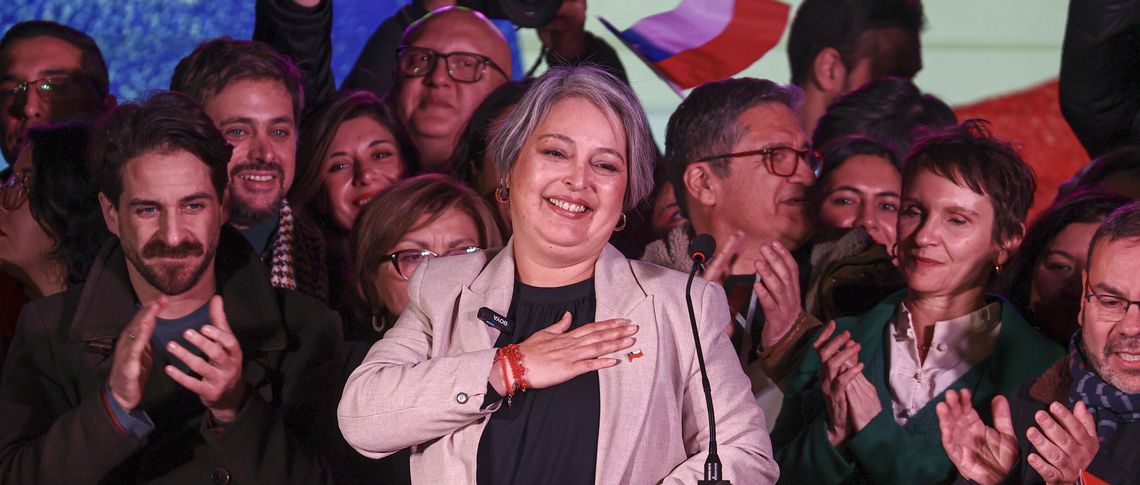
Meanwhile, Jara finds herself caught in the middle. She embodies what remains of the idea of social justice, with her down-to-earth principles, credibility and proximity to ordinary people. But she has a burden to bear — as the candidate of the left-wing government, whose record has disappointed many voters. This is the key mistake of the left in Chile: it has failed to transform social anger into concrete, measurable progress. Rather than positioning the constitution as a long-term project with relevance for the whole of Chile, it became embroiled in ideological trench warfare, tokenism and internal power games. Meanwhile, the right used the time to reinvent itself — rhetorically rather than in terms of substance. If Jara wants to give herself a chance of winning, she needs to find the courage to address these mistakes honestly. Only those who acknowledge their own failings can win back the trust they have foregone.
Fear – of crime, poverty and even communism – is playing a key role in this election. Kast and Kaiser exploit it with calculated precision. The situation is, however, more complex than slogans such as ‘chaos’ or ‘abyss’ would suggest. Chile is not on the verge of collapse. It is a functioning democracy — and while the economy is stagnating, it remains stable. The institutions are holding up. Yet the perceived loss of control is real. Those who are scared are rarely bold when they get to the ballot box. This year sees the start of compulsory voting with automatic registration. Approximately one third of the electorate are considered to be unknown — people who have never voted in recent years. They include many in precarious situations, and many who are young and disillusioned.
Jara could score points with them. Her background and simple origins, together with her direct, warm manner, lend her authenticity. But even here doubts remain. Already at the first constitutional referendum, the left hoped that non-voters would get them over the line — but in the end, the far right won the day. The only possible scenario that might clearly improve Jara’s chances would be a run-off against Kaiser — a man considered to be too radical, even by many on the right. In this case, a repeat of the 2021 presidential election may be on the cards, when fear of Kast – perceived at the time to be too extreme – brought the left-wing student leader Boric to power. A duel between Jara and Kast is, however, the more likely scenario. In that case, all signs point to a shift to the right — not out of conviction but rather out of exhaustion.
Even if Kast projects a more moderate image today, his political DNA remains the same.
A victory for Kast would not be any normal transfer of power. There is a high chance of the right-wing parties also winning a majority in parliament. This would give Kast a good opportunity to implement his programme, ranging from stricter security laws and neoliberal economic policy to the erosion of achievements by the progressive camp. Even if Kast projects a more moderate image today, his political DNA remains the same. Like his ideological allies, such as Milei or Trump, he would instigate a culture war sooner or later: against abortion, sex education, gender-neutral language and foreign infiltration. Maybe not immediately, but definitely at some point in the future.
For the left, losing both the presidency and parliament would be a devastating double defeat. The fragile unity of the progressive alliance between Frente Amplio, socialists and communists could be shattered. Boric, currently still the president but an opposition leader in waiting, would have to pick up the pieces of a disillusioned movement. Chile is not facing collapse but is at a fork in the road. It does not need a ‘firm hand’ but a firm state that creates trust. A state that not only reacts but shapes the future. It requires good public schools, an improved public health system and a new development model that promotes innovation and jobs that secure people’s livelihoods.
The left would be well advised to design a new political project that offers genuine solutions to real issues, thereby embodying the hope of a better future. This means politics again being regarded as a tool for change — not as a moral gesture but as hard graft targeting greater equality and security.
The runoff on 14 December will reveal whether Chile is giving in to fear — or whether it still has enough courage to believe in a more just society. Maybe Jeannette Jara will lose — not only because she is a communist but also because of that. The chances of the not-so-communist communist gaining further votes from the centre or centre-right camps in the second round of voting are low. It is more likely that the far right, which is more extreme than it currently projects itself to be, will take the helm in Chile for the first time. And yet perhaps there is still a chance of a miracle, as Chile’s history has proved many times in the past. As the saying goes, ‘Firstly, things come differently and secondly, never as you think’.


