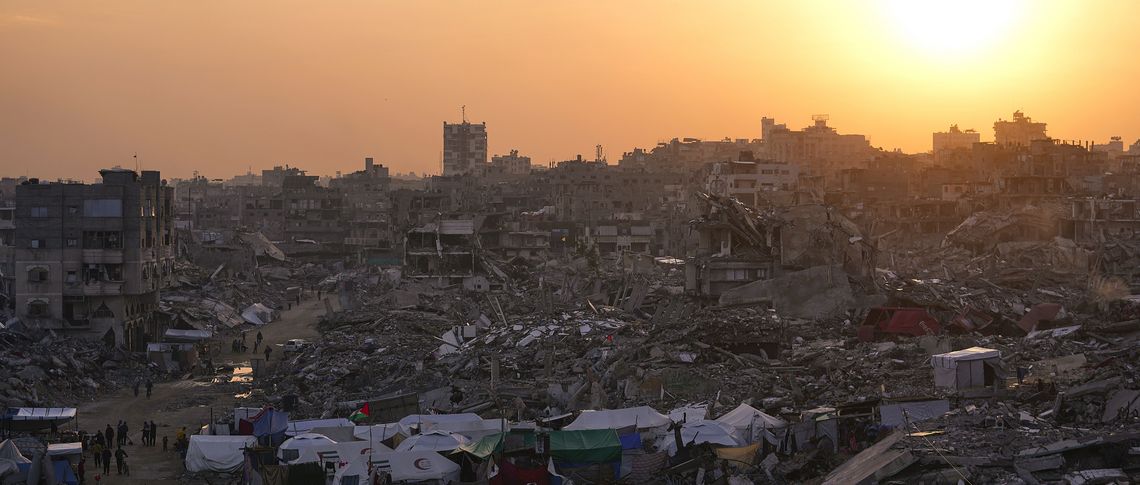
Despite the current ceasefire, we are still seeing Israeli military operations in Gaza, with recent reports of new strikes and casualties. Is Trump’s so-called peace plan, which was recently endorsed by the UN Security Council, working?
What we have right now is a ceasefire, not a peace plan. Calling it a peace plan creates false expectations. The region has known different forms of agreements for thousands of years, so the notion that this is unprecedented is simply wrong. Words matter: if you call something a peace plan, people conclude that peace has failed when the agreement is violated. But there is no peace agreement. There is a ceasefire, and it is being breached.
The United States has positioned itself as the referee, but the interpretations of the document differ dramatically. The text speaks of a Palestinian state, yet Prime Minister Netanyahu insists it opposes such a state. It demands disarmament of Hamas, but Hamas explicitly rejects disarmament. The first phase was significant — most living hostages were released, as well as most of the bodies. The real question is whether either side is prepared for the second stage. For Hamas, that would mean the end of its quasi-military rule in Gaza; for Israel, it would entail acknowledging a political path toward a Palestinian state. Neither side appears willing. In that sense, both Hamas and the current Israeli government might prefer to remain stuck in phase one.
You mentioned the prospect of a Palestinian state. Do you see any realistic political actors who could reopen negotiations?
At this moment, Trump is the only actor with the leverage to push for a Palestinian state. If he insists, something may move. If he doesn’t, nothing will. The next important moment on the Israeli side is the October election. No one knows what will happen, but it seems unlikely that Netanyahu will return as prime minister — though, of course, anything is possible. A new government might approach the issue differently. Before the elections, no one will speak openly about a Palestinian state, because they fear being labelled ‘leftist’. After the elections, some parties might put it back on the agenda. My own party, the Democratic Party, will certainly push for it, and others could join. Ultimately, Israel must recognise that, without a defined border and a Palestinian state alongside it, Israel cannot remain both Jewish and democratic. No one wants to reproduce the conditions of apartheid South Africa. On the Palestinian side, the need for self-determination and an end to the occupation is obvious.
The central obstacle today is the settlement expansion. When the Oslo Accords were signed, around 100 000 settlers lived in the West Bank; now there are more than half a million. So when people say they support a two-state solution, I ask: How do you plan to implement it? No Israeli prime minister will evacuate all these settlers. This is why Hiba Husseini and I have proposed ideas to address the settlement challenge — an issue that was much less central during the Oslo era, when other questions like Jerusalem and refugees dominated the debate. We propose creating a Palestinian-Israeli confederation to provide a new framework for negotiating a permanent peace solution. Instead of requiring mass evacuation, Israel and a future Palestinian state would remain two sovereign states but allow citizens to live on either side of the border under agreed legal arrangements.
How is this debate reflected in Israeli society? Are there initiatives pressuring political leaders toward a new approach?
The idea is back on the agenda. A few years ago, when you mentioned the two-state solution, people dismissed it as unrealistic. The dominant approach was to ‘manage the conflict’: improve life in the West Bank and Gaza, strengthen welfare systems, demand that Palestinians behave responsibly and so on — without addressing the political core.
Today, the two-state solution is discussed more seriously. Netanyahu’s insistence on rejecting it shows he feels the pressure. Trump’s somewhat contradictory statements – ‘You may have one state, two states, whatever you want’ – also keep the issue alive. His written plan clearly assumes a Palestinian state. Moreover, diplomatic initiatives from Saudi Arabia, France, various UN resolutions and growing international support for a Palestinian state all contribute to placing the issue back on the global agenda. Of course, nothing will happen unless the parties themselves move. And again, regretfully, Trump is the only one with the power to force a breakthrough. Still, the international community has succeeded in elevating the issue again.
How do you see Germany’s current role, also considering its impact within Europe? Could Germany play a more active role in advancing peace?
Germany has long been extremely restrained. The Israeli peace camp would like Berlin to be more proactive, but we understand Germany’s historical context. The distinction between supporting Israel and supporting Israel’s government is clear in theory, yet in practice, the line becomes blurry. Criticising government policy is often perceived as criticising Israel itself.
Germany knows that the two-state solution is the only viable outcome, yet it has not recognised the Palestinian state. Still, it is important that the issue returns to public debate. Germany’s dilemma – between its historic commitment to the Jewish state and its commitment to human rights after 1945 – remains unresolved. And it cannot simply be ‘solved’ — the country must navigate between these principles. I believe Germany could do more to stimulate debate. In the past, there were many public events, conferences, discussions — at think tanks and academic institutions. Today, there is less of that. Even a more engaged debate would help maintain international attention.
Turning to Israeli domestic politics and the upcoming elections: What are the prospects for pro-democratic and peace-oriented forces, given the high polarisation?
It is very hard to see the centre-left winning outright. The best scenario is a coalition between the centre-left and the Bennett camp, similar to the government that existed two years ago. It would be an unstable coalition, united mainly by opposition to Netanyahu’s attempt to overhaul the judiciary – his so-called legal revolution – and by opposition to Netanyahu personally, the first sitting prime minister indicted for bribery and other charges.
The key question is whether the centre-left could influence the peace process even if Naftali Bennett were prime minister. This has happened before. In a previous Netanyahu government, he declared there was ‘no chance’ for peace but said he would not prevent others from negotiating. Netanyahu then asked Tzipi Livni, then justice minister, to lead talks with the Palestinians. They continued for two years. They ultimately failed – mostly because of Netanyahu – but the model shows that influence is possible without holding the premiership.
But let’s be realistic: the centre-left will not win a majority. The aim is to strengthen our camp, mobilise voters and prevent the fragmentation that cost us crucial seats in past elections. We must also ensure strong turnout among Arab citizens, whose participation is essential to maximising the democratic camp’s potential. Even then, the centre-left may only become a decisive partner in coalition bargaining, not the leading force. It is unlikely we will see someone like Yair Lapid as prime minister again, although it’s not impossible. Lapid clearly supports a two-state solution – he even declared it at the UN as prime minister – but the political landscape makes such a scenario improbable.
What could be a compelling alternative to Netanyahu’s narratives and policies — something that resonates with the wider public?
Beyond military strategy in Gaza, the alternative must be a political solution. Whether or not leaders explicitly call it a two-state solution before the elections, they should be prepared to advocate it afterwards. Most political figures – including Netanyahu in the past, though not Bennett – have supported it at some point.
There are also other critical issues shaping Israel’s future. One is the question of conscription for the Haredi community — a central topic for any upcoming government. Another is the broader liberal agenda: strengthening the judiciary and the institutional ‘gatekeepers’ of Israeli democracy. These issues unite much of the democratic camp, even if they do not share a unified vision for peace. But, regrettably, the question of reaching peace is not part of the common denominator that binds potential coalition partners. This is the political reality we face.
This interview was conducted by Philipp Kauppert.