


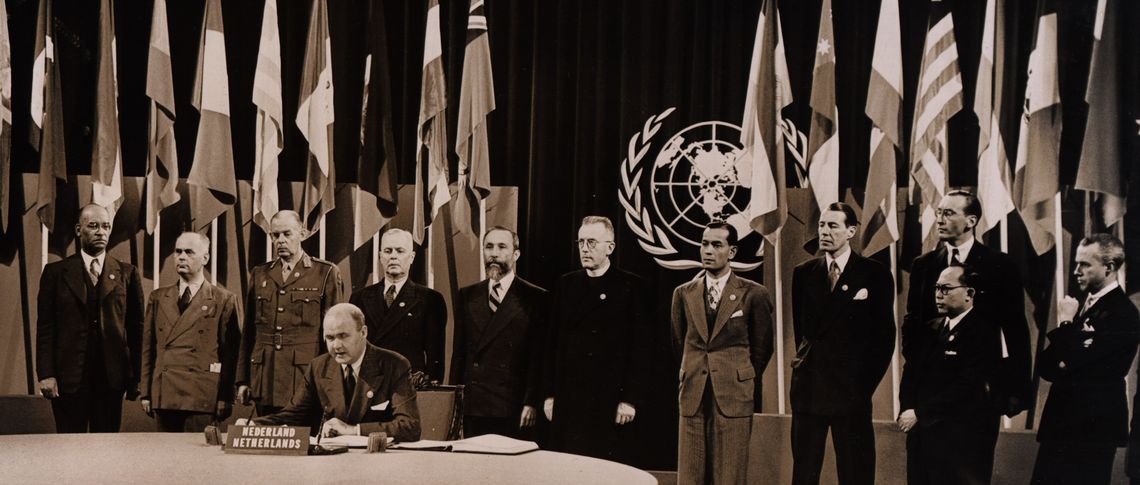
Alliances among countries rarely last long. Whether it was the League of Nations, the Protestant Union, the League of the Three Emperors or the Holy Alliance, the partners generally parted ways acrimoniously after just a few years. The United Nations can therefore be proud that this year marks the 80th anniversary of its foundation.
Yet, on the occasion of this anniversary, the international community is witnessing the return of those phenomena against which it had once united: superpower politics, imperialism, territorial expansion, lawlessness and an erosion of trust.
At the same time, the world is experiencing an increase in all those challenges that Kofi Annan described as ‘problems without passports’ and that actually require more cooperation among countries rather than less: climate change, pandemics, failed states, poverty and inequality, refugee flows and war.
On its big birthday, the UN therefore seems trapped in a vicious circle. Within the organisation, geopolitical rivalry is leading to an inability to act and is blocking reform. International cooperation is being undermined by increased national unilateralism and conflicts. To make matters worse, the wealthiest member states, in particular the US, are pulling the plug on the already cash-strapped United Nations. As a result, lifesaving programmes throughout the world are being cancelled and thousands of employees dismissed. There is no getting around the diagnosis that the very existence of the multilateral system, with the UN at its heart, is on the line.
80 years of remarkable success…
Multilateralism is like a body tendon — only when it suddenly tears does it become clear how indispensable it is for every movement. For 80 years, the United Nations has formed the locomotor system for the international community — and it has functioned impressively.
Even after 1945, the world was not a peaceful place. Millions of dead in more than 250 armed conflicts bear witness to this. Nevertheless, the UN contributed significantly to the creation of a set of rules that enabled the longest period without a war among major powers in modern history. From the protection of human rights to humanitarian international law, from the banning of cruel weapon systems to the combatting of pandemics and illnesses, from refugee protection to core labour standards, the United Nations has prevented millions of deaths, saved countless lives and made the existence of billions of people simpler and safer with its sophisticated system of conventions, treaties, programmes and specialised agencies.
Power is still the decisive factor in international politics. Thanks to the United Nations, however, it is no longer the uncontrolled and unaccountable power that states knew before 1945. For the first time in history, the UN has succeeded in countering the Law of the Jungle and the logic of the zero-sum game with a different model for relations between countries.
Global institutions are created for challenges that countries cannot handle on their own. Sometimes this means making a binding commitment or, in extreme cases, sacrificing some sovereignty. The result, however, is more stability, more reliability and an increased capacity to act that weighs more heavily and ultimately serves their own national interest. This concept has a name — multilateralism. The second half of the 20th century was defined by this principle.
…but leaving many on the side-lines
It did not result from negotiations between free and equal states. An international order only arises through the political will of influential powers to create and develop it.
As the largest power in the 20th century, the US for decades followed the multilateral strategy of holding other countries to global rules that Washington was able to influence significantly. This allowed the US to gain partnerships, influence, market access and loyalty: it had the means to identify problems before they could endanger its security.
The UN is facing its biggest turning point in 80 years.
This Western-style multilateralism did not only cater for a comprehensive system of political rules, but also promoted economic hyper-globalisation. Between 1950 and 2020, the global economy grew by around 3.5 per cent per year. This figure illustrates huge gains in prosperity, even for regions that had previously suffered from colonialism and exploitation for centuries. Yet, these dynamics also created dramatic upheavals that produced losers, created crises, increased inequalities and placed too great a strain on the planet’s natural resources. In other words, they triggered all those cross-border issues that could in turn only be resolved by means of international rules.
From the perspective of countries from the Global South in particular, Western-dominated multilateralism was always selective, inefficient and a target of criticism. But it was this multilateralism that enabled it to hold all countries, even the most powerful, to common rules: the first time that this had happened in the history of humanity.
Of all countries, the US now seems ready, however, to leave the order it has been instrumental in creating. As a result, the UN is facing its biggest turning point in 80 years. Other countries can now choose between also leaving this order or reinventing it. When doing so, a question arises that has never been posed before:
Can a multilateral order exist in a multipolar world?
The answer is ‘Yes’. The basics are all in place. The overwhelming majority of countries would like a rules-based order and support the principles of the UN Charter, even if they resist its selective application. This needs to be utilised — for example, by creating an alliance of medium-sized powers. If 20 large middle powers from all continents with a commitment to multilateralism were to join forces, they would carry enough weight to counter the big power politics and strengthen the multilateral order. There is a need for smart, issue-based reform alliances between north and south, and between small and large countries, to achieve progress in critical areas — finance, debt, climate and trade.
Western countries must, however, learn that multilateralism and liberalism are not the same thing. It is possible to collaborate multilaterally, and in a rules-based manner, without Western countries exclusively setting the tone. The so-called liberal order is weak because Western democracies have lost their charisma. And because the neoliberalism propagated by them for decades has brought both mankind and nature to a state of exhaustion. The common good, shared global goods and the development requirements of less developed countries will need to be given higher priority if we are to convince societies and countries of the benefits of progress, democracy and international cooperation.
Furthermore, foreign policy needs to account for multilateralism becoming more complex in the future. Unlimited loyalty to one particular camp is becoming an exception. Equidistance, tiered partnerships, and overlapping and even contradictory alliances will define the foreign policy of many countries. This translates into the growing importance of ‘minilaterals’, regional organisations and informal collaborations.
The UN possesses the ability to reveal the image of a possible future amid the gruelling reality of international politics.
Multilateral politics must be both pragmatic and principled to navigate this world. It must be pragmatic because the stereotypical division of the world no longer works. And it must be principled in its recognition of the UN Charter as the highest common reference point for all multilateral negotiations.
The crucial question is the extent to which the member states allow the UN to act in a financially, organisationally and politically legitimate and efficient manner. This is key to the UN’s ability to form the common denominator of networked multilateralism in the 21st century. If the UN continues to be blocked politically and starved financially, a fragmented, multilateral patchwork is the best the world could hope for. And in the worst case, the world may slip back to the brutal lawlessness of the period before 1945.
In that year, countries established the UN to create a new order from the ruins of the old world. Since that time, the United Nations has been holding up a mirror to the international community and showing it both sides: how the world is and how it could be. This is precisely where its unbroken, mobilising power lies. The UN possesses the ability to reveal the image of a possible future amid the gruelling reality of international politics. And that is exactly why the United Nations, since its foundation, has also always been a disappointment — because it is also a hope.


