Early in US President Donald Trump’s second term, right-leaning tabloid New York Post splashed the headline ‘The Donroe Doctrine. Trump’s vision for the hemisphere’ all over its front page. Trump had begun the year by announcing he wanted Canada to become the 51st US state and to take control over Greenland and the Panama Canal. The New York Post duly obliged with a map. Trump then renamed the Gulf of Mexico the ‘Gulf of America’.
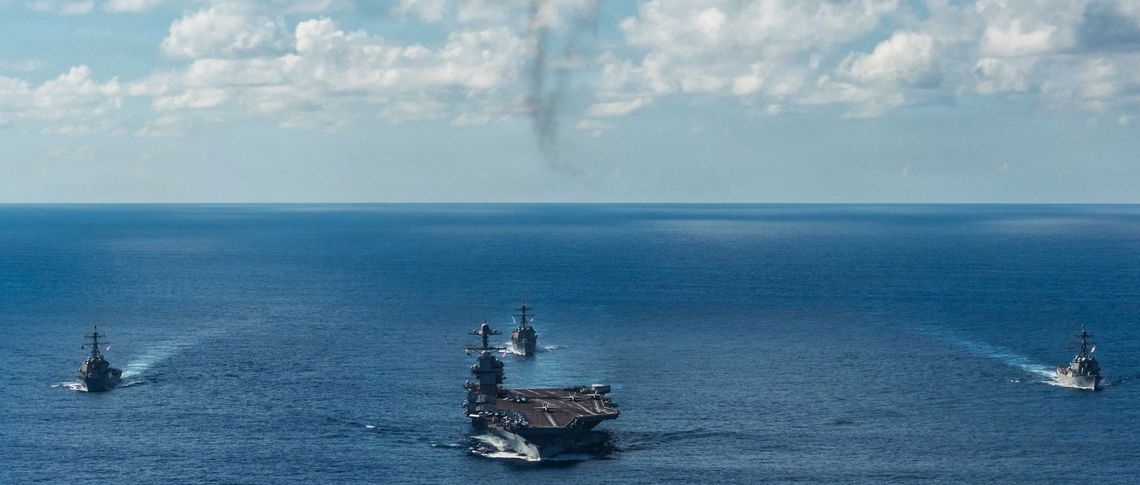
As Trump’s first year is coming to a close, the US government is having the Navy fire on boats in the Caribbean. A large fleet, including the biggest, most modern US aircraft carrier, the USS Gerald R. Ford, is cruising off the Venezuelan coast. This is the biggest military presence in the region since the US invasion of Panama in 1989. Throughout the summer, Trump openly threatened a number of Latin American governments, in addition to imposing tariffs on them.
The US president has made it perfectly clear that he would like to topple Nicolás Maduro’s authoritarian regime, if necessary by deploying ground troops. The White House and the Pentagon have consistently stressed that US warships are in the Caribbean to prevent drug smuggling. In relation to Mexico, Trump hasn’t ruled out military strikes in a bid to eradicate drug smuggling. But is such an armada really needed to combat the drugs trade, complete with an aircraft carrier, a submarine, three destroyers, a host of supply ships and 15 000 seamen? Indeed, isn’t wielding such an enormous military stick in the war on drugs counterproductive?
In the meantime, the Caribbean mission has been dubbed ‘Southern Spear’. More generally, Trump has taken against the Venezuelan government and says he needs to do something about Venezuela. He has expressed particular interest in the country’s enormous oil reserves. The message is clear, even if more specific goals remain obscure.
The term ‘Donroe doctrine’ has since been taken up by serious newspapers such as TheNew York Times and the Financial Times to describe the significant change of course in a US foreign policy that had stood for decades. It constitutes a shift towards what the US calls the Western Hemisphere (North, South and Central America).
We are now seeing a resumption of 20th-century gunboat diplomacy.
The coinage ‘Donroe doctrine’ is a reference to the historical Monroe Doctrine. In 1823, President James Monroe persuaded Congress to take action to curb European influence in Latin America. After Theodore Roosevelt developed the doctrine in 1904/1905, the US used it to justify its military interventions in the region. Latin America, henceforth, was deemed to be in the US sphere of influence, as its ‘backyard’. The core of the doctrine, which shaped US foreign policy throughout the 20th century, was the claim to be the dominant power in the Western Hemisphere, whether as benevolent hegemon, with a corresponding sense of mission, or, if needs must, in a spirit of cold-blooded imperialism and with military intervention.
The US duly intervened to topple governments and install more congenial ones in their place. In the early 20th century, the US conducted the so-called ‘Banana Wars’. It interfered in many Central and South American countries up until the 1930s in order to protect the trade interests of US firms – above all the United Fruit Company – which imported bananas and other agricultural products from the region. The countries included Cuba, Panama, the Dominican Republic, Nicaragua, Mexico, Haiti, Honduras, Grenada, Peru, Guatemala, Colombia and El Salvador.
During the Cold War, ideological reasons – notably keeping communism in check – played a key role in military interventions and counterinsurgencies in Cuba, Haiti, Ecuador, Panama, Brazil, the Dominican Republic, Guatemala, Chile, El Salvador, Nicaragua, Grenada, Honduras and Bolivia. In the wake of the Cold War, as a wave of democratisation swept over many Latin American countries, the US shifted its priorities towards economic and political cooperation.
We are now seeing a resumption of 20th-century gunboat diplomacy. Washington is seeking to assert its will in Latin America, as in the past, using strongarm methods, including military might, clandestine operations and economic pressure, not least extortionate tariffs. Trump’s government is interested in a lot more than drug smuggling. Another important aim is to eradicate immigration. Trump’s approach is much less ideological than earlier US foreign policy. There is no missionary zeal to ‘make the world a better place’. The basic thrust is strictly pecuniary. In other words, what will the USA – or at least the President personally and his family – get out of it? In contrast to the Cold War period, competition between capitalism and communism is no longer an issue. The two great economic powers, the US and China, are basically capitalist and competing for markets and influence. China’s strong economic presence in Latin America makes Washington nervous, and the country is regarded as a ‘foreign body’ in the Western Hemisphere. Presumably, the region’s enormous natural resources, security interests and lucrative markets are key motivations here.
Four different approaches
Washington has adopted a range of different approaches in Latin America. First comes the group of authoritarian regimes, above all Cuba, Nicaragua and Venezuela. Even before Trump came to power, sanctions had been imposed on these countries, and they were largely isolated. It remains to be seen how far Trump is willing to go. Although he promised his voters that he would keep out of foreign wars and bring US troops back home, he has just deployed a fleet to the Caribbean.
A second group of countries includes those that see no other option than to play ball with Donald Trump. Many countries are just too economically dependent on the United States. Countries such as Bolivia, Chile, Paraguay, Peru and Uruguay reacted critically, but also with uncertainty and pragmatism. They are seeking a trade reset. Ecuador and Guatemala have concluded new trade agreements with the United States in an effort to secure tariff concessions.
Pan-American diplomacy has virtually ground to a halt.
Thirdly, those countries and leaders that are on board with Trump’s approach and behave accordingly, such as Argentinian president Javier Milei, receive not only political support, as in the recent elections, but also funding, which enables them to cope with financial crises. Argentina and El Salvador have welcomed Trump’s policies and have also signed new trade agreements. El Salvador has even taken in alleged ‘illegal immigrants’ deported from the United States, and Argentina was gifted a $20 billion loan.
Finally, there is a fourth group, which includes Brazil, Colombia and Mexico. Although they have voiced strong criticisms of US tariff policy and colonial attitudes, and emphasise their national sovereignty, they have also made vigorous diplomatic efforts to come to some sort of rapprochement with the US. After all, renouncing the US market would entail enormous economic losses. For example, when Colombian president Gustavo Petro pushed back against US deportation flights, Trump threatened punitive tariffs. Although Petro announced counter-measures, he ultimately caved because of Colombia’s close economic dependence. When in November the United States lowered tariffs on Brazilian beef, coffee and fruit, Brazil welcomed it as a diplomatic triumph.
The current revival of the Monroe Doctrine has already made its mark. Pan-American diplomacy has virtually ground to a halt. Tensions are rife, and mistrust of the US is growing. It remains to be seen, however, whether treating Latin America as its geopolitical backyard is sustainable. Latin American countries have suffered too long under this arrogant policy over the past century. Whether these countries find effective ways of fending off current US policy, however – for example, through rapprochement with China and other Asian countries, not to mention the EU – remains to be seen. It depends not least on whether the global community is in a position to cope long-term with Trump’s blatant assault on multilateralism.