War always ends in negotiations. It would seem, however, that this once immutable axiom has long since been refuted by the hybrid, metamodern nature of contemporary international relations. At times it appears as though conflicts arise almost out of nowhere, cease irrespective of the objective circumstances, and then, like dormant volcanoes, lie in wait, threatening to wreak destruction once again. The last time war was officially declared was back in 1941, when German Ambassador Friedrich-Werner Graf von der Schulenburg delivered a note to Soviet Foreign Minister Vyacheslav Molotov announcing ‘military countermeasures’ against the USSR (in keeping with the times, Hitler did not mention the word ‘war’).
Russia’s war against Ukraine, which entered its most active phase on 24 February 2022, is also in line with modern hybrid trends. This includes the aggressor’s refusal to recognise its actions as aggression, a constant blurring of objectives and endpoints, the propaganda machinery working in overdrive before and during military operations, as well as continuous and broad-based influence being exerted on the target country’s population. Of course, the negotiation track has become an important component of these information campaigns, with significant resources being invested into portraying Ukraine as largely incapable of negotiating and the Ukrainian government as being in support of the war, which it wants to continue fighting ‘to the last Ukrainian’.
Yet we are seeing increasing Ukrainian diplomacy regarding a final agreement on a ceasefire and security guarantees for Ukraine. Although the negotiations conducted over the course of 2025 had mixed success, by early 2026, the parties had managed to condense their ‘28-point proposal’ to 20 points and come up with a provisional list of the key ‘sticking points’ that Kyiv and Washington agreed to work on moving forward – both during working meetings and at the highest level.
Changing attitude
When it comes to the points themselves, a number of questions arise. Although Ukraine has made significant diplomatic efforts to avoid including any real concessions regarding Ukrainian national interests in the existing 20 points, so far the thorniest of them remain on the negotiating table. Even the most recent meetings in Davos and Abu Dhabi, along with other communications between Kyiv and Washington, have demonstrated that it is not yet possible to move away from the issue of territory (its de jure status and the de facto control regime, as well as the potential withdrawal of Ukrainian Armed Forces from the occupied positions) or the issue of security guarantees (which the Americans initially carefully avoided and are now trying to link in with the unresolved territorial issue).
And although, during the final months of last year, it proved possible to avoid including the issue of the official status of the Russian language and church in the negotiation track (to the satisfaction of the Ukrainian side), the territorial and security guarantee issues continue to stand in the way of concluding a comprehensive agreement. This is precisely why the Ukrainian leadership is actively participating in what are, at times, rather complex talks with the Americans and is gradually establishing communication with the Russians.
A 2025 poll conducted by Gallup and the Ratsukov Centre shows that almost 70 per cent of Ukrainians want to see a quick end to the war through negotiations.
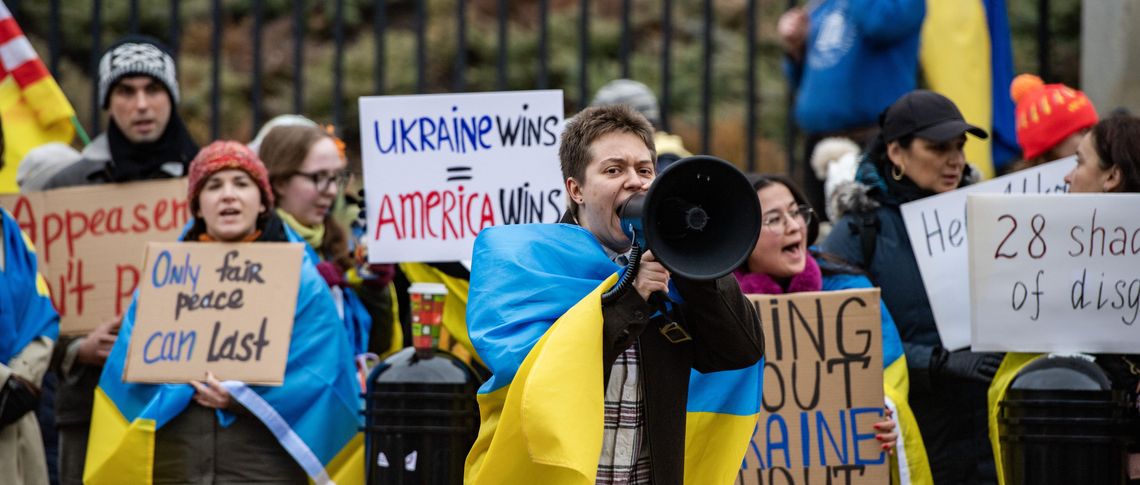
An important factor here is that the Ukrainian government has a popular mandate for these actions. The polls clearly show that there has been a change in mood, but the goal remains the same. While in 2022, the majority of Ukrainians were in favour of continuing to fight until complete victory, data from a 2025 poll conducted by Gallup and the Ratsukov Centre shows that almost 70 per cent of Ukrainians want to see a quick end to the war through negotiations. However, this is not a call for peace at all costs. Ukrainian society is ready to accept a ‘freezing’ of military operations and compromises for the sake of saving lives, but categorically does not accept recognition of occupation or territorial concessions.
On the one hand, there has been a clear increase in the number of Ukrainians supporting peace talks. The exhaustion of the civilian population from the Russian attacks and the difficult situation at the front has inevitably had a detrimental impact on the morale of the Ukrainians and their willingness to continue their resistance. That said, it would be an exaggeration to say that this is a definitive position and that the Ukrainians are willing to accept diplomacy as the only possible option, to be implemented under any circumstances.
Indeed, the same sentiment is reflected in the rhetoric of the Ukrainian political leadership. In July 2024, in an interview with the French media, President Zelenskyy made it clear that any issues of territorial integrity cannot be resolved by the president alone without the will of the people, as this violates the constitution.
Acceptable outcomes
It is also important to note the continued support for a fair peace settlement as opposed to negotiations on capitulation. As of August 2025, according to the independent sociological research organisation ‘Rating’, 59 per cent of the Ukrainians surveyed supported the end of hostilities and search for a compromise, but only on the condition that reliable international security guarantees are provided. A total of 20 per cent were in favour of continuing the war until the whole of Donbas and Crimea is returned to Ukraine by military means. Thus, more than 79 per cent of Ukrainians are not prepared to support ‘negotiations for the sake of negotiations’ and ‘peace at all costs’. Diplomacy remains a priority, but it must be reasoned and considered, not based on capitulation.
It seems the only way to make talks acceptable is to adhere to the motto ‘negotiations do not mean surrender’ – but then what exactly would they entail?
Another positive is that there is broad support for a conclusive end to Russian aggression from the majority of the world’s democratic governments and populations.
According to the polls described above, a ceasefire regime could be considered an acceptable outcome that would not require Ukraine to make territorial concessions but would allow it a break from the active phase of the conflict. Unfortunately, there has so far been a lack of clear information on the potential contours of such a peace agreement – it is perceived as a strategic and currently unattainable format. The main problem with this approach remains Moscow’s willingness to take such negotiations seriously. Essentially, Russia’s position has not changed in the last six months – the same demands for territorial concessions, the same contrived restrictions on the Ukrainian Armed Forces, the same questions about the official status of the Russian language and recognition of the Russian Orthodox Church in Ukraine.
Active negotiations with the US administration are an excellent diplomatic signal. Another positive is that there is broad support for a conclusive end to Russian aggression from the majority of the world’s democratic governments and populations. However, the level of confidence in the Kremlin’s statements is not enough to allow for complete commitment to the diplomatic formula of a full cessation of hostilities. Without a change in Russia’s position and essentially forcing it to start honest and open diplomatic contacts – in particular by transferring more weapons to Ukraine, lifting the restrictions on strikes within the territory of the Russian Federation and strengthening the exchange of intelligence – it will all be to no avail. This is why the policy doctrine of ‘peace through strength’ remains relevant for Ukraine and its international partners alike. It may also facilitate a move away from ‘negotiations for the sake of negotiations’, lending talks a more pragmatic characte