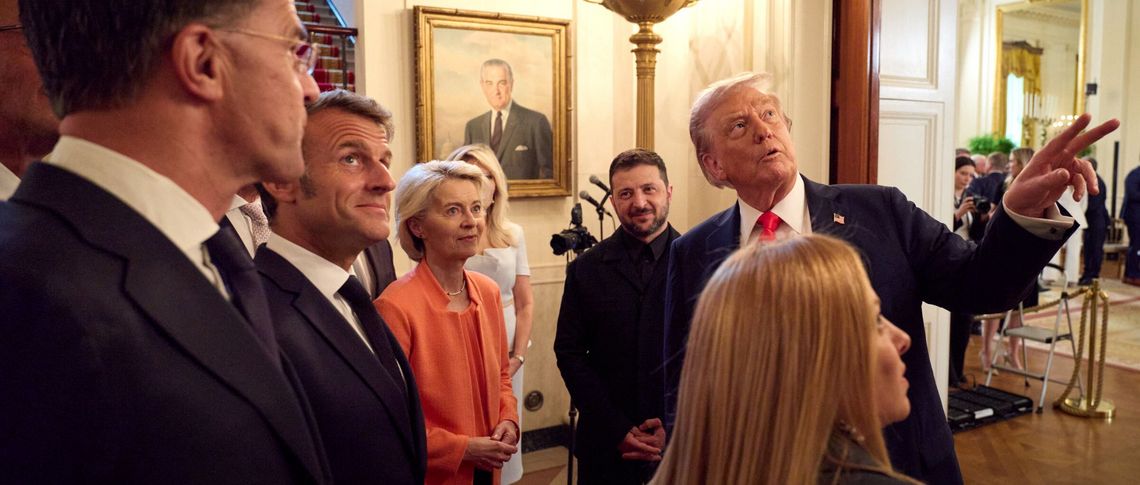
Many observers this week have focused on Steve Witkoff’s visit to Moscow and his meeting with Vladimir Putin. But it is, paradoxically, the meeting that did not take place last October that says even more about Europe’s current weak international position: the planned Trump–Putin encounter in Budapest. The mere fact that such a meeting was being considered – on EU territory but without any EU involvement whatsoever – was a humiliation in itself. The same pattern reappeared when the United States unveiled its 28-point peace plan for Ukraine, again imposing obligations on Europe without involving it at any stage of the negotiations.
Fortunately, Europeans did state their position forcefully when Trump first seized the initiative in early 2025. Europe will continue the EU accession process, arm Ukraine and maintain sanctions against Russia. But it remains reactive — and not just on Ukraine. European strategy, whether at the level of the EU, the European Allies in NATO or the Coalition of the Willing, is not proactive enough. European diplomacy ends up running after the initiatives of others. It is continually in pursuit.
The loyal ally
The main reason is that too many European decision-makers do not seem to realise that the part they are used to playing on the international scene has been deleted from the script. Europe remains wedded to its decades-old role as the most loyal ally of the US. In that logic, Europe does have to make concessions, but then a new stable relationship can be achieved with the second Trump administration. But it should be clear by now, from the way Trump treats Europe, that what he really wants is not allies but vassals. Trump and his ilk do not care about NATO, which they see as a scheme by free-riding Europeans to make the US pay for their defence. And if Trump manages to normalise relations with Putin’s Russia, as he seems itching to do, NATO becomes of lesser importance. The traditional American defence establishment still cares very much, of course — but Trump makes the decisions, not the generals and admirals. Trump does care very much about the EU, though, because he is opposed to its very existence. He is not seeking a new relationship with the EU — he wants to get rid of it.
Making concessions (the five per cent norm in NATO, the 15 per cent tariff against the EU) will only trigger demands for more concessions. Because Trump’s approach is not transactional, as everyone constantly repeats. A transaction implies give and take; Trump just wants to take. Trump’s way is a power play. That works much better if the US can deal with each European state separately, so for Trump, the EU is an obstacle. If Europe does not urgently assume another strategic role, not only will it never get anywhere with the US, and remain forever reactive — it will also undermine its position vis-à-vis all other actors. Because inherent in the role of loyal ally is that one does not make any major move without US consent. Even more problematic is the psychological effect this continues to have on much of Europe’s leadership: the habit of never acting without active US support has made many entirely risk-averse. But this precisely creates a major risk: of Europe becoming quantité négligeable in the eyes of the other powers.
This danger is not theoretical. It is already materialising in the way major powers treat Europe as a secondary actor in decisions that directly affect its own security. The 28-point peace proposal for Ukraine was negotiated over the heads of Ukraine and the rest of Europe. A plan that puts strong emphasis on the economic benefits for the US. Ever since taking office again, Trump has been attempting to negotiate with Putin. That he was going to continue trying was very plausible. Given this, it is baffling that Europe had not even prepared its own negotiating position, let alone tried to take the initiative itself. Once again, Europe is now forced to scramble in reaction to a US initiative.
What all of this shows is that the Trump Administration may be less willing to share in the responsibility for the defence of Europe, but is definitely not disengaging from Europe’s neighbourhood. Indeed, it is fast re-shaping that neighbourhood in pursuit of the American interest, with little or no thought for the implications for Europe, let alone for the need to coordinate with Europe. American and European interests often coincide, of course, but Europe cannot just passively wait and see — it must make sure that its interests are taken into account.
Where power matters
Has Europe really understood its own geopolitical situation? Europe does not pursue an exclusive sphere of influence, but it does have a sphere of interest: the area around Europe that it must seek to keep stable, and where it must therefore also have a presence — because of its markets and natural resources; because of the lines of communication to markets and resources further beyond that pass through it; and because any instability there may spill over to Europe itself. This area includes the North Atlantic and the Arctic; the entire European continent; the Caucasus, the Middle East and the Gulf; and North Africa, including the Horn and the Sahel.
Europe must decide which relationship it is willing to offer to which states in this area, in the full knowledge that great power competition and rivalry mean that other powers, allies included, will make counter-offers, and that hostile powers will punish those that take up Europe’s offer. That requires a proactive diplomacy to avoid the states in Europe’s sphere of interest from turning away from, or even against, Europe. In some parts, notably the Sahel, this has already happened, and turning this around is extremely difficult. In other areas, notably the Caucasus and Central Asia, there remains an active interest in European involvement. But Europe must also have the will and the capacity to actively support those that are targeted, through hybrid attacks or even military action, because they decide to work with it. If Europe does not have the courage to stand up for its partners, partnership should not be offered. These challenges and opportunities all require focused action.
One gets the (rather scary) impression that Europe’s top leaders feel that they are doing quite well on the international scene.
Yet even if Europe were to act more strategically and decisively, one fundamental point tends to be forgotten: power is indivisible. Just like any other (aspiring) great power, Europe will not be able to exercise its political and economic power to full effect if it does not have military power as well. Ultimately, one of the main reasons why in the Middle East, for example, the US’ word carries weight is because the US (and only the US) can deploy a carrier strike force. Vital as the survival of an independent Ukraine has become to the security of Europe, therefore, Europeans should be careful not to look only to the East. Europe must have the capacity to project military power on all of its flanks. A long-standing, but still illusory, aim of the Common Security and Defence Policy.
One gets the (rather scary) impression that Europe’s top leaders feel that they are doing quite well on the international scene. Whereas if one travels outside Europe, one immediately feels that many have just stopped caring about what Europe says — unless words are followed by actions. Treating Europe as quantité négligeable is a conscious tactic, of course, but all too often, it works. The assumption is that European trade, investment, and aid will continue to flow anyway, or that Europe will always fall in line with the US. Why bother then to sincerely negotiate with a player that never quite acts as a real power? Why, indeed.
This is a shortened version of the original article published by EGMONT.