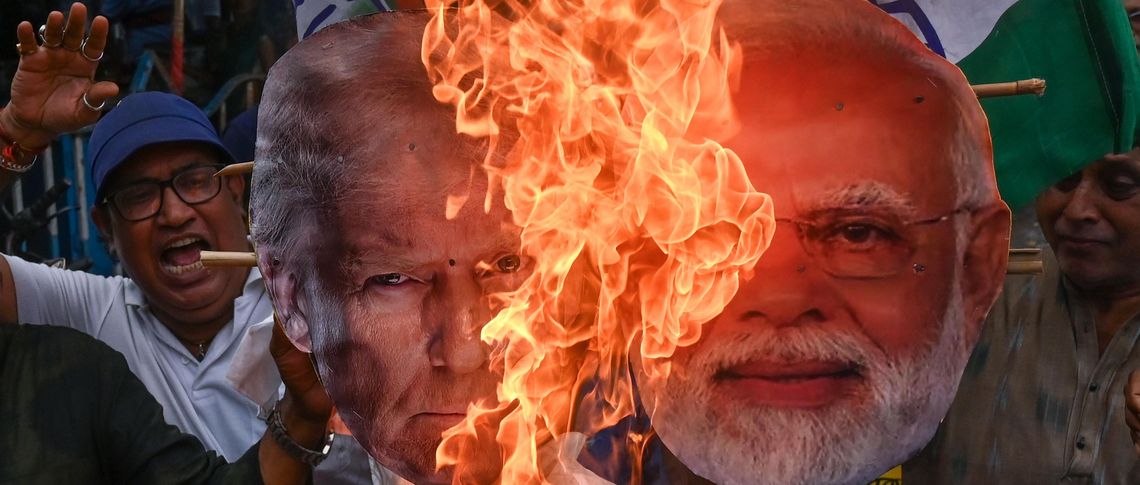
Just a few years ago, Donald Trump was seen as a reliable partner in New Delhi. With his high-profile appearances in Houston in 2019, under the slogan ‘Howdy, Modi!’, and in Ahmedabad in 2020, this time it was ‘Namaste, Trump’, the Indo-American partnership reached a symbolic level that suggested equality and mutual respect. Common interests in the Indo-Pacific, growing technology transfer and mutual investments seemed to pave the way for deeper strategic cooperation.
But even during Trump’s first term, trade issues remained a sore point in bilateral relations. Many publicly announced agreements fell short of expectations. Still, this phase brought progress in defence cooperation. Trump’s second term, on the other hand, means less continuity for India and much more of a break, for which New Delhi seems unprepared for. The announced tariffs will hurt India in the short term, but in the long run, Washington may lose more than New Delhi.
Falling from grace
The break took place in several stages. First, in the spring of 2025, Trump presented himself as a mediator in the brief but intense conflict between India and Pakistan — a role that New Delhi decisively rejected. Just a few weeks later, there was a massive trade policy U-turn: in response to India’s continued oil imports from Russia, Washington doubled import duties on Indian products from 25 to 50 per cent.
US President Donald Trump recently described the Indian economy as a ‘dead economy’ and criticised New Delhi’s trade practices in his usual sharp rhetoric. In several public statements, he questioned India’s economic performance and accused the government of a lack of cooperation in bilateral trade. The latter is understandable, as India can indeed be a difficult trading partner — mainly due to its protectionist approach. Trump also cooperated with Pakistan in a manner that attracted public attention.
This meant that India went from being a privileged partner to a target of trade policy, while other countries such as China and Turkey faced hardly any consequences for similar behaviour in purchasing Russian energy sources. At least, that is the Indian perspective. The message was clear: in Trump’s second term, values and previous partnerships do not count, only usefulness — definable by Donald Trump.
It is becoming clear that, with the exception of China, there is no other centre of power that could respond to the former hegemon’s change of course and take effective countermeasures, for example in the customs dispute.
India, which benefited from special arrangements and symbolic gestures during the first term, is now experiencing a foreign policy that is transactional to the extreme. Whether Trump actually wants to increase pressure on Russia to end the war in Ukraine and risk relations with India in the process remains to be seen. One thing is certain, however: America’s role has changed dramatically.
For decades, the United States was the backbone of the liberal world order — militarily, economically and institutionally. The transatlantic alliance formed the normative core. Washington guaranteed security structures, defended multilateral institutions and shaped the rules of globalisation. All that is now over. The rules-based international order that was established after 1945 under US leadership is thus losing its central guarantor, and the world is at a historic tipping point. On the journey from multilateralism to multipolarity, we currently find ourselves in limbo — in an interregnum. New alliances, uncertainties and rivalries are emerging between the emerging power centres. At the same time, it is becoming clear that, with the exception of China, there is no other centre of power that could respond to the former hegemon’s change of course and take effective countermeasures, for example in the customs dispute.
Trump’s protectionist revival with punitive tariffs underscores the demise of the existing order. India is not spared from this, yet it does not currently have the capacity to respond appropriately. The latest US measures specifically target products of strategic relevance to India. This signals that even supposed geopolitical partners no longer enjoy economic preferential treatment under American doctrine.
India is under structural pressure in this emerging order. On the one hand, the country is increasingly acting as a self-confident geopolitical player: with a growing economy, a young, dynamic population and a government that positions itself as the voice of the Global South. New Delhi claims an active role in reshaping international order structures, but has also benefited greatly from a rules-based order.
Unlike China, which has built up a robust export architecture over decades, India does not yet have comparable levers to respond flexibly to external pressure or build up countervailing power.
On the other hand, this ambition remains limited in important sectors due to real vulnerabilities and a lack of power resources. India continues to be heavily dependent on global supply chains in technologically critical areas such as semiconductor production, civil and military aviation, pharmaceuticals and the energy sector. Its own industrial policy, for example within the framework of the Production Linked Incentive Programme, is ambitious but not yet capable of ensuring strategic self-sufficiency in the short term. Added to this are structural weaknesses: a fragmented industrial base, an oversized informal sector with low productivity, and a relatively narrow export diversity by international standards.
Only a few industries – primarily IT services, pharmaceuticals and jewellery – contribute significantly to export volume. At the same time, many of these sectors are not resilient to protectionist measures. This economic asymmetry makes New Delhi particularly vulnerable to external shocks such as the sudden increase in US tariffs. Unlike China, which has built up a robust export architecture over decades, India does not yet have comparable levers to respond flexibly to external pressure or build up countervailing power.
Stepping up to the plate
And yet, it is precisely this moment of geopolitical shock that also presents a strategic opportunity for New Delhi. The current upheavals could encourage the country, as it continues its rise, to pursue existing initiatives to diversify its foreign trade partnerships with even greater vigour. The intensification of relations with the European Union, for example through the desired conclusion of negotiations on a free trade agreement, is an expression of this reorientation. India’s openness towards economic and strategic partners such as Indonesia, Vietnam and the Gulf states also demonstrates its strategy of broadening its base.
At the same time, there is a growing willingness to engage in tactical rapprochement with geopolitical competitors such as China. Although there are deep structural differences, from border conflicts to diverging interests in the Indo-Pacific, selective cooperation is also becoming an option in a world of relative instability. The extent to which this is true could already become apparent at the upcoming summit of the Shanghai Cooperation Organisation, which Indian Prime Minister Narendra Modi is also expected to attend in person. India is not seeking to belong to a bloc, but wants to preserve its strategic autonomy by expanding its options.
What is seen in Washington as a sign of strong leadership is in reality a foreign policy blunder. India is on its way to becoming one of the decisive powers of the 21st century — militarily, economically and geopolitically. Weakening this country through tariffs undermines one’s own global relevance and will damage bilateral relations in the medium and long term. Trump is reducing the last 25 years of trust-building to absurdity with a coup de main. The Americans could also unconsciously change the strategic perspective on BRICS and contribute to a rapprochement of positions within this alliance.
Anyone considered unreliable in New Delhi will lose influence in a key state of the developing global order.
The United States’ status as India’s preferred partner has not been a given since August 2025 at the latest. It will have to be renegotiated in the future, because pressure and threats achieve nothing in India. This could cost Washington dearly in its systemic competition with China. Anyone considered unreliable in New Delhi will lose influence in a key state of the developing global order — a player that is becoming increasingly important as an economic and security counterweight to Beijing and as a bridge builder in the Global South, even if it is likely to lose out in the short-term tariff dispute.
India will continue to diversify its foreign, economic and trade policies towards the EU, ASEAN, the Middle East and the Global South. And also towards China, if it serves its own interests. In an increasingly volatile world, trust and reliability have become strategic resources — and the US is currently squandering them in New Delhi.