


The United States’ attack on Venezuela marks a key watershed in the world order. We still cannot predict how this violation of another state’s sovereignty will ultimately play out. But it has called into question the global order that is founded on sovereign equality. Experts talk of ‘imperialist imitation dynamics’ and a return to spheres of influence — a world where the major powers call the shots and smaller states have no choice but to toe the line.
There is one dynamic fuelled by the US intervention in Venezuela that we can’t ignore: countries in the Global South, especially middle powers, have begun to stand up for their interests more assertively, more strategically and in a more coordinated way. Not through open confrontation, but through a combination of flexibility, adaptation, diversification and tactical pushback. Far from all countries in the Global South have openly condemned the American attack on Venezuela, but they have all at least expressed concern about what happened in South America. These events made clear how quickly military force can now be used to enforce a country’s interests, without any regard for the fundamental principles of the international order — and how limited their own options, especially military ones, actually are.
Containment and political autonomy
That is exactly why Latin America’s strategy is one of diplomatic containment, making efforts to reach a pragmatic agreement with the United States. Last year, Donald Trump and Colombian President Gustavo Petro engaged in a fierce war of words. The tensions only worsened after the US attack on Venezuela, and Trump threatened Colombia with military action. Once the two leaders spoke over the phone, the situation began to cool. Petro is now preparing to meet Trump face-to-face in the United States. This shift from public confrontation to direct dialogue reflects a deliberate strategy of containment in the face of an imbalanced power relationship: pressure should be funnelled into managed, personal diplomacy to prevent things from escalating.
Alongside Colombia, Cuba and Mexico have found themselves in the American firing line, with the US adopting a noticeably harsher tone towards both countries. Cuba responded with a carefully calibrated strategy, showing it was willing to engage in dialogue and improve bilateral relations, while emphasising the importance of treating each other with respect on an equal footing. Political concessions were explicitly ruled out. This can be seen as a sensible two-pronged approach — easing tensions while firmly defending sovereignty.
The Mexican President took a more pragmatic course when under pressure from Washington. Claudia Sheinbaum made only some targeted concessions, especially on key security and trade policy issues, such as taking tougher action against smuggling rings and raising tariffs on Chinese imports, to avoid escalation. But she stuck to her guns on the judicial reform that was criticised by the United States and on increasing energy subsidies for Cuba. With its government openly condemning the US intervention in Venezuela, Mexico is pursuing a steady, measured path in its diplomatic relations: limited concessions coupled with political autonomy. But whether this strategy will work in the long term remains to be seen, not least in view of Trump’s unpredictable and erratic nature.
Diversifying foreign relations has become the Global South’s core strategy to reduce dependency and shore up political autonomy in times of global uncertainty.
There is no reason to think that China and Russia – as the other great powers – could be relied on as military counterweights in the Western Hemisphere. Neither has any military bases there, nor are they bound by any explicit mutual defence obligations involving military action. Russia’s cooperation with Venezuela was limited to providing political support and supplying weapons and air-defence systems. This has given Latin America little choice other than de-escalation and dialogue with the United States, combined with asserting their right to make their own decisions.
The situation is similar in India. New Delhi responded to the American attack on Venezuela with a strikingly restrained statement, expressing ‘deep concern’. This drew sharp criticism domestically, with the opposition warning of setting such a precedent and that what happened to Venezuela could happen to any other country, including India itself. The Global South is known for pursuing this diplomatic flexibility, deliberately diversifying its foreign and economic relations. This is not dissimilar from the multi-vector strategy that Central Asian states under the influence of Russia and China have successfully practised for decades. India is a prime example, maintaining strategic relations with the United States while remaining closely tied to Russia on defence policy. New Delhi is currently on the verge of concluding a free-trade agreement with the EU and is stepping up its security and defence cooperation with European countries.
These trends can be seen in Latin America, too. It is no coincidence that the EU–Mercosur agreement – recently signed after more than 20 years of negotiations – comes at a time when both the EU and South America are under pressure from US trade and tariff policies. In the same vein, Colombia joined China’s Belt and Road Initiative in 2025. The Colombian President recently travelled to Saudi Arabia, Qatar and Egypt, and articulated the strategic logic behind this: Latin America’s path does not lie in joining a power bloc, but in building its own autonomous growth pole. Diversifying foreign relations has become the Global South’s core strategy to reduce dependency and shore up political autonomy in times of global uncertainty.
A notably independent stance
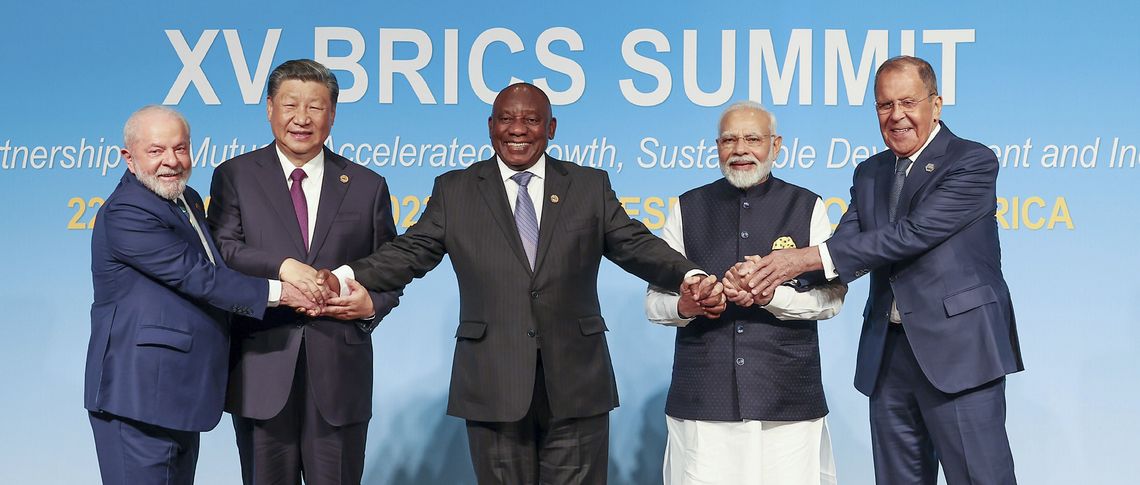
The clearest pushback so far has come from Africa. Several states there responded to the US attack not with open confrontation, but by taking symbolic and politically meaningful steps to distance themselves. South Africa’s ruling party condemned the aggression against Venezuela, with the country’s representative to the United Nations criticising the breach of core principles of the UN Charter and stressing the importance of sovereignty, non-interference and conflict resolution through diplomacy. This message was underlined by conducting joint naval exercises almost simultaneously off the South African coast with several BRICS states, including Russia, China and Iran. At the opening ceremony, the commander of the South African joint task force stated that the drills were more than just a military exercise; they were also a political declaration of their intent to work more closely together in an increasingly complex maritime environment. BRICS could well take a tougher position on security policy in the future — not necessarily in the form of a military alliance, but by expressing their strategic autonomy in the face of Western dominance.
As much as US behaviour might bring 19th-century gunboat diplomacy to mind, the world is a very different place today.
Ghana, a country that has traditionally maintained close relations with the United States, also took a notably independent stance. Accra voiced clear reservations about the unilateral military action and warned of setting a dangerous precedent that could undermine the security of smaller states in particular. The African Union argued along similar lines and is so far the only regional organisation to have agreed on a common position. It is no surprise that African countries have taken a relatively forthright stance, given that so many of them have been deliberately broadening their security and economic partnerships for years. China is now a key economic player in Africa, while Russia has expanded its military presence and security cooperation. Moscow is currently preparing to host this year’s third Russia-Africa summit — a special form of cooperation previously reserved for Russia’s Central Asian neighbours.
As much as US behaviour might bring 19th-century gunboat diplomacy to mind, the world is a very different place today. The traditional concept of spheres of influence assumes that weaker states will remain passive, something that the Global South is increasingly proving wrong: these countries are flexible and adaptable in their diplomatic relations, they consciously hedge their strategic bets, and they cooperate with multiple major powers at the same time, without allying themselves too closely with any one of them.
The spheres-of-influence narrative also underestimates the role of regional organisations, such as ASEAN, Mercosur, the African Union and the Shanghai Cooperation Organisation, as well as transregional groups like BRICS. These unions increasingly function as collective platforms that act as a buffer from external pressure, create greater leverage in negotiations for smaller states and throw a spanner in the works of great powers trying to assert their dominance. The Global South is not a homogeneous bloc, nor is it merely a playing field for geopolitical rivalries. Many countries are exploiting the chaotic and fragmented world order to express and pursue their interests more assertively. The American operation may work as a power play in the short term, but in the long run, it could end up creating a more pluralistic and less hierarchical world order much more quickly.


