


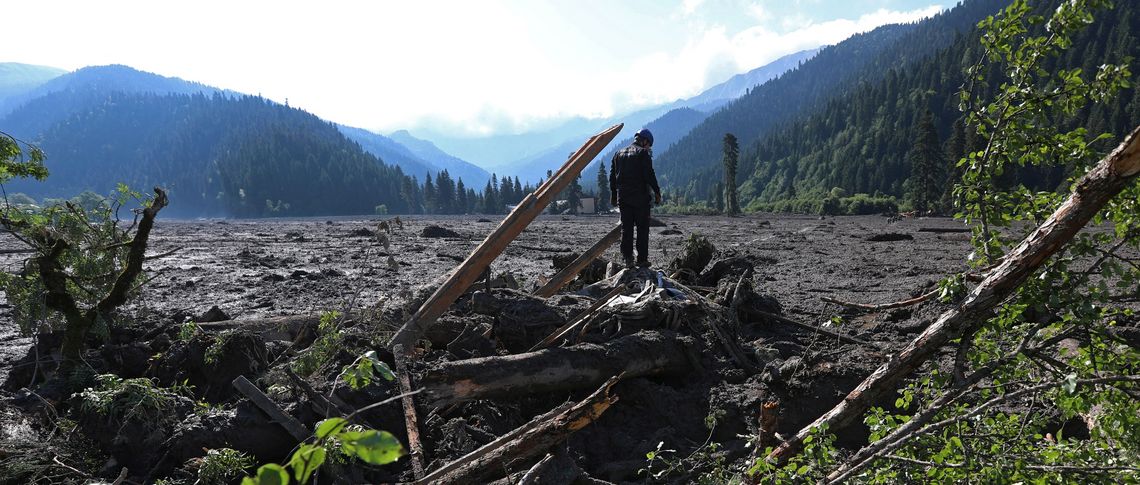
Last month, Georgia experienced several abnormal phenomena caused by climate change. One of the most tragic disasters in recent years occurred on 3 August in the mountain resort of Shovi: a landslide. The mudflow that covered the popular holiday village killed more than 30 people and crippled the fates of many who lost relatives, friends and loved ones. Climate change was one of the reasons for the disaster, but civil society organisations also drew attention to the authorities' lack of preparation to both anticipate and promptly deal with natural disasters.
Later, on 29-30 August, Tbilisi was hit by a heavy downpour. According to the National Environmental Agency, the amount of precipitation that fell in the Georgian capital in the course of the evening was twice as much as during the flooding of 13 June 2015. Back then, at least 20 people died as a result of the overflow of the Vaka River, and the Tbilisi Zoo was destroyed – animals had to be captured all over the city.
An expected tragedy
Analysis of satellite data showed that extensive melting of snow had occurred in the area of the landslide a week before the tragedy. Also, due to long-term glacier melting caused by climate change, there was a build-up of mudflow and further landslide conditions in the river valley. The combination of these factors caused the formation of a powerful mudflow that led to the tragedy.
The National Environment Agency, in an official statement, also noted the role of the melting glaciers, but repeatedly stated that such landslides had not previously been recorded in the Shovi area and therefore were not expected.
Thus, according to both official and independent sources, the landslide was caused by abnormal phenomena caused by climate change. But these phenomena cannot be called unexpected – they were preceded by a long period of glacier degradation in the Caucasus. As noted by Georgian geologist Levan Tielidze, back in 2018, the landslide that came down was located in a stable glacier zone. But in six years, this section of the Tbiliso glacier has practically melted away, which led to the collapse of rocks. The fact that the melting process was intensifying had been known for more than five years.
Studies have shown that over the past five decades, the Tbiliso Glacier has lost 31.5 per cent of its area.
Analyses of glaciers in the Caucasus conducted by geologists clearly showed an intensive melting processes, which, in particular, led to the release of water masses and changes in the landscape. This included the activation of landslides.
On the one hand, the water released as a result of glacier melting is a resource for local communities, ecosystems and hydropower. But on the other hand, it poses a significant danger, as it can lead to rock slides, mudslides and flooding. If we add to this the high volume of precipitation that fell in Georgia this year and the high temperatures, we have a dangerous combination which led to the tragedy.
Studies have shown that over the past five decades, the Tbiliso Glacier has lost 31.5 per cent of its area. Obviously, with the exposure of rocks and high temperatures, melting will increase during the summer period, which is highly likely to lead to new landslides. It is also important to remember that Buba and Tbiliso are not the only glaciers in Georgia. The danger could affect all high-altitude regions of the country.
As Global Forest Watch shows, deforestation has indeed increased in Georgia in recent years.
In addition to the melting of mountain glaciers, experts cite several other reasons for the tragedy: deforestation, as well as the lack of an early warning system and effective rescue methods during natural disasters.
Forests are indeed an important element of climate change adaptation and landslide prevention. Trees not only hold back rocks and strengthen river banks, but can also act as a buffer zone in the event of a landslide threat. A resilient, healthy forest can protect human settlements by offering protection from mudslides.
As Global Forest Watch shows, deforestation has indeed increased in Georgia in recent years. And while it is not as noticeable on a country-wide scale, individual regions are significantly affected by intensifying tree loss. Nevertheless, it is not (yet) possible to speak about the disappearance of forests in Georgia. And still, in the period from 2000 to 2022, forest losses totalled 18 thousand hectares, while 93.5 thousand hectares were restored. Most of the forests – 3.4 million ha – remain stable.
In the Chauvy area, there has been no large-scale logging in recent decades that could have caused significant forest degradation or prevented forests from fulfilling their landslide-protective role. On the contrary, as a result of climate change and global warming, trees are beginning to climb higher up the mountains.
Still, this does not negate the need for a separate analysis on how the development of holiday cottages may have influenced the formation of the river channel. Were the conditions favourable to the accumulation of debris flow created by infrastructure development? Lack of sustainable planning and chaotic land use are perhaps some of the main challenges in Georgia on the path to climate change adaptation.
Could the disaster have been avoided?
This is perhaps the main question that has sparked debate between the government and civil society representatives. In the first days after the tragedy, Georgian civil society organisations and activists criticised the government's actions to prevent and avoid the disaster.
In particular, attention was drawn to the presence of only two rescue helicopters and the understaffing of rescue equipment. The government was also criticised for its sluggishness in responding.
How time-efficient the response was is difficult to comment on. However, the likelihood of a landslide in a river valley formed by intensely melting glaciers in August, when melting rates are highest, was to be expected. If not on 3 August 2023, then on another day. Perhaps a month or a year later. It wasn't a complete surprise.
With a proper level of monitoring and modelling, with high awareness of the population and special services, the tragedy could have been, if not avoided, at least mitigated.
The lack of coordination between scientists and government agencies, the lack of monitoring and early warning systems for disasters, of staffing of rescue equipment (having only two helicopters instead of four) - these were all issues that civil society actors pointed out to official institutions and the government and demanded immediate solutions.
With a proper level of monitoring and modelling, with high awareness of the population and special services, the tragedy could have been, if not avoided, at least mitigated. A more detailed and continuous study of glaciers would have provided information on the probability of a landslide. In turn, the knowledge that melting processes caused by climate change are underway would allow for more careful management of the resort area. This could be done, for example, by developing an action plan in the event of a landslide or by reinforcing the river banks to prevent the development of a mudflow. These are exactly the tasks that Georgia should prioritise today.
The disaster in Shovi was the loudest ringing of the climate change bell, but we will hear more and more of these abnormal natural phenomena, be it heat waves or rains, all over the world. We must adapt and be prepared for possible disasters. This preparedness does not mean living in fear or panic. It means taking a closer look at possible consequences and finding solutions. States must raise the issue of adaptation to climate change more actively. This should happen both at the level of government and civil society.


