‘…I see the Tiber foaming with much blood’, Virgil writes as a dark premonition of the end of the Roman Republic. Two millennia later, another republic is stumbling: the Islamic Republic of Iran. And it, too, seems destined for anything but a peaceful end. Once consolidated through literal rivers of blood, it now, at almost 47 years of age, faces perhaps its greatest challenge yet: a population in which an ever-growing majority sees no prospects and no future, and which is rising up en masse for the fifth time since 2009 against a rigid, ossified theocratic leadership.
Challenges, of course, are nothing new for this republic with its claim to world-historical significance. Once, it positioned itself against both East and West, fighting alone against a vastly superior adversary. ‘Many enemies, much honour’ long served as its motto, as long as God was on its side. But that is now uncertain. Almost five decades of a God-state have produced what is probably the most secular population in the Middle East. In this sense, the old criticism levelled by Shiite quietists against Ayatollah Khomeini has been vindicated: that the direct fusion of religion and state corrupts both alike.
A republic on the edge
‘This time is different’ — or so one hears in many places. It is said to be not just another crisis through which the Islamic Republic is passing, but a polycrisis that, with some probability, heralds its end. Indeed, a great deal is coming together at once. Militarily, geopolitically, economically, fiscally, socially and politico-ideologically, those in power in Tehran are backed into a corner. External and internal threats appear to be converging. The republic can scarcely escape crisis mode. But does all this lead, as not a few people in the West are hoping, to a clean break: the end of the God-state and Iran’s national rebirth as a secular, possibly pro-Western regional power?
Scepticism is warranted. The historian Afshon Ostovar considers the situation ‘entirely unpredictable’, seeing effects of the protests that could move in ‘drastically different directions’. The only certainty at present is the inevitability of change. The status quo itself is, in fact, unsustainable.
The social and ideological base of the regime is steadily shrinking, but it still exists.
What began shortly before the turn of the year as smaller, economically motivated protests has, since the middle of last week, grown into a large-scale movement with a clear political edge. Not least among the factors contributing to this have been the calls by Reza Pahlavi, the son of the last Shah, who was overthrown in 1979. His name clearly resonates within the country — not only because it evokes a supposedly better past, but also because the rest of the opposition has failed, in almost five decades of exile, to build anything resembling viable structures. This is the opposition’s great weakness. Unlike the Islamists in 1979, it has hardly any organisations or networks robust enough to take over an entire state.
Recent regional history is full of uprisings that either failed or ended up reproducing the old order. Yet looming like a warning beacon in the night sky over Tehran is something else entirely, and something that is by no means unfamiliar in the Middle East: state collapse and civil war.
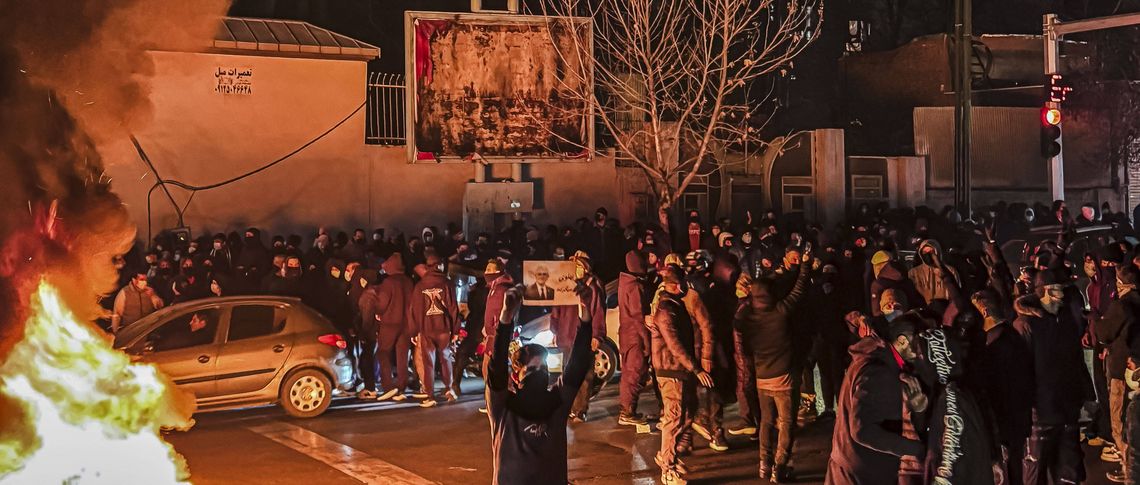
The protests themselves offer a foretaste of the latter. In marked contrast to the Woman, Life, Freedom movement of 2022, these protests can certainly be described as prone to violence. Videos smuggled out despite the regime-enforced internet blackout show above all young and very young protesters, mostly male, dressed in black hoodies and masks. Government buildings are set ablaze, as are mosques time and again. Pahlavi himself, whose name echoes here and there, is calling on demonstrators to seize and defend city centres in direct confrontation with the security forces.
A path beyond violence?
It is, however, questionable whether street battles rather than peaceful demonstrations are really the method of choice against a heavily armed and brutal security apparatus. It is, at the very least, a risky calculation. Over time, it is difficult for security forces to keep shooting at peaceful protesters, especially when they come from their own people, possibly even their own families. But when the streets resemble a war zone, the Islamic Republic is being engaged precisely where it is most effective: in the use of violence.
The central question, of course, is that of the regime’s resilience. How stable is it in the face of this polycrisis? So far, at any rate, there has been no notable rupture within the power elites. The apparatus of repression is functioning with terrifying efficiency: several hundred deaths since the start of the year are already a realistic estimate, with more than 200 in Tehran alone by the end of the week. We do not know the exact figures. The internet blackout, and a situation in which information and disinformation are increasingly hard to distinguish, only add to the uncertainty.
What is clear, however, is that this is not simply a case of people versus dictatorship. Reality is more complex. Even now, the regime is still capable of mobilising tens of thousands for rallies of acclamation. Hundreds of thousands are organised in the paramilitary Basij units, the regime’s thugs. In the last presidential elections, marked by a broad boycott, 13 million people nevertheless voted for the arch-conservative hardliner Saeed Jalili. The social and ideological base of the regime is steadily shrinking, but it still exists. Those who ignore this do so at their own peril.
History has not been kind to externally induced regime change.
‘Assad or we burn the country down!’ — this was a widespread slogan among regime loyalists in Syria. It could easily be applied to the Islamic Republic. Among those who still associate the regime with an ideological mission, a high degree of willingness to sacrifice can be assumed. Martyrdom has a long tradition in Shiite Islam. The torching of mosques by some protesters may therefore be more likely to mobilise than to deter. For the Islamist elites, however hypocritical many of them may be, it is clear that their lives and survival depend on the continued existence of the Islamic Republic. Unlike the monarchist leadership strata in 1979, they have no prospect of a comparatively comfortable exile, given their state’s extensive isolation. The strategy of violently bringing down the Islamic Republic, therefore, entails, at the very least, the risk of a substantial blood toll.
External intervention is no less risky. Even if the logic of helping the protest movement from outside against a brutal apparatus of repression seems compelling at first glance. It did in Libya, too. History has not been kind to externally induced regime change. The use of air power to support street protests is almost without precedent. And it should be clear what that would mean: not a surgical strike against the command centres of the Revolutionary Guards, but war. Very likely regional escalation. Iran still possesses, alongside its long-range missile arsenal reduced in June, a considerable stockpile of short-range missiles — enough to target the Gulf and Iraq, and the US bases there. Unlike in the Twelve-Day War, when Tehran recovered quickly after the first 48 hours and did not allow the confrontation to escalate excessively, an Islamist regime operating under an endgame logic could be prone to making unilateral decisions.
Not least for this reason, American sabre-rattling in the region is meeting with little enthusiasm. From Saudi Arabia’s perspective, Iran is no longer the beast it once was, but an ideologically exhausted state whose decline needs to be managed rather than allowed to end in a fireball. A regime locked in a martyr-like final struggle, mobilising its last allies, is the very definition of a nightmare. No less nightmarish would be a state of 90 million people collapsing entirely under the weight of internal and external pressure, possibly with civil war-like conditions and secessions along ethnic and confessional lines, with the potential to destabilise the entire region. If the state collapses in Tehran, why should Kurds and Baluchis – the stepchildren of Persia – wait until it reconstitutes itself?
The strategy of violently overthrowing the regime could backfire spectacularly — at a price that the Iranian people would have to pay in blood.
It goes without saying that a power and state vacuum between the Caspian Sea and the Persian Gulf would draw in all other regional powers. Riyadh would be no more of a bystander than Abu Dhabi, Islamabad, Ankara or Baku. Not to mention Tel Aviv. In the midst of it all would be a country that remained a nuclear threshold state, with 400 kilograms of missing highly enriched uranium and far advanced nuclear know-how.
On the side of the former crown prince in particular, the understanding of risk appears strikingly abstract. Politics should be more than social media posts and calls for bombardment from the safety of American exile. The strategy of violently overthrowing the regime could backfire spectacularly — at a price that the Iranian people would have to pay in blood. The more violent the confrontations become, and the greater the brutalisation, the fewer people will take to the streets. A more promising approach might be to initiate the regime’s agony more gently: by insisting on non-violence; by creating the broadest possible opposition alliance, one in which the vast majority of Iranians can see themselves and which also shows openness towards reform-minded forces within the Islamic Republic. The aim must be maximum inclusivity in the alliance against the ageing dictator, not doctrinal purity. And by securing, with public visibility, assurances from the Americans that sanctions would be lifted in the event of a transition.
If history is any guide, regimes fall when parts of the old elites switch sides, and the security apparatus refuses to shoot at its own people. When the logic of violence and revenge – which is, not least, the logic of the Islamic Republic – can be broken.
The rivers of blood that are looming on the horizon need not become reality. In Virgil’s time, the turmoil at the end of the Roman Republic was followed, incidentally, by the rule of Augustus, which ushered in a period of stability and high culture for Rome. The best is yet to come — inshallah, for Iran too.