In 1939, the German writer Thomas Mann published his essay ‘Brother Hitler,’ in which he rejected the comforting myth of Adolf Hitler as a superhuman monster. Instead, Mann portrayed Hitler as a mediocre, lazy failure whose destructive power stemmed precisely from his ordinariness. Incapable of sustained work and overwhelmed by the demands of everyday life, Hitler nonetheless possessed one extraordinary skill: the ability to ensorcel and mobilise crowds.
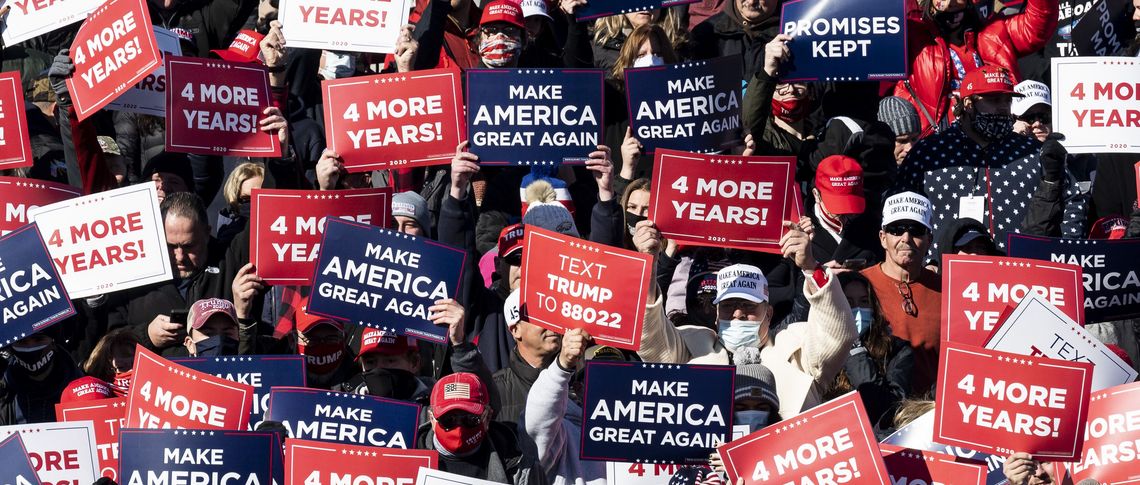
How, then, could someone so unremarkable win over a society as educated and sophisticated as Germany’s? Mann’s answer was that democratic politics is never purely rational. Beneath its institutions lies a more primitive layer, one that rewards those who can seize voters’ attention and steer emotion, often at the expense of complexity and substance. As US President Donald Trump continues to assert his dominance over political discourse in the United States and much of the world, Mann’s essay – along with The Magic Mountain, his interwar masterpiece – offers valuable lessons. Mann’s central insight is that figures like Hitler do not succeed because they are exceptional, but because they activate dispositions that already exist within democratic societies. Trump, in this sense, is the product of a shared preference for cheap spectacle and a desire for belonging that too often overrides critical thinking.
Another mechanism Mann described is the transformation of personal grievances into matters of national honour.
Several of the mechanisms Mann identifies as responsible for Hitler’s rise remain painfully relevant today. For starters, lies and fictions need not contain a kernel of truth; they simply have to spread quickly and appeal to feeling rather than reason.
In the Trump era, the key question isn’t what actually happened, but whose version of events is amplified most aggressively through social media. Consider, for example, the fatal shooting of Alex Pretti, a 37-year-old intensive-care nurse and US citizen, by Border Patrol agents in Minneapolis. In the immediate aftermath, top administration officials, including Homeland Security Secretary Kristi Noem, claimed that Pretti had attacked the agents and labelled him a ‘domestic terrorist.’ These claims circulated rapidly and continued to do so even after video footage and eyewitness accounts contradicted them.
Another mechanism Mann described is the transformation of personal grievances into matters of national honour. Trump’s threats to seize Greenland by force offer a striking example. According to his letter to Norwegian Prime Minister Jonas Gahr Støre, he was motivated at least partly by resentment over not receiving the Nobel Peace Prize.
Mann argued that the success of demagogues depends less on strategic brilliance than on favourable circumstances and, above all, a lack of resistance. By refusing to mythologize Hitler as a political mastermind, he showed how institutions – and the people within them – gradually give way, dismissing intimidation as mere rhetoric until it hardens into normal practice.
But Mann did not argue that all humans are evil. Rather, he insisted that figures like Hitler rise to power when those dark impulses are repeatedly fed and rewarded.
One finds no consolation in Mann, because he offers none. He called Hitler ‘brother’ to underscore the fact that fascist demagoguery relies on impulses that exist within us all. Similar insights animate Joseph Conrad’s Heart of Darkness and David Lynch’s Twin Peaks: darkness is both external and what confronts us when we look in the mirror. Viewed through this lens, Trump functions as a kind of safety valve, easing the pressure to appear virtuous and allowing his supporters to cheer for brute force, domination, and revenge.
But Mann did not argue that all humans are evil. Rather, he insisted that figures like Hitler rise to power when those dark impulses are repeatedly fed and rewarded. The spectacle works only if we supply the energy.
The pleasure of moral abandon and the intoxicating effect of brutality can end in mass graves. My own city, Gdańsk, knows all too well what happens when populist rule is allowed to run its course. When the historian Timothy Snyder described this region as the ‘Bloodlands,’ he was not reaching for a metaphor but stating a historical fact. It was here, at Westerplatte, that the opening shots of World War II were fired in September 1939.
Yet Gdańsk is not only a symbol of catastrophe. It is also the birthplace of Lech Wałęsa’s Solidarity movement, which played a decisive role in the collapse of communism in Europe. That history of grassroots resistance may resonate with the residents of Minneapolis. Given their organised response in the face of Immigration and Customs Enforcement-led violence masquerading as federal immigration enforcement, Minneapolis may become for the US what Gdańsk once was for Poland and Central Europe, demonstrating how civic activism can resist the normalization of official brutality.
That same struggle for the soul of the world is now playing out in many places, from Ukraine to the streets of America’s major cities.
To be sure, the struggle against the dark impulses that animate Trumpism is never-ending. In The Magic Mountain, the battle for the soul of the naive young protagonist Hans Castorp is fought between two rival mentors: Lodovico Settembrini, who represents democracy and the emancipatory power of reason and science, and Leo Naphta, whose revolutionary rhetoric masks a reactionary logic that embraces terror, violence, and war.
That same struggle for the soul of the world is now playing out in many places, from Ukraine to the streets of America’s major cities. Its outcome is not predetermined. While humanity has a dark inheritance, it also has an innate capacity to learn and change. For that to happen, however, we must first do what Mann asked of us: recognise our kinship with those who succumb to authoritarian temptation and accept that we are made of the same material. Only such moral awareness can prevent the demagoguery and repression that defined the 20th century from prevailing again.