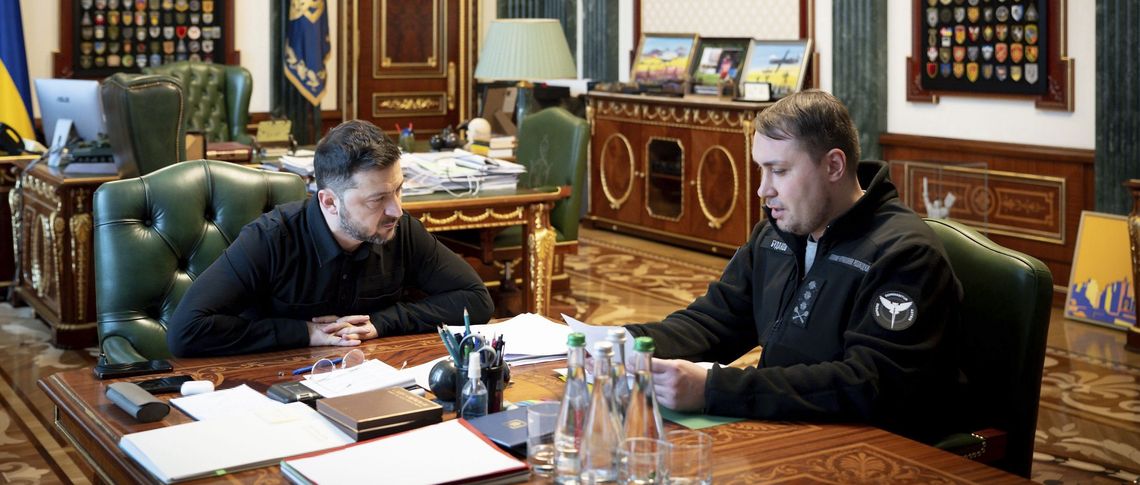
Ukraine entered the new year with a sharp institutional reset at the very top of power. On 2 January, President Volodymyr Zelenskyy appointed Kyrylo Budanov as head of the Office of the President, with combat commander Pavlo Palisa becoming his deputy. At the same time, Oleh Ivashchenko was named chief of military intelligence (HUR), while Mykhailo Fedorov was appointed minister of defence, replacing Denys Shmyhal, who moved to the energy portfolio as vice prime minister.
These decisions amount to the most far-reaching reconfiguration of Ukraine’s security and power architecture since the start of the full-scale invasion. Whether this represents deeper securitisation of the state or preparation for a political transition is the central question now facing Kyiv.
Power reset at the top
The changes followed the resignation of Andriy Yermak as head of the presidential office at the end of November. Zelenskyy did not rush the succession. This partly reflected the intensity of negotiations with the United States at the time, but it also suggests the president needed space to recalibrate his inner circle after the departure of his closest and most trusted aide. Within weeks, Yermak was reportedly back in the loop — consulted and kept informed, though no longer managing daily operations.
Budanov was widely seen as a frontrunner even before Yermak’s exit. Yet according to multiple accounts, he initially declined the president’s offer. In the weeks before the reshuffle, Budanov was among the very few officials meeting Zelenskyy without the head of the Office present — an unusual signal in Kyiv’s tightly managed power system.
The eventual appointment reflects political necessity as much as personal choice. With Zelenskyy’s electoral potential in gradual decline, Budanov offers something the president needs: a figure who can help stabilise the domestic situation while strengthening Kyiv’s standing with Washington. Polling suggests that both Budanov and former army chief Valerii Zaluzhnyi would defeat Zelenskyy in a second round. For now, the president’s ratings are holding, helped by his insistence on securing the best possible deal with the United States, including security guarantees. But Ukraine is slowly losing the war of attrition, and that reality is reshaping domestic politics.
The backdrop to Yermak’s departure helps explain the intensity of the current struggle.
In this context, Budanov serves several functions at once. He offers political cover at home – though at the price of creating a latent dualism with Zelenskyy that could ultimately complicate Budanov’s own political standing – while also acting as a shield against domestic challengers, including parts of the anti-corruption community. At the same time, he provides a reliable channel to Washington. Trained with US intelligence from 2016 onward as part of an elite Ukrainian special operations programme, Budanov has long acted as a discreet backchannel — not only with the US, but also with Russia and Belarus during the war. He has also been unusually candid: already in early 2025, he warned that without serious negotiations by summer, ‘very dangerous processes could begin, threatening Ukraine’s very existence.’
The reset does not stop with the Office of the President. Following media reports that the head of the Security Service of Ukraine (SBU) may also be removed, Vasyl Malyuk resigned. Importantly, prominent military bloggers and even field commanders have intervened openly to try to block the removal of Malyuk. Such public pressure on the president from within the security establishment during wartime is without precedent. Malyuk’s apparent transgression was his reported refusal to move against the leadership of the anti-corruption agencies. While members of parliament have publicly floated the name of Oleksandr Poklad, deputy head of the SBU – considered close to Yermak and an opponent of Budanov – the President appointed another deputy, Yevhen Khmara, instead.
The anti-corruption–security fault line
The backdrop to Yermak’s departure helps explain the intensity of the current struggle. His resignation followed a major corruption scandal, known as the ‘Mindich Gate’, far from fully unravelled. Many initially believed the episode was encouraged by the US to soften Kyiv’s negotiating position. Insiders, however, describe a deeper institutional conflict — an escalating war between the specialised anti-corruption bodies and the traditional security services.
At the centre of the scandal was the bugging of the apartment of a businessman closely linked both to Igor Kolomoyskiy and Zelenskyy’s production company Kvartal 95. The apartment was reportedly used for private gatherings involving the president and his closest aides. The initial response was an attempt to impose legislative control over the anti-corruption agencies. That move collapsed under rare wartime street protests and swift European pressure, forcing Zelenskyy into a public reversal. What followed instead was pressure on anti-corruption investigators through the SBU.
This episode underscored how heavily Ukraine’s governance now depends on security institutions. The defence ministry also illustrates this instability. Since Zelenskyy took office in 2019, Ukraine has had no fewer than six defence ministers. Fedorov is the third in just six months. Such turnover is extraordinary for a country at war and reflects the president’s struggle to balance military effectiveness, Western confidence and domestic political control. Fedorov’s appointment is also politically calibrated. He maintains solid working relations with the anti-corruption community and enjoys credibility with Western partners, while his background in digital transformation positions him to bring more control into the notoriously chaotic and corruption-prone defence ministry. At the same time, he is widely seen as a political ally of Zelenskyy and a potential future party leader ahead of parliamentary elections.
Budanov’s acceptance of the role is not a trap designed to neutralise a rival. Rather, Zelenskyy has chosen to bind a potential challenger into the system to reinforce presidential legitimacy toward the war’s endgame.
Yet amid all this turbulence, balancing remains. First is the continued shadow influence of Andriy Yermak. Ivashchenko and Palisa are both seen as close to Yermak, while Budanov has long been one of Yermak’s institutional opponents. Reportedly, US intervention was required on several occasions to prevent Budanov’s removal. The second is the survival of army chief Oleksandr Syrskyi, one of the most controversial figures in Ukraine’s military leadership, but loyal to Zelenskyy.
Zelenskyy’s logic appears deliberately ambivalent. He wants Yermak’s influence to persist in some form because he trusts him and the two are bound. At the same time, he needs Budanov — whose ambition is evident but whose authority has become indispensable. The result is not a clean break, but a carefully managed overlap of competing power centres.
These moves point to further securitisation of the Ukrainian state — but not in a narrowly defensive sense. Given current frontline trends, Russia is positioned to gain more ground before any agreement is reached, but no strategic collapse is expected. Strengthening command, discipline and institutional coherence is necessary both to sustain the defence effort and to prepare for a volatile transition phase, in which law and order, the army’s cohesion and continued European support will be decisive.
Seen in this light, Budanov’s acceptance of the role is not a trap designed to neutralise a rival, as some have suggested. Rather, Zelenskyy has chosen to bind a potential challenger into the system to reinforce presidential legitimacy toward the war’s endgame. At the same time, Zelenskyy has been forced to share power with a potential rival, transforming him into a formal stakeholder. If managed carefully, it can serve several purposes at once: restoring overall control as wartime politics begin to unfreeze; providing Zelenskyy with protection and political capital during an uncertain transition; granting Budanov the most important managerial position in the state; and preserving some leverage for Yermak.
Zelenskyy’s team is thus attempting to manage the war’s endgame across three fronts simultaneously — military effort, the peace track and internal political stability. The resulting configuration is a hedging strategy under extreme constraints, designed to hold the system together as Ukraine enters the most difficult phase of the war. Whether it ultimately stabilises the country or deepens elite fragmentation will depend on timing: the pace of military exhaustion, the credibility of Western guarantees and Europe’s ability to provide sustained political and financial commitment.