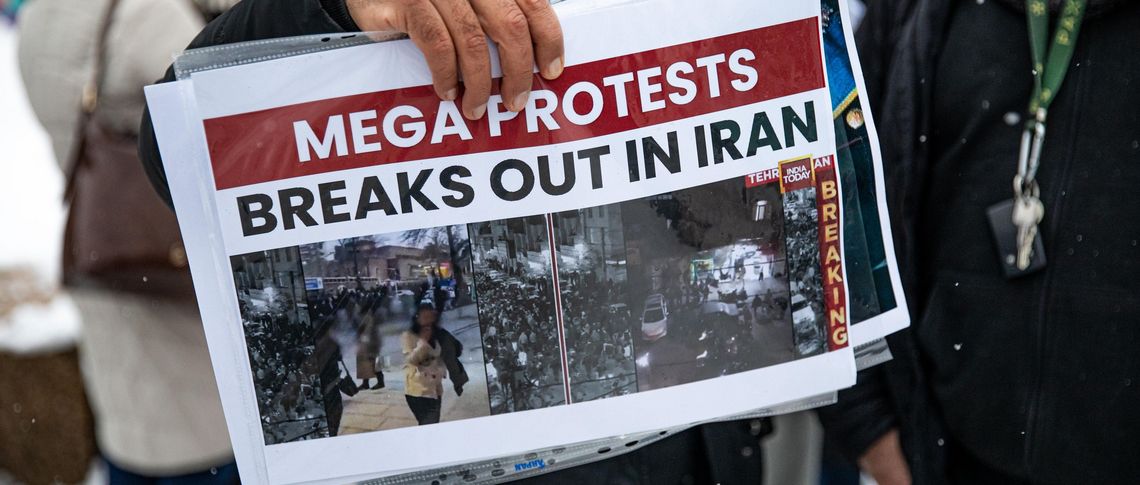
Once again, the people of Iran are protesting, calling for an end to the Islamic Republic. And with good reason: decades of oppression, systematic violations of rights and economic policies that have plunged millions into poverty. All this has led to anger and despair among the population.
The immediate trigger for the current protests was economic in nature: a further dramatic decline in the value of the Iranian rial, which has further exacerbated an already precarious situation. But as with previous uprisings, the root cause of the discontent runs deeper. This is no longer just about economic hardship, but about the system itself, which many Iranians believe is no longer capable of solving the country’s fundamental problems.
Protests and paralysis
Crises and misery are omnipresent. Environmental disasters have become a recurring part of everyday life and do not even spare the major cities; most recently, these suffered from acute water shortages for months on end. At the same time, civil society engagement, not to mention political engagement, is being stifled by ever-increasing repression — last year, the number of executions doubled. Added to this is a foreign policy that recently exposed the country to its first direct attack on its territory since the end of the war with Iraq in 1988, fuelling concerns among many in the country that this could be just the beginning of a new spiral of escalation.
In this context, the current protests tie in with those of previous years, most recently the wave of protests in 2022, which attracted international attention under the banner ‘Woman, Life, Freedom’. As what is now the fourth major uprising since 2017, they show that with each new wave of protests, the demand for an end to the Islamic Republic is being raised more openly and decisively. The loss of faith in the system’s ability to reform, and the resulting rejection of the regime itself, has become a central feature of the country’s social dynamics.
It is noteworthy that this loss of confidence is no longer confined to the general population. Significantly, even regime representatives are publicly voicing doubts about their own capacity to act. President Masoud Pezeshkian, once elected as a reformer, issued a striking admission of helplessness in the wake of the recent water crisis: he acknowledged his powerlessness while simultaneously pleading not to be condemned for it.
In fact, Iran’s political class has appeared paralysed at the latest since the war with Israel in June last year. While domestic protest movements are fundamentally challenging the survival of the Islamic Republic, the pillars on which Iran’s security doctrine long rested are simultaneously eroding in foreign policy: the network of allied militias across the region, the missile and drone programmes, and the implicit threat of nuclear armament. In June, it became clear for the first time that the previous deterrence strategy had lost its effectiveness.
The protesters face an overwhelmingly powerful apparatus of repression in an unequal struggle.
These developments have shaken the regime to its core. At a time when the country urgently needs far-reaching strategic decisions, Supreme Leader Ali Khamenei appears both politically and physically weakened, manifestly incapable of decisive action. Instead, power struggles within the regime’s elite are intensifying. These are less about short-term policy adjustments than about positioning for the foreseeable succession of the Supreme Leader.
The various factions are vying to secure the most influential positions for themselves, which, at present, amounts to little more than a self-imposed deadlock and reinforces the impression of a system rendered incapable of action both internally and externally. While the streets of many cities are calling for the end of the regime, its politics beyond cosmetic reform announcements are consumed entirely by internal power struggles.
The regime has, over the years, steadily refined its instruments for suppressing protests: specialised riot police units, targeted polarisation of the protest movement, internet shutdowns, digital surveillance, show trials and executions. In the current wave of protests, dozens of demonstrators were killed and thousands detained within just a few days. Yet the continual perfection of these repressive measures stands in striking contrast to the regime’s glaring inability to offer solutions to the many underlying causes of societal discontent.
Despite these circumstances, the regime has so far held firm, and there are no signs that the state is losing its monopoly on violence or that serious fractures are emerging within the security apparatus. This is partly because the protests, while expressing widespread discontent, have so far remained limited in size and smaller than the uprisings of previous years. It is also due to the continued lack of organisation and clear leadership among the protesters.
Attempts to bridge this gap from exile have so far failed. For decades, the Iranian diaspora has tried in vain to develop a political project of real significance and genuine capacity for action. While the often-invoked notion that Iran’s future must be determined by the people within the country themselves is understandable, it remains largely inconsequential in light of reality. In fact, the protesters face an overwhelmingly powerful apparatus of repression in an unequal struggle.
Europe should step up
It is precisely here that a political opportunity opens up for Europe. If European policy wants to provide the Iranian protest movement with concrete support beyond well-meaning expressions of solidarity, there are several avenues to pursue. A central lever is the promotion of internet freedom. Access to independent information and secure communication is as essential for protesters as it is for civil society networking. As a catalyst, the internet often makes political and social engagement possible in the first place.
This is not the only area in which Europe has an opportunity to fill the gap left by the United States under Trump. For decades, American programmes supported a wide range of civil society initiatives, from women’s projects to minority rights. Their withdrawal has left a vacuum that could hardly be more urgent. Another key area is the systematic and legally sound documentation of human rights violations and state violence, with the aim of holding those responsible to account in the long term. Initiatives such as the United Nations Fact-Finding Mission could be strengthened and expanded.
Equally crucial is the effective protection of Iranian activists and dissidents abroad by no longer tolerating intimidation, surveillance and threats by the Iranian authorities. This form of transnational repression must not be treated as a marginal phenomenon but requires a coordinated response from judicial and security authorities.
Anyone who believes that political change in Iran can be forced through a handful of external impulses is profoundly mistaken.
Humanitarian visas could also be expanded, procedures at the embassy in Tehran accelerated and deportations suspended. For activists, journalists and human rights defenders facing acute threats, such measures would send a concrete signal that European human rights policy does not stop at declarations. Only an immediate halt to returns can prevent people from being forced back into an environment where political persecution, imprisonment or worse await them.
Measures such as these are unlikely to bring about a decisive breakthrough in the short term. Anyone who believes that political change in Iran can be forced through a handful of external impulses is profoundly mistaken. Yet they do have value. They can strengthen Iranian civil society, expand its room for manoeuvre and provide it with the means to drive change itself, often quietly, often under the most adverse conditions, but with a persistence that can hardly be imposed from outside. In this quiet strength may lie the only realistic hope for sustainable change.
Even if the regime is likely to remain in power this time as well, the situation in the country is set to deteriorate further. The death of the 86-year-old Supreme Leader will mark a turning point in Iran’s political development. Europe remains a peripheral actor in this process, yet its scope for action is greater than the widespread impression of impotence suggests.