At the beginning of the war in Gaza, you spoke of crimes against humanity. What changed your mind? Why do you now define Israel’s actions as genocide?
I changed my mind around May 2024. I explained this in an article that was published in The Guardian in August. After 7 October, there were two kinds of statements coming from Israel. On the one hand, a whole series of comments by politicians and generals clearly indicated genocidal intent. They spoke of flattening Gaza, of destroying it, of denying water, food, power. They described Palestinians as ‘human animals.’ All these statements, made by people in executive positions, could be interpreted as not only genocidal in intent, but as incitement to the troops.
On the other hand, Israel officially declared its war goals to be the release of hostages and the destruction of Hamas. That, on the face of it, appeared reasonable. So, when I wrote in November, by which time some 10 000 people had died in Gaza, I described the situation as involving war crimes, and given the extent of civilian casualties, crimes against humanity. I warned that if it were not stopped, it could become genocide. By May 2024, when the IDF [Israel Defense Forces] entered Rafah and moved half of Gaza’s population, about a million people, from there to the beach area of Al-Mawasi, without any humanitarian infrastructure, and then proceeded to destroy Rafah, I looked back and concluded that the IDF was no longer pursuing the official war goals. It was in fact acting in line with the early statements that called for Gaza to be made uninhabitable.
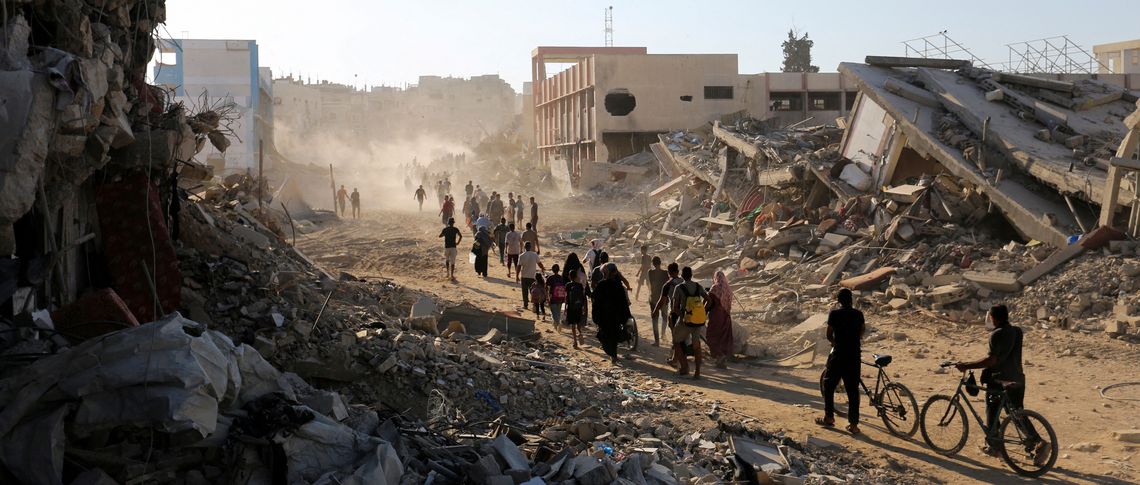
That’s when it became clear to me that this was not collateral damage, nor mere callous disregard for civilian life, but deliberate action. We know now, thanks to reports like the one from Physicians for Human Rights in Israel, that there was deliberate destruction of the healthcare system. And we know that about 90 per cent of schools have been destroyed — universities, museums as well. All of that shows a pattern. Statements that seemed at first like rhetoric in the heat of the moment were in fact being carried out. Since then, things have only escalated further. To me, anyone who is still in denial about what they are witnessing is simply refusing to see what is right in front of them.
Now, the Prime Minister said again that Israel would take over all of Gaza. He changed policy yet again. ‘Everything for everything,’ he said — but not in the sense of Hamas’ ceasefire offer from May 2024, which included the release of all hostages in exchange for prisoners and a withdrawal from Gaza. What Netanyahu now proposes is total takeover, at the cost of the remaining live hostages, and further concentration of the population, already confined to about 25 per cent of the territory. According to Defense Minister Katz, the idea appears to be to create a large camp over the ruins of Rafah, where over half a million people will be enclosed initially. The goal seems to be that they either remain trapped or leave Gaza altogether. That’s the logic of what is unfolding. My op-ed in the New York Times about this appeared in mid-July, but I wrote its first draft back in May. By now, finally, the facts that I wrote about are increasingly reaching public awareness.
Netanyahu’s recent statements — do they change your assessment?
My conclusion was already clear. But what’s going on is extraordinary. What Israel is doing in Gaza is not separate from what is happening in Israel itself. The genocidal campaign is accompanied by the decimation of the rule of law and any semblance of democracy inside Israel. The Attorney General has been fired, illegally, by the government. Israel is in a constitutional crisis. The Supreme Court has become very weak. Neither it nor the Attorney General have said anything meaningful about Gaza, and have declined to debate famine. They are supposed to be guardians of civil rights. Even the IDF itself does not want to do what Netanyahu is asking of it. Not necessarily because they are committed to human rights — but because they still hope to preserve the lives of the 20 remaining hostages, and because they do not have the manpower to implement this policy.
The Chief of Staff has refused to call up more reserves. The troops are exhausted. There’s been attrition, there have been many casualties due to exhaustion, operational errors, and lack of discipline. Suicides have increased. This Chief of Staff was brought in to be more ‘combative’ than his predecessor. Now even more radical figures, like David Zini, who is being considered to head the internal security agency, are being put forward. So, there’s turmoil inside Israel too. And we see a clear connection between a government trying to consolidate executive power domestically and carrying out genocidal policies in Gaza. The one provides cover for the other.
Coming back to the legal definition: at the core of genocide is the intent to destroy. How do you prove intent? Some say these are just tactical threats aimed at Hamas. What’s your view?
That argument is absurd. In most cases of genocide, it’s hard to prove intent directly. Governments don’t usually say, ‘we’re committing genocide.’ They say, ‘we face a security threat,’ or ‘this is an internal enemy.’ They clothe it in other language — especially the claim that it’s a war. But by May 2024, it was clear that this is no longer a war in Gaza. The use of the term ‘war’ is itself a euphemism, just like calling the planned displacement zone in Rafah a ‘humanitarian city.’ What the IDF is doing is destroying Gaza, day by day. Israeli contractors are being paid handsomely to demolish houses with heavy equipment.
Intent can be shown in two ways: by explicit statements, or by a pattern of operations. In Israel’s case, we have both. The statements were made openly and repeatedly, and the actions follow them precisely. Yes, Netanyahu says different things in English and in Hebrew. To the international community, he says Israel targets Hamas. To the Israeli public, he says Gaza must be destroyed, invoking biblical language about Amalek. Intent is not difficult to establish here. And the operational pattern confirms it. If you look at Gaza now, you’ll see bulldozers systematically destroying empty homes — homes where no Hamas fighters are present, no ‘human shields.’ They are just wiping out entire neighborhoods. Over 70 per cent of Gaza’s buildings are gone.
Many argue that Israel had no choice, that it had to respond to 7 October. What’s your answer to that?
Even if you describe the Hamas attack as genocidal, based on its charter from the 1980s, it doesn’t matter. Genocide is never legitimate. Even if a genocide were carried out against you, you cannot respond with genocide. Hamas does not have the means to carry out genocide against Israel. No tanks, no navy, no air force. But even if you believe that was their intention, it does not justify Israel’s actions. Every genocidal regime claims it’s acting in self-defense. That’s what the Germans said in Southwest Africa. That’s what the Ottomans said. That’s what the Nazis said. It’s always the same story. There is no justification for genocide, and it’s a crime.
Let’s turn to Europe — especially Germany. How do you see the German government’s role and responsibility in this situation?
The United States and Germany are deeply complicit. They provide weapons, and diplomatic cover. The EU is Israel’s main trading partner. Germany said it would defend Israel in the ICJ case brought by South Africa. I can understand Germany’s reluctance to criticise Israel, given its history. I understand the discomfort in using the word ‘genocide.’ But what I cannot understand is this idea, expressed by Angela Merkel, that Germany’s responsibility to Israel means unconditional support — even when Israel is in grave breach of international law.
Germany’s first responsibility must be to international law. That is the legacy of the Second World War. These laws were created in response to Nazi crimes. And if Germany truly wants to support Israel, it should support the parts of Israeli society that believe in democracy, human rights, and the rule of law — not those who promote Jewish supremacy, racism, and authoritarianism. Germany could say: ‘we’ve lived through national catastrophe. Let us share our experience of how to rebuild, how to coexist.’ That would be meaningful. But instead, the German government has buried its head in the sand.
One last question: why does this debate over whether it’s genocide matter? Some say this is only a theoretical question, that it doesn’t help people suffering in Gaza.
It matters a great deal. Yes, people often use the word ‘genocide’ as an expression of moral outrage. But there’s a clear legal definition. And while war crimes and crimes against humanity are just as serious, genocide is unique in some ways. For one, states that signed the Genocide Convention are legally obligated to act — to prevent it, stop it, and punish it. That’s why the US avoided calling Rwanda a genocide. They knew that once you say the word, you have to do something.
Second, genocide is not just about the perpetrators — it implicates entire societies. In Israel, the media is spreading falsehoods willingly. Academia is silent. Medical services, cultural institutions — they’re all involved. That’s what makes genocide different. And finally, if there is no accountability, there will be no end. Impunity leads to repetition. Recognising genocide is not just about Gaza. It’s about setting limits on what states can do — and whether the international community will enforce them.
This interview was conducted by Philipp Kauppert.