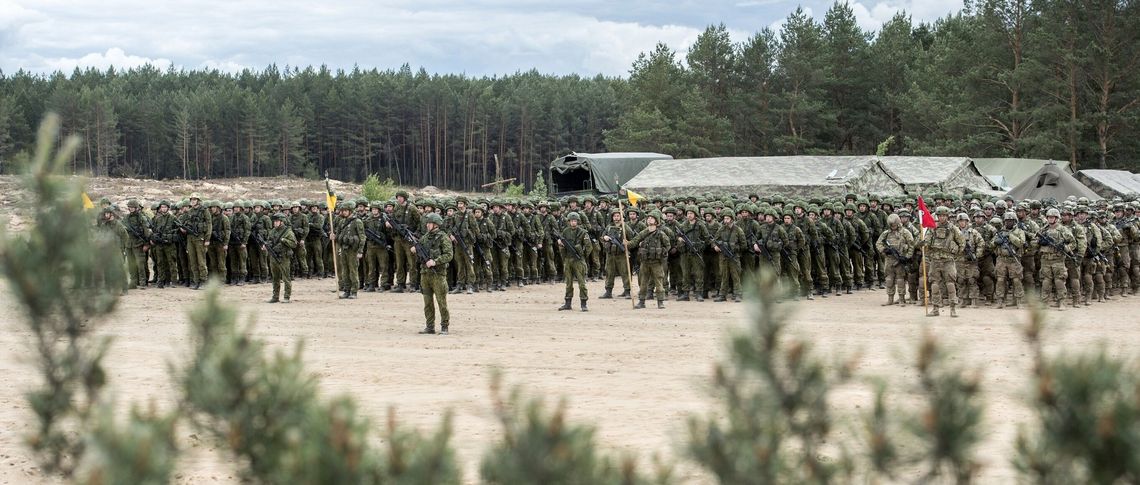
The recent NATO summit decision to invest 5 per cent of GDP annually in defence by 2035 was warmly welcomed by the countries on the alliance’s eastern flank, which feel most vulnerable to the Russian threat. The Baltic states were the first to pledge to increase their spending to 5 per cent as soon as Donald Trump demanded it from all the NATO countries, to avoid losing favour with the US president. However, further increases in military expenditure will pose a severe test for the Baltic economies, which have already suffered from the consequences of the war in Ukraine, leading to a rise in populist sentiment and threatening the erosion of power by the ruling pro-European forces.
The Baltic states have been among the leaders in NATO in terms of defence budget. According to NATO data, for the end of 2024, Estonia reached 3.43 per cent (ahead of even the United States with 3.38 per cent), with Latvia at 3.15 per cent and Lithuania at 2.85 per cent of its GDP. But just a week after Donald Trump’s inauguration, Lithuanian Foreign Minister Kęstutis Budrys told The Financial Times that the country will spend between 5 per cent and 6 per cent of its GDP on defence as of 2026. Estonian Prime Minister Kristen Michal also agreed to meet this target. Later, he specified that the baseline defence budget will rise to at least 5 per cent of GDP next year. Latvia plans to raise defence spending to 4 per cent next year and reach 5 per cent in 2028, said Latvian Finance Minister Arvils Ašeradens.
Big spenders
The Baltic states’ eagerness to significantly increase combat readiness is rooted in the shared history of Soviet occupation. In Moscow’s imperial rhetoric, the Baltic states are still considered part of Russia, lost during the collapse of the Soviet Union. Putin compared himself to Russia’s Czar Peter the Great in 2022, specifically mentioning the battle for Narva, a predominantly Russian-speaking Estonian city on the Russian border.
The Russian-speaking population of the Baltic States (especially Latvia and Estonia) is particularly vulnerable to the Kremlin's propaganda also because there is a relatively high proportion of ‘non-citizens’: these former citizens of the USSR and their children, after the restoration of independence in Latvia and Estonia, did not automatically receive citizenship of the new countries and had to undergo a naturalisation procedure, including an exam for knowledge of the state language and constitution, as well as swear an oath of allegiance.
All Baltic States have reinstated compulsory conscription for men.
According to official data, there are about 60 000 non-citizens (4.3 per cent of the population) in Estonia and 169 000 (9 per cent) in Latvia. Non-citizens are subject to numerous restrictions, including participating in elections and working in dozens of professions. Another weakness is ’the Suwałki Gap’ between Poland and Lithuania, which Western politicians consider a strategically important land connection corridor.
In preparation for the invasion, Latvia has been implementing a 303 million euro anti-mobility plan, which involves creating a chain of strongholds (including protective fortifications, obstacle courses, and ammunition depots) along its borders with Russia and Belarus within five years. During military exercises KILP-2025 this April, Estonia practiced a large-scale evacuation of the residents of Narva to distant cities. In case of emergency or martial law, Lithuanian authorities pledge to ensure the operation of 125 pillar stores across the country, guaranteeing an uninterrupted supply of food, medicine, and essential goods. In March, the Baltic States announced their withdrawal from the Ottawa Convention, which would allow them to use anti-personnel land mines to counter a Russian invasion. All Baltic States have reinstated compulsory conscription for men.
A financial nightmare
According to the Kiel Institute for the World Economy, the Baltic states have given the most aid to Kyiv by GDP since the beginning of the full-scale Russian invasion: Estonia and Denmark share the first place (having sent 2.3 per cent of GDP), followed by Lithuania (1.9 per cent) and Latvia (1.5 per cent). However, this support, as well as the war in Ukraine itself, has already had a noticeable economic impact on the Baltic states: the average GDP growth in the Baltic states fell to 1.6 per cent in 2022 from 5.9 per cent in 2021; and in 2022 inflation in Latvia reached 22 per cent, 25 per cent in Estonia, and 24 per cent in Lithuania, more than double the average level in the Eurozone.
Rising energy prices were the primary driver of inflation, as before the war, the Baltic states imported almost all their natural gas from Russia. According to the Bank of Latvia, the energy price rise in 2022 cost Latvian companies and households nearly 1.7 billion euros. In February 2025, the Baltic States completed the disconnection from the Russian power grid and synchronised with European lines; however, electricity prices remain higher than in Finland and Sweden due to the repair of the EstLink-2 (Estonia-Finland) interconnection, as well as the low capacity of the LitPol (Lithuania-Poland) and NordBalt (Lithuania-Sweden) interconnections.
In such a situation, ensuring further defence spending growth to 5 per cent of GDP will not be easy. Estonian Finance Minister Jürgen Ligi called this ‘a nightmare, from a financial point of view,’ saying that such a steep rise may require significant cutbacks in several areas. As Triin Tomingas from the Ministry of Finance suggested, Estonia could redirect to the defence sector nearly €1 billion of its Cohesion Fund allocation, initially meant to spend on increasing energy efficiency, research and innovation, circular economy and waste management, road and rail investments, regional development support, digital support and 5G investments. Head of the Latvian Fiscal Discipline Council Inna Šteinbuka noted that even boosting defence expenditure at least to 4 per cent of GDP will enlarge Latvia's budget deficit to 4 per cent, which exceeds the maximum allowable level for Eurozone countries.
As expected, the economic situation has been influencing the political agenda in the Baltic States.
In April, 12 EU countries, including Latvia and Estonia, submitted a request to activate the national escape clause, as part of the ReArm Europe Plan/Readiness 2030 package, which aims to enhance the EU’s defence capabilities. Although the plan would allow these countries to increase budget deficits through defence spending by 1.5 per cent, the clause would expire in 2028 to ensure fiscal sustainability. This relaxation of the EU fiscal rules may lead to turning the security crisis posed by the war in Ukraine into a fiscal crisis for some Eurozone countries, warns the Bruegel think tank.
And, as expected, the economic situation has been influencing the political agenda in the Baltic States. According to the recent survey published by the State Chancellery of Latvia, the mood of residents continues to deteriorate: more than half of respondents feel bad or very bad because of the war in Ukraine (it was 35 per cent a year ago), and the number of those who do not trust the government amounted to 64 per cent (56 per cent a year ago).
In June, the country held municipal council elections, considered as a prologue to the 2026 parliamentary elections. The right-populist Latvija pirmajā vietā ('Latvia First') party, whose leader compares himself to Trump, came first in Riga, gaining 18.1 per cent. Among the seven parties that managed to break the 5 per cent barrier are also populists and eurosceptics SUVERĒNĀ VARA, APVIENĪBA JAUNLATVIEŠI ('Sovereign Power/Young Latvians') (12.1 per cent) and Stabilitātei! ('Stability!') (6.9 per cent). Although the populist parties failed to form a new ruling coalition in Riga, the election outcome may indicate a significant shift in voter sentiment. This sentiment may become even stronger with the upcoming parliamentary elections in October 2026.
The approval ratings of the parties in the ruling coalition in Estonia have fallen to a historic low of 20 per cent, while the opposition parties stand at 66 per cent.
In Estonia, support for the ‘Reformierakond’ (Reform Party), which leads the ruling coalition, has dropped from 32 per cent in May 2022 to 17 per cent in May 2025. The approval ratings of the parties in the ruling coalition in Estonia have fallen to a historic low of 20 per cent, while the opposition parties stand at 66 per cent.
Lithuania's populist far-right party ‘Nemuno Aušra’ (Dawn of Nemunas) came third in the October 2024 parliamentary elections and even joined the ruling coalition. Party leader Remigijus Žemaitaitis has repeatedly criticized the military and economic aid given to Ukraine.
It remains to be seen, how political forces in the Baltic states will manage to strike a delicate balance between economic health of their respective countries and the growing perception of a needed increase in security spending.