On the morning of November 26, three armed police officers showed up at the Berlin apartment of American playwright C.J. Hopkins. They presented a warrant, seized his computer, and questioned both him and his wife. The supposed threat to Germany’s Rechtsstaat? A self-published book cover. Hopkins, a cantankerousleftist critic of Covid-19 policies, had superimposed a faint swastika on a facemask to satirise what he saw as Germany’s authoritarian drift. For tweeting images of that cover, he was convicted last year of ‘disseminating pro-Nazi propaganda’. Now, despite that conviction, police have returned — this time apparently investigating him simply for having published the book cover at all.
If Hopkins’ case was an isolated incident, one could shrug it off as a regrettable instance of overreach that can happen in even the most speech-protective democracy. After all, in Tennessee, where I live, a man recently spent 37 days in jail for posting a sarcastic meme of Donald Trump on Facebook, before charges were dropped. However, in European countries like Germany and France, Hopkins’ case is no longer an anomaly. And unlike the United States, there is little public outcry or political concern about the free speech recession, nor much resistance to the underlying political consensus that European democracies must become ever more militant to defeat their enemies. But for Europeans persuaded by facts and reason, the evidence is now too overwhelming to deny the danger of creeping censorship.
Given Germany’s history, it is obvious why the country’s constitutional order is committed to keeping totalitarians at bay. However, the arsenal of Germany’s militant democracy is being deployed indiscriminately, causing collateral damage to the very basic values that it is supposed to protect. This has become particularly evident in the digital age, where thousands of Germans have been targeted for expressing controversial viewpoints on topics like immigration, Covid policies, the Israel-Gaza conflict and members of the country’s political class.
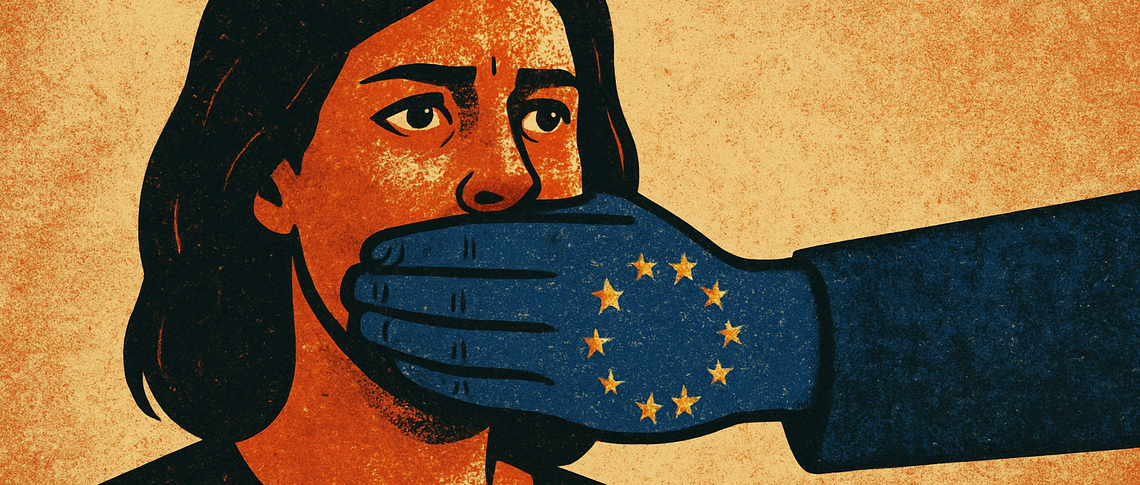
While Germany’s speech laws were intended to protect minorities and democracy, they now frequently shield governments from criticism.
In March 2022, the head of Germany’s Federal Criminal Office made it clear that the government would meet online intolerance with real-life intolerance: ‘Anyone who posts hate messages must expect the police to be at the front door.’ In 2022, The New York Times reviewed German state records and found more than 8 500 open investigations into online speech-related offences. At least 1 000 people had been charged or punished since 2018.
This practice lives on. In February 2025, Americans were shocked when they viewed a 60 Minutes episode following German police officers and prosecutors tasked with combating online speech crimes. Prosecutors smilingly explained how reposting or merely indicating a ‘like’ for false or offensive content – such as hate speech, malicious gossip, fake quotes or personal insults – can amount to a criminal act. Even calling a powerful politician an ‘idiot’ or ‘lying piece of shit’ may prompt a police raid.
Others on the receiving end include climate activists and pro-Palestinian activists, as well as political satirists. The right to peaceful protest has also been severely affected by bans against pro-Palestinian demonstrations in many German cities since October 7. While Germany’s speech laws were intended to protect minorities and democracy, they now frequently shield governments from criticism. Ironically, they are sometimes used against those minorities they were designed to protect. The Berlin-based far-left anti-Zionist Israeli Jew Iris Hefets has been detained several times for her peaceful solo protests against what she calls a genocide in Gaza. Moreover, there are frequent prosecutions of Muslims during pro-Palestinian protests. This effectively leaves a predominantly white, German political administrative class to determine which minorities deserve protection – or prosecution – under laws meant to defend them from majoritarian intolerance.
Not an isolated case
Germany is not alone. France – home of the Declaration of the Rights of Man – has also seen aggressive speech restrictions, despite that Declaration’s guarantee of the right to ‘speak, write and publish freely’. However, the ability of French citoyens to organise and mobilise dissent against the government has been severely curtailed during the presidency of Emmanuel Macron. In some cases, the French president has pursued those who mock him in court.
More concerning is the fact that during the presidency of Macron, 46 civil society organisations have been banned by decree, more than under any other president during the lifetime of the Fifth Republic. Those banned include anti-fascist, anti-immigration, Muslim civil rights, conservative Catholic and even environmental groups. Several of these organisations have been banned for speech crimes, including harsh criticism of the government and nebulous categories of hate speech, including failure to remove hateful comments of users on their social media platforms. In other words: guilt by association.
Across Europe, extremism and intolerance have continued to rise despite an ever-thickening web of hate-speech laws.
The growing list of NGOs banned by decree sends a chilling message to civil society: dissent from official policy or republican values risks retribution. Many groups now face a catch-22 — speak out and risk being targeted, or stay silent and wait for a thaw. Neither choice befits a nation that prides itself as a human rights pioneer.
Help is not forthcoming from European institutions despite the importance of freedom of expression in the Council of Europe’s European Convention on Human Rights and the EU’s Charter of Fundamental Rights. The European Court of Human Rights provides little protection of speech it views as extremist (even blasphemy is punishable). The EU is actively working to limit free speech, including a proposal that would make hate speech an ‘EU crime’, expanding the scope of criminalised speech and tougher punishments across all 27 member states.
Europeans might shrug off these encroachments as the price of creating more tolerant societies, insulated from hatred toward minorities and the rise of far-right populists. Yet there is little evidence that the ‘militant’ approach actually delivers on that promise. Across Europe, extremism and intolerance have continued to rise despite an ever-thickening web of hate-speech laws.
Boomerang effect
In 2025, Germany’s Federal Office for the Protection of the Constitution reported a sharp increase in the number of right-wing extremists, which has more than doubled over a decade from 20 000 in 2015 to over 50 000 in 2024. The report also noted a 47 per cent rise in right-wing extremist crimes – including violent crimes – from the previous year. This is not particular to Germany: in 2024, the European Parliament warned about ‘a sharp rise in discrimination, hate crimes and hate speech across the EU’ over the past decades.
But ironically, recent research finds that stronger protections for expression correlate with greater racial tolerance and stronger safeguards for minority rights. Indeed, far from reducing hatred or extremism, hate-speech laws often backfire. Studies show that in democracies, free expression works as a safety valve, lowering violence, whereas repression fuels radicalisation and violence, provokes more hate speech and even boosts electoral support for the politicians targeted. In France, Germany, the UK, and the Netherlands, far-right leaders such as Marine Le Pen, Geert Wilders and Björn Höcke have gained strength despite – indeed sometimes because of – prosecutions for hate speech.
If and when these leaders are elected into office by democratic majorities, the current free speech recession will provide a template for the repurposing of speech restrictions by revanchist right-wing populists. Something on full display in the United States, where only the robust protection of the First Amendment keeps the worst censorial policies of the Trump administration at bay. Despite these troubling trends and the undeniable collateral damage to free expression, there’s little indication that European democracies will rethink their illiberal approach.
For all of modern Europe’s admirable qualities, its militant democracy may be more of a cautionary tale than a model to emulate. The real question now is whether Europe’s crackdown on speech has become a bigger threat to democracy than the extremists it seeks to contain. The answer will shape not just Europe’s future, but the fate of liberal democracy itself.