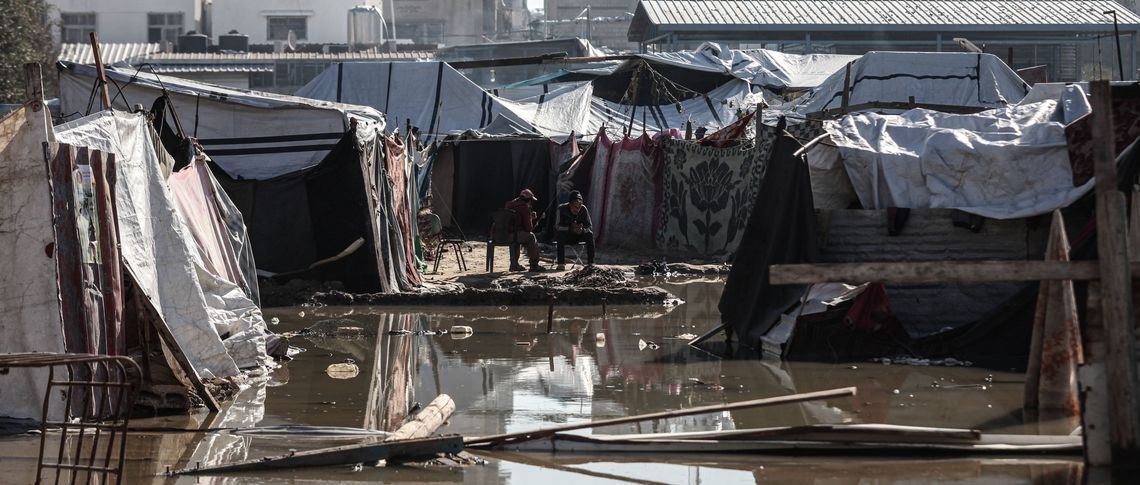
Gaza entered 2026 under a fragile ceasefire, yet winter arrived as though nothing had changed. Flooded streets, tents that offer no protection from the cold, and long nights without electricity revealed a reality many prefer to ignore: in Gaza, winter is not merely a natural season or a climate-related disaster, but a condition politically produced and managed through ongoing siege and restrictions. And although the bombardment has not stopped, the conditions of life have remained the same, as if the war has not ended but has simply changed its form.
The widespread assumption after the ceasefire was that conditions in Gaza would automatically improve. But the question that imposes itself today is: what has actually changed? Border crossings remain restricted, construction materials are scarce, electricity is cut off, and even humanitarian aid and tents have become subject to decisions that obstruct its delivery and continuity. As a result, this winter has been harsh not only because of the weather, but because ongoing restrictions have turned cold and rain into additional tools of pressure on a population already living under exceptional conditions.
Fading international attention
Winter in Gaza is not a fleeting seasonal event; it is a direct extension of the siege. The unsafe, worn-out tents sheltering thousands of families are not the result of sudden poverty, but of the deliberate prevention of reconstruction or even temporary alternatives. The cold becomes deadlier when people are deprived of electricity and heating, and when the most basic necessities of life are reduced to near-impossible privileges.
What makes this reality even more dangerous is its timing. After the announcement of a ‘paper’ ceasefire in October 2025, the world began to treat Gaza as though it had emerged from war or was on a path toward recovery. Yet despite ongoing bombardment and daily targeting, international attention continues to fade, and with it the political pressure needed to force any lasting change, while life itself remains besieged and unstable.
As international attention fades and promises remain on paper, the people living here are left to judge not the authorities or committees, but the reality in front of them.
For people living in Gaza, the question of who Trump and his government will decide will govern, has become almost irrelevant. What matters most is not the names of committees or officials, but whether anyone in power can provide the rights that people deserve: electricity that works, safe shelters, access to food, water, and medicine. After years of war and siege, survival has overtaken politics, and hope now depends on tangible actions rather than promises on paper.
As humanitarian work is increasingly criminalized and organizations are accused of unsubstantiated affiliations, the last mechanisms of protection and documentation are stripped away.
The restriction of 37 international humanitarian organizations in Gaza, understood not as distant institutions but as vital survival networks, has a direct impact on people’s lives. These organizations include teams distributing food, clinics treating the wounded, and programs providing minimal access to clean water and essential services in a place where access to basic resources has become the exception rather than the rule. Removing them from Gaza’s already fragile landscape is not a neutral step; it is a political decision that translates directly into a matter of life or death. Years of siege, genocide, and the destruction of infrastructure have left Gaza unable to sustain itself: hospitals operate with severely limited capacity, safe water remains scarce, and entire residential neighbourhoods lie in ruins. Under these conditions, restricting humanitarian work means depriving millions of civilians of their most basic rights.
This reality intersects with the repeated discourse around the ‘entry of aid’ through border crossings, particularly Rafah, often presented as evidence of improvement after the ceasefire. Yet opening the crossing intermittently, or allowing a limited number of trucks to enter, cannot compensate for the absence of a humanitarian system capable of operating and sustaining itself. As humanitarian work is increasingly criminalized and organizations are accused of unsubstantiated affiliations, the last mechanisms of protection and documentation are stripped away. Gaza is further isolated, even at the very moment it is supposedly entering a post, ceasefire phase.
Clear political action
In this third consecutive winter, harshness is no longer an abstract description, but a lived reality experienced day by day across the Gaza Strip. In the camp where I live, just 17 minutes of rain were enough to flood it entirely. In that short time, water poured into the tents, and people lost most of the few belongings that had survived displacement with them. What we hear daily is no longer weather forecasts, but warnings of an approaching low-pressure system, and fear of a night in which the tents may not withstand the wind. And as we try to protect what little remains, the daily winds and storms do not stop at damaging tents; they have also caused parts of inhabited buildings to collapse, reminding everyone how fragile life here is, where a single storm can turn shelter itself into a danger.
Gaza demonstrates, day after day, that rights taken for granted in many parts of the world, such as safe housing, basic services, and freedom of movement, remain almost unattainable here. Yet people’s lives are not defined by passive waiting or helplessness, but by ongoing efforts to adapt and preserve hope. Observing this reality reveals not only the human cost of the siege, but also the forms of resistance that emerge when all other options are closed off.
However, turning this resilience into a feel-good story of inspiration carries its own danger. Admiration for people’s ability to endure must not become a justification for the conditions that force them to endure in the first place. Everyday resistance is not a substitute for rights, nor should it be used to normalize suffering or accept it as an inevitable reality.
What Gaza’s winter of 2026 exposes is this: if life remains this harsh after a ‘ceasefire on paper,’ what does the promoted notion of ‘improvement’ actually mean? And if the basic restrictions are still in place, why has international attention waned? Should the suffering of civilians be allowed to fade from view simply because mass killing is no longer dominating headlines?
The siege must be lifted to allow real reconstruction of homes, schools, and basic infrastructure, and to give people the chance to rebuild their lives through work and education.
What people in Gaza need is not seasonal sympathy, but clear and urgent political action. In the short term, border crossings must be kept open to allow fuel, food, medicine, and winter supplies to enter without restrictions. Fuel is essential to keep hospitals operating, water systems running, and families warm during winter.
There is also an urgent need to replace unsafe tents with proper emergency shelter, such as caravans and insulated temporary housing that can protect people from rain, wind, and cold. Emergency winter support should focus on children, the elderly, and the sick, while civilian shelters and infrastructure must be protected from further damage.
In the long term, preventing another winter of crisis requires more than humanitarian aid. The siege must be lifted to allow real reconstruction of homes, schools, and basic infrastructure, and to give people the chance to rebuild their lives through work and education. This must be matched with sustained political pressure and accountability to prevent the repeated destruction of Gaza.
Without these changes, each new year in Gaza will remain just a number, and every winter another season of forced survival.
In Gaza, winter is measured not only in degrees of cold, but in the capacity to endure. And while people continue to persevere, the persistence of these conditions tests not only their ability to resist, but the credibility of the entire international system and the moral bankruptcy of the world. For when winter is politically managed, it is no longer a matter of weather, it is a matter of life.