As the anniversary of the 7 October massacre approaches, the fate of many hostages remains unknown. How has this affected Israeli society over the past year?
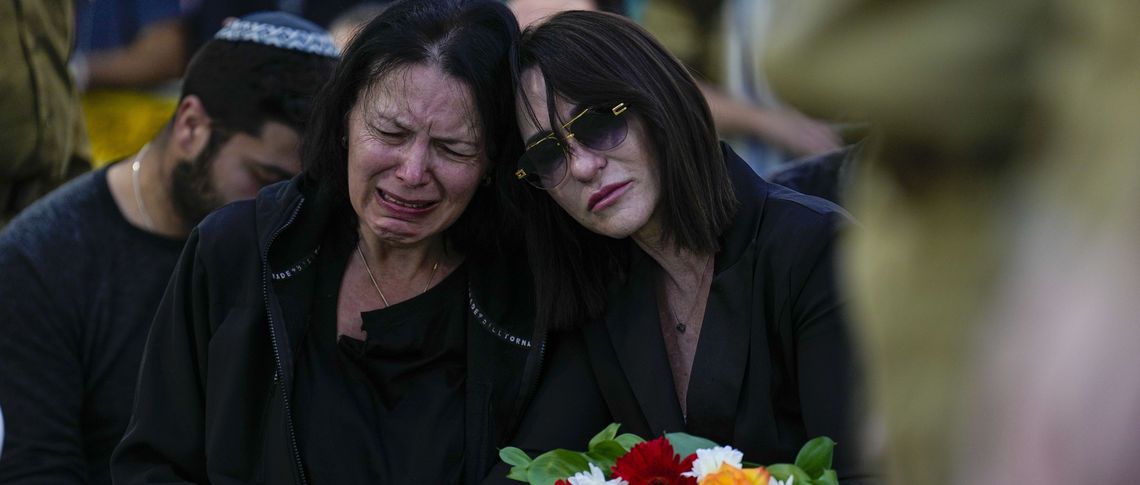
Society has been thrown completely off course — in every single way imaginable. The people’s confidence in its government has been deeply afflicted, as the state’s role in protecting its citizens had been taken for granted until now. Citizens feel abandoned, and they have every right to. There is a great deal of confusion about where Israeli society stands now and what remains of the image it had of itself up until 7 October. Everyone in Israel has been touched by the events, whether directly or indirectly, because almost everyone knows someone who has been affected.
Life has also fundamentally changed socially and economically. Many had to leave their homes overnight, without knowing if they can ever return. In Europe, it took a while to realise that it wasn’t only the south of the country that was affected, but also the north, where 68 500 people suddenly had to flee their homes and cannot return, even to this day. About a third of the 75 000 evacuees in the south of the country still can’t go back.
Israeli society is in a major crisis. Even before 7 October, the country was divided by the debate on judicial reform, or the judicial revolution as opponents call it. If this division wasn’t already serious enough, 7 October tipped things over the edge. This initially led to a public backlash: there was a sense of cohesion and people showed a remarkable level of solidarity — something that was clearly needed as the protests and strikes resulted in the government and ministries grinding to a halt in the first few days and weeks. Over time, though, views on how to get out of this crisis have been drifting further and further apart. These differences have only widened the social divide over the months.
How is the divide in Israeli society manifesting itself?
This depends on the layer of society. In fact, there are two major groups: those opposing the government and demanding new elections and Netanyahu’s resignation, and those seeking to double down on settlement policies and even repopulate the Gaza Strip. However, these groups don’t generally come into contact with each other very much on a day to day basis, even geographically. The settlers live mainly in the West Bank, while government opponents tend to come from the middle class in the centre of the country or in the northern regions. So, the two groups rarely clash. But the differences of opinion are more than apparent in the media and in public discourse. Demonstrations have also repeatedly led to skirmishes with smaller extremist groups trying to disrupt protests against the government.
In recent weeks, the focus of the demonstrations has changed, shifting from demands for the government’s resignation to calls to release the hostages and to reach a possible agreement. After six hostages were found murdered in a tunnel in the Gaza Strip at the end of August, the outrage among Israelis was enormous. Releasing the hostages became the most pressing issue, and the two camps (apart from the extremists) grew closer together. Yet there is still uncertainty about what a meaningful deal to release the hostages could look like, and there is still widespread fear that not all the hostages could return.
Most people know that the situation is terrible. The discussions, which are often both emotional and objective, reflect this uncertainty. There is also profound sadness that has come to the fore in recent days as the anniversary of the massacre approaches, with commemorations having already begun. Many people fluctuate between brief moments of hope when there is positive news and disappointment when those hopes are quickly dashed. The death of Hezbollah leaders may be seen as a success, but the question remains: what does this mean for the hostages who have not been freed yet? And how can the security of the Israeli population be guaranteed — especially now, in view of Tuesday’s massive rocket attack from Iran and the danger of the war escalating?
The recent attacks against Hezbollah show that Israel can still achieve military success. How is this perceived by the people in Israel?
There is definitely relief that the army has now acted. Previously, the north of Israel felt abandoned, as if the government didn’t care enough about the fate of people there who had to leave their homeland or continue to live under constant rocket fire. The evacuations only affected settlements within a 4 km radius of the border, which is absurd given the range of rockets that can reach large parts of the country, including Jerusalem. Many Israelis can hardly imagine living under constant sirens and fear for their children’s lives while they are at school. The threat that these people live under is real and persistent.
The economy in the north is also suffering massively: a lot of people have lost their sources of income, and it’s unclear what will happen about reconstruction. So, many are relieved that the army is acting now. The killing of Hezbollah leaders such as Nasrallah also provides a source of relief, but this will be short-lived. The overarching concern is where things will go from here. Nobody is naive enough to believe that peace will be achieved by taking out the leaders alone. It’s clear that this is not a quick path to peace. Most Israelis simply want to live in their homes without fear, and they know that military action must be followed by diplomatic efforts and long-lasting agreements.
Last year, Israel came under heavy criticism internationally and was left partially isolated. During Netanyahu’s address to the UN, many countries walked out of the room. Do people in Israel feel abandoned?
There is a widespread feeling of double standards against Israel. Most Israelis, apart from a few extremists, are well aware that the Israeli army isn’t perfect and that there have been too many civilian casualties. Nevertheless, the prevailing feeling is still that it was Israel that was attacked and continues to come under fire, which is why it has every right to self-defence. The international community’s expectation that Israel should simply not react and turn the other cheek instead is perceived as unrealistic and unfair — especially as groups such as Hamas or Hezbollah are often not criticised in the same way. There is the impression that Israel is always portrayed as the villain, while the other side is seen as more vulnerable or even poor and hard done by. This imbalance is causing a lot of frustration.
Many members of the Israeli government have come out with a highly inhuman rhetoric over the past year. Does this reflect the opinion of the people as a whole?
Only a small minority back these kinds of statements. It’s understandable that only very few people can empathise with the other side, as many are concerned with their own pain and suffering, but these extreme opinions still don’t reflect the majority. The entire opposition and all left-wing, liberal and progressive forces outright reject these statements. Even within Netanyahu’s Likud party, there are still some – if not many – voices that have publicly spoken out against this rhetoric.
Iran hit Israel with about 180 rockets this week. What’s the situation in the country now?
For the first time since war broke out, the missile attack from Iran has seen people fleeing to shelters across almost the whole of Israel, as the Home Front Command didn’t want to take any unnecessary risks, given how inaccurate the Iranian missiles are. Nearly all the projectiles were neutralised thanks to Israeli air defence and US support. Apart from one Palestinian killed near Jericho by missile shards, there were no other deaths. But there is huge concern among Israelis, of course. Shortly before the rockets hit, two Hamas terrorists carried out an attack in Jaffa, killing seven people and injuring many more. There is no end to the violence. People are exhausted, desolate and extremely anxious, faced with the danger of further escalation or even all-out war in the region. Not a nice start to the Jewish new year, which began on Wednesday evening in very subdued circumstances.
After a year of this multi-front war, do you still have any hope of a solution to the conflict?
As Viktor Frankl said, ‘Hope dies last,’ and I hold on tight to that. Without hope, it would be impossible to get up in the morning. I don’t believe that hope is unrealistic, because it’s in the interests of all parties involved to find a solution. I’m convinced that most Israeli, Palestinian and Lebanese people want peace. It won’t be a naive, idyllic peace, but in essence, people all over the world want the same thing: a good life. They want their children to grow up feeling safe and with a positive future. And peace is needed for that.
I am confident, perhaps more than ever, that a solution is possible. The recent missile attack from Iran has clearly demonstrated to the world the Ayatollah regime’s potential for aggression, which could lead to increased international efforts to contain this threat. The massive blow against Hezbollah’s leadership offers a chance for progress in the conflict. Interestingly, this week, following a conversation with the Shia Speaker of the Parliament of Lebanon, Nabih Berri, the country’s Prime Minister Najib Mikati publicly expressed his support for UN Resolution 1701 to be implemented, which states that the Lebanese army should ensure security in the south of the country and that Hezbollah should retreat to behind the Litani River. This gives me cause for optimism. Whether that opportunity will be seized remains to be seen. But it’s there at least.
This interview was conducted by Alexander Isele.