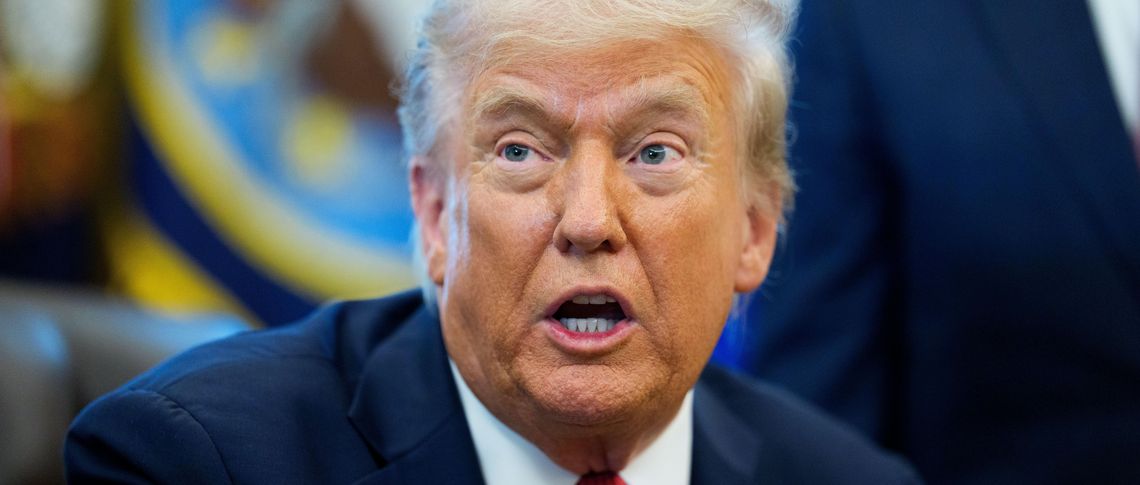
In the context of the disputes over Greenland, US President Trump has now announced that he will impose a 10 per cent tariff on all goods from a total of eight European countries from February onwards. How should Europe respond to this?
This is an incredible affront. This is no way to treat partners. This is a new dimension of imperialism on the part of the US President – simply unacceptable. The EU must now take a clear stance. A trade instrument is being used as a lever for political pressure. It is now impossible to simply move on to the agenda. This means that the European Parliament's work on implementing last summer's trade deal between the EU and the US must be suspended.
We in Parliament have already discussed our obligations under the deal critically and were sceptical about the extent to which we could grant duty-free access to US products when there is no reliability to be expected from the other side of the Atlantic. Especially since the deal was not really honoured due to additional tariffs. But now it is clear that work on implementation must be suspended for the time being. Secondly, the anti-coercion instrument must now be used. The anti-coercion legislation is designed precisely for situations where a trade instrument is used as a means of political pressure. I call on the European Commission to initiate proceedings and an investigation without delay.
What specific trade policy instruments does the EU have at its disposal to exert pressure on the US?
The so-called Scotland deal was about setting a zero tariff rate on industrial products and many agricultural goods from the US. This is problematic for several reasons. Firstly, the US itself did not adhere to the agreements. Just a few weeks after the deal was struck, over 400 products were again subject to a 50 per cent tariff on steel and aluminium – even though a basic tariff rate of 15 per cent had originally been agreed. Among other things, this affects pumps, compressors, motorcycles and, above all, agricultural machinery such as seed drills and combine harvesters, as well as large parts of the mechanical engineering sector. These products have effectively disappeared from the US market. That is unacceptable. Secondly, it remains to be seen how the US Supreme Court will rule on key issues of customs policy. And thirdly, additional political ambitions – such as the current situation in Greenland – are causing massive uncertainty.
Are there any other options? Will the EU also impose counter-tariffs?
Even before the Scotland deal, we had already given careful consideration to possible counter-tariffs. This included the idea of imposing export duties on goods that are particularly important to the US, such as scrap steel for electric steelworks. These instruments are available; they just need to be used consistently. If the punitive tariffs announced by Trump over Greenland become a reality, the EU would still have the option of reactivating last year's countermeasures, which were put on hold due to the Turnberry deal. This can be done very quickly. It would mean EU tariffs on US bourbon, aircraft parts, soybeans and poultry, for example, with a potential total volume of up to 93 billion euros.
We must also not forget how important Europe is to the US economy. The trade volume of goods from the EU to the United States is over €600 billion. European companies have a market share of 50 per cent or more for around a third of these goods. These figures alone make it clear that the European Union not only has considerable economic power, but has often been too cautious in using it. Anyone with such significant market shares is not just a mere spectator, but a key player in global trade. In concrete terms, this means that if the US chooses to escalate the situation in Greenland, Europe is not powerless, but can respond with trade policy measures.
Does the US sometimes underestimate Europe's market power? Donald Trump always likes to emphasise the strength of the American economy.
I don't think the US underestimates it. The decisive factor in Ursula von der Leyen's decision to agree to the deal in Scotland was security policy. Donald Trump deliberately mixes security and trade policy. In Scotland, the demands ranged from 30 to 10 per cent tariffs, and in between there was always the question: ‘What happens if the US stops supporting Ukraine?’
This systematic mixing of security and trade policy is not a casual side effect, but a deliberately used means of pressure. The fact that Europe has so far been only partially prepared for this has noticeably limited its ability to act in terms of economic policy. However, we are currently seeing that Europe has learned from this and is now increasingly responding to it. Programmes such as ‘SAFE’ are being used to develop a more independent security strategy. This is the right way to ensure that Europe is no longer economically blackmailed over security policy issues.
Does that mean, conversely, that Europe itself should also link trade and security policy more closely in future?
I would put it differently: it is not a question of mixing everything together, but of not being susceptible to blackmail. If we can organise our own security, we can also use our economic power more confidently. Europe must be able to defend itself independently – for example, through its own protection systems against drones. This will take several years, but it is essential. A second area in which we are vulnerable is digital infrastructure. We all use US platforms such as Windows, Amazon and PayPal. This also creates dependency.
That is why two things are at the top of the European agenda: independence in security policy and digital sovereignty. This includes promoting our own start-ups as well as building European cloud infrastructures so that sensitive data is not stored exclusively in the US. As in energy policy, it is clear here too that dependencies limit political freedom of action – often only becoming apparent when it is already too late.
Is the new geopolitical situation also changing trade policy itself? In the past, trade agreements were often lengthy, technical processes. Today, deterrence seems to play a greater role.
Yes, trade policy has changed significantly. At the same time, the EU is increasingly perceived as a reliable partner. I have recently experienced this very concretely, for example in Indonesia. When the US suddenly announced arbitrary tariffs of up to 39 per cent there, the shock effect was enormous. Indonesia is a country that has historically placed great value on independence – it was a leader in the non-aligned movement. It was very clear there that the EU acts differently: we respect international law and the development interests of our partners. That gives us credibility.
That is precisely why the EU now has the opportunity to build rule-based and fair partnerships – in contrast to a policy of might makes right. We can see this in the ongoing talks with many countries: Mercosur, New Zealand, India and Indonesia. The EU can act as a real counterweight to the US here – on a different, partnership-based foundation.
Will the EU actually manage to play an adequate role in the new world order and be capable of acting? Will it be possible to negotiate these agreements more quickly than in the past?
The geopolitical situation has definitely led to a new dynamic. With India, for example, we formally began negotiations back in 2016, but for years there was hardly any progress. It is only in the last year or two that the pace has picked up significantly. If all goes well, we could reach a conclusion by the end of January. The situation is similar with New Zealand.
Talks with Australia are also being resumed after recent difficulties. The geopolitical situation is forcing all parties involved to act more quickly and pragmatically than in the past.
How is the EU perceived in these countries? Where are there opportunities for new partnerships in a multipolar world?
South Africa is a very clear example. A partnership agreement has been in place there for a long time, and it works well overall. Historically, older ANC (African National Congress) officials in particular had close ties to Europe, partly because of the joint struggle against apartheid. Younger generations were at times more oriented towards China. That phase is now largely over. Chinese products have flooded the South African market, and problematic credit conditions have added to the issue. The idea that this is a model for independent development has lost its persuasive power.
We are now working very closely with South Africa – for example, on an agreement on energy transformation and raw materials partnerships. Europe is increasingly perceived there as an equal partner, no longer primarily through the lens of the colonial past. The same applies to other countries, such as Kenya. There, too, the aggressive trade policy of the US and China's less than cooperative economic policy have led to disillusionment. This opens up opportunities for Europe that did not exist a few years ago. In a world where economic power is increasingly being used openly for political purposes, rules-based trade itself becomes a strategic advantage – and this is precisely where the European Union has a particular strength.
This interview was conducted by Philipp Kauppert.