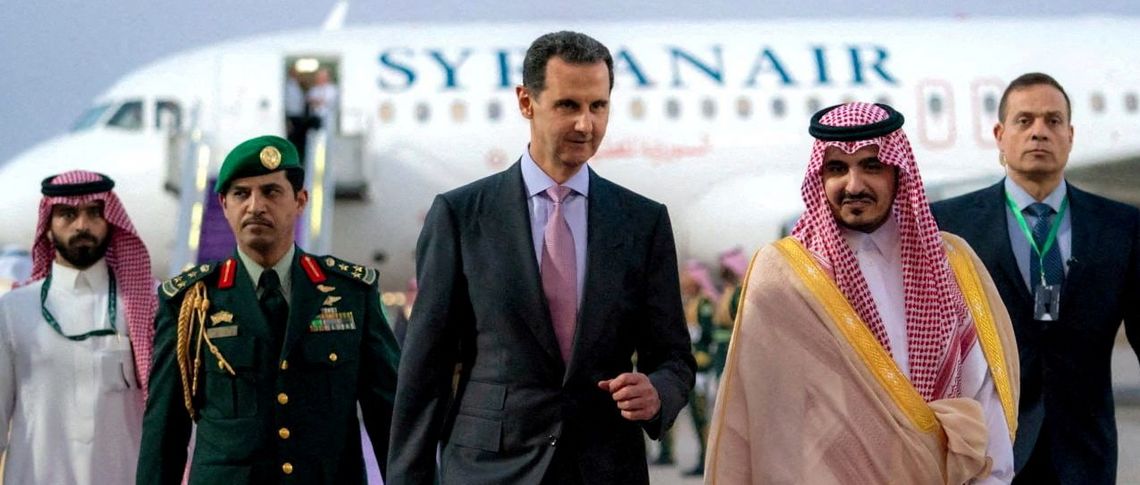
After more than 12 years of being suspended, the League of Arab States voted to welcome back the Syrian regime on 7 May 2023. Less than two weeks later, Syrian President Bashar al-Assad was welcomed in Saudi Arabia by Crown Prince and Prime Minister of the Kingdom of Saudi Arabia (KSA), Mohammed Bin Salman (MBS), at the League’s Arab summit.
While the United Arab Emirates (UAE) has played a leading role in the normalisation process of Damascus – reopening its embassy at the end of 2018 and reportedly inviting Assad to the COP28 – the Saudi-Syrian normalisation in April 2023 undoubtedly played a key role in unlocking Syria’s return to the Arab League. The motivations behind Riyadh’s decision to rehabilitate Damascus are linked to national objectives as well as regional dynamics. The end of the smuggling of the drug Captagon is, for instance, a priority of the Saudi Kingdom. Much of the Captagon production and distribution is under the domination of the Fourth Division and affiliated Syrian businessmen, who rose during the war.
Saudi Arabia’s new foreign policy direction
But, moreover, the normalisation process is the consequence of Saudi Arabia’s evolution in terms of foreign policy. The confrontational foreign policy of MBS – represented by the deadly war launched against Yemen in 2015 and maximum pressure against Iran and its allies in the region – has failed, becoming too costly politically and a threat to the Kingdom’s plans to reform the economy. Riyadh has therefore sought to establish more cordial relations with its neighbours.
These changes in Saudi foreign policy are mainly connected to the need for the Kingdom to focus on economic reforms and the objectives of Saudi Vision 2030.
This started with the end of Qatar’s ‘blockade’ in January 2021, followed by a reconciliation between the two countries. Similarly, Riyadh amended its relations with Turkey, symbolised by the meeting of MBS and Erdogan in June 2022 in Ankara and the announcement of a $ 5 bn deposit with Turkey's central bank to boost the country's economy in March. This evolution continued with the historical political rapprochement between Iran and Saudi Arabia through the mediation of China at the beginning of April. Both states have since declared their willingness to collaborate with one another for ‘security, stability and prosperity’ in the Middle East. This is especially important for the KSA to stabilise the situation in Yemen and to prevent security threats at its southern border. Saudi Arabia’s perception that Washington can no longer provide the needed security to the Kingdom, particularly after the eruption of the uprisings in 2011 and the bombing of Aramco production units in 2019 and 2020, also pushed the Kingdom in this direction.
These changes in Saudi foreign policy are mainly connected to the need for the Kingdom to focus on economic reforms and the objectives of Saudi Vision 2030, which plans to end dependence on fossil fuels and reach $ 100 bn in annual FDI by 2030, as well as attract 100 million visitors per year by 2030.
The global weakening of US power
The US and the European Union have officially denounced these normalisation processes, but have been unable to stop regional countries from rekindling ties with Damascus. In the US, a new bill called ‘Assad Regime Anti-Normalization Act of 2023’ was introduced in May 2023 to expand the list of possible Caesar Act targets to include all members of the Syrian parliament, senior members of the ruling Baath Party and those responsible for diverting international humanitarian aid.
On the side of the European Union, Damascus’ continuous normalisation processes will probably create further division among European states in regard to which attitude is to be adopted towards Syria. The normalisation process of Damascus in the Middle East could prompt some EU member states to do the same, notably in view of encouraging the ‘return of refugees’ to Syria.
Despite continuous rivalries among various states in the region, they hold a common position in wanting to return to a situation similar to that in place before the uprisings in 2011.
The normalisation processes must also be seen as a consequence of the global weakening of US power. This situation has not only left more room for other global powers such as China and Russia to operate in the Middle East and North Africa (MENA) region but also benefited regional powers that acted increasingly more independently and expanded their influence regionally, including Turkey, Saudi Arabia, Qatar and the UAE.
More generally, there is a willingness by Saudi Arabia and other regional actors to consolidate a form of authoritarian stability in the region, guaranteeing their political and economic interests. Despite continuous rivalries among various states in the region, they hold a common position in wanting to return to a situation similar to that in place before the uprisings in 2011.
For example, Qatar allowed the ‘Arab consensus’ to prevail regarding Damascus' return to the League of Arab States, despite the country’s reluctancy, so as not to risk angering the leadership in Riyadh and other Arab capitals. Qatar has been steadily mending ties with Saudi Arabia, Egypt, the UAE and Bahrain. Moreover, Doha’s close ally Turkey has also followed a policy of normalisation towards the Syrian regime.
Little hope for improvement in Syria
Syria’s re-integration into the League of Arab States will not facilitate a reconstruction or an economic recovery in the country. While sanctions are a significant obstacle to attracting foreign investments and collaborations and, therefore, boost a viable context for a reconstruction process, a recovery of the economy and a strengthening of state capacities, they are by far not the only element.
First, the lack of a secure and stable economic situation in Syria constitutes a significant impediment to promoting local and foreign investments. Second, Damascus has been incapable of enhancing the country’s financial situation and preventing the constant depreciation of the Syrian Pound. This context undermines the attractiveness of possible rapid and medium-term returns and profits from investments in the country and, therefore, does not promote any incentive to invest – whether from inside or outside the country. Third, the country has limited financial capacity in both the public and private sectors and it does not have a functioning infrastructure or a skilled labour force.
Damascus has apportioned very modest investments to rebuild and develop its infrastructure, instead assigning most of its expenditures to the war effort, public sector wages and subsidies, although these are continuously diminishing.
Syria’s poverty level exceeds 90 per cent today, compared to an overall poverty rate of 33.6 per cent in 2007.
At the end of 2022, the total deposits in private banks in Syria were, for example, estimated at $ 1.9 bn, in comparison to $ 13.87 bn in 2010. In addition to the insufficiency of funding sources, the country suffers from a shortage of qualified manpower, which is combined with continuous and severe high rates of emigration, particularly of young graduates.
Last but not least, any reconstruction policy under the rule of the Syrian regime will not serve the people most affected by the war or the catastrophic socio-economic situation in the country. The poverty level exceeds 90 per cent today, compared to an overall poverty rate of 33.6 per cent in 2007. In January 2023, approximately 15.3 million people in Syria required humanitarian assistance. The policies of the Syrian regime are not designed to remedy the country’s economic and societal challenges. Instead, the regime’s political and security objectives have led it to prioritise consolidating its own power and sanctioning its population. The regime will seek to gain politically and economically from reconstruction while solidifying its perceived security.
The continuous normalisation process of Damascus is, of course, serving the interests of the Syrian regime to maintain and consolidate its rule but also the interests of the authoritarian states across the MENA region that are adamant on securing their power and crushing any progress and ideals, emanating of the eruption of the popular uprisings in 2011.